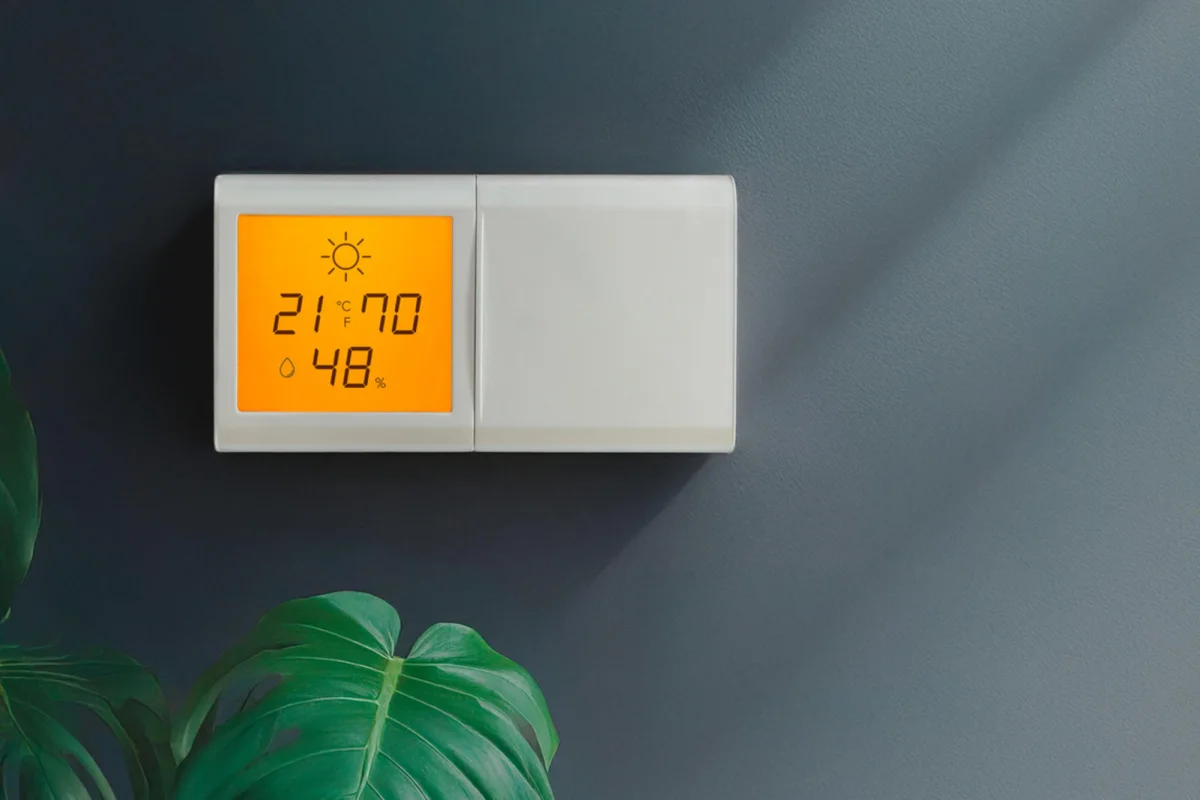
+35°C in Volgograd and +35°C in Sochi are the same reading on a thermometer, but entirely different sensations. In Volgograd, it's hot but tolerable. In Sochi, it feels like a sauna you can't step out of. The difference isn't the degrees — it's the percentage of humidity, and that difference can be lethal.
Air temperature is only half the equation. The other half is humidity. It determines whether the body copes with heat or starts to overheat. Dry heat at +40°C is easier to tolerate than humid heat at +32°C, and there's a specific physiological reason for that.
How the Body Cools Itself — and Why Humidity Gets in the Way
The human body has one primary cooling mechanism: sweat evaporation. Sweat glands release moisture onto the skin's surface, it evaporates, and it carries away heat. This works perfectly — but only under one condition: the surrounding air must be dry enough to absorb the moisture.
In dry air (20–40% humidity), sweat evaporates quickly, and skin stays relatively dry even at +40°C. The body copes: internal temperature holds steady at 36.6°C, and the heart operates normally.
In humid air (70–90% humidity), something different happens. The air is already saturated with water vapor and can't absorb more. Sweat is produced but doesn't evaporate — it runs down the skin in streams without carrying away heat. The body keeps sweating, losing water and salts, but gets no cooling in return. Internal temperature starts to climb.
That's exactly why Sochi's +30°C at 80% humidity feels like +38°C, while Volgograd's +38°C at 25% humidity feels like +33°C. Meteorologists use the concept of "perceived temperature" or "heat index" to account for both factors and show what the body actually experiences.
Wet-Bulb Temperature: The Survival Threshold
Researchers at the University of Pennsylvania introduced a metric that defines the absolute limit of human endurance: wet-bulb temperature.
It's measured simply: a thermometer is wrapped in wet cloth and exposed to air. Water evaporating from the cloth cools the thermometer — exactly the way sweat cools skin.
If the air is dry, evaporation is strong, and the "wet-bulb" reading falls well below the "dry-bulb" one. If the air is humid, evaporation barely happens, and both thermometers show nearly the same value.
It was initially thought the threshold for humans was +35°C wet-bulb. At that value, sweat stops evaporating entirely, and the body can't cool itself by any means — not in the shade, not with water, not even without clothing. Death from overheating follows within a few hours.
But recent research shows the real threshold is lower. For young, healthy people, it's around +31°C wet-bulb. For the elderly and those with chronic conditions, +30°C or even lower. That translates to roughly +26°C at 90% humidity or +32°C at 50%.
What +31°C Wet-Bulb Means in Practice
Here are several "temperature + humidity" combinations where the body approaches its limit:
- +30°C at 90% humidity — perceived temperature ~41°C
- +33°C at 75% humidity — perceived ~44°C
- +35°C at 65% humidity — perceived ~47°C
- +40°C at 40% humidity — perceived ~47°C
Note: +30°C at 90% humidity feels just as brutal as +40°C at 40% humidity. The thermometer reads 10 degrees lower — yet the body suffers just as much.
That's exactly why residents of Dubai at +45°C in dry air feel no worse than residents of Bangkok at +33°C with 85% humidity. And the heat of the Persian Gulf coast, where +46°C combines with sea-driven humidity, is one of the most unbearable on the planet: in Bandar-e Mahshahr, Iran, in 2015, the heat index reached +74°C.
How It Feels — Stage by Stage
The body reacts to humid heat in a cascade, from discomfort to life-threatening danger.
In the first stage, sweating intensifies. The body tries its usual cooling method, but the sweat doesn't evaporate. Clothes soak through within minutes, skin stays constantly wet. It feels like being in a sauna. Thirst builds, and performance drops.
In the second stage, heart rate rises. The heart pumps blood toward the skin, trying to release heat through dilated vessels.
Pulse climbs to 100–120 beats per minute even at rest. Blood pressure drops, dizziness and weakness set in. This is heat exhaustion — a state that's still reversible.
In the third stage, sweating stops. Paradoxically, right when cooling is needed most, the body shuts it down — either from dehydration or because thermoregulation has failed. Skin becomes dry and hot. Body temperature climbs above 40°C. This is heatstroke — a life-threatening condition.
Who Is Most Vulnerable to Humid Heat
Anyone can suffer from overheating, but certain groups are far more vulnerable.
- The elderly
With age, sweat glands work less efficiently, blood vessels respond more slowly, and the body's compensatory reserves shrink. Heatstroke in a 75-year-old can occur at temperatures a 25-year-old wouldn't even notice.
- Children under 5
Thermoregulation is still immature, skin surface area relative to body mass is greater (heat enters faster), and the ability to communicate distress is limited. A child can overheat before parents even notice.
- People with cardiovascular disease
The heart is already working at its limit — the added strain of heat dissipation can trigger a heart attack or crisis.
- People who are overweight
Fatty tissue acts as insulation, hindering heat release. Sweating intensifies, but efficiency drops.
- People taking certain medications
Diuretics accelerate dehydration, beta-blockers slow the heart-rate increase needed for cooling (the body can't speed up blood flow enough), and antihistamines reduce sweating.
Dry Heat vs. Humid Heat: Real Examples
The difference between heat types isn't theoretical — it's the everyday experience of people in different regions.
- Volgograd, +38°C, 25% humidity. Hot, but tolerable in a breeze. Sweat dries fast, skin stays dry. By evening, temperature drops to +22°C, and the city cools. Shade is 8–10 degrees cooler than the sun.
- Sochi, +32°C, 80% humidity. The thermometer reads lower, but the sensation is worse. Sweat runs in streams, clothes stay wet, and shade offers almost no relief — humid air transfers heat regardless. At night, +24°C at 85% humidity makes sleeping without air conditioning difficult.
- Bangkok, +33°C, 85% humidity. Stepping out of an air-conditioned building feels like a blow. Glasses fog up within seconds. After five minutes of walking, you're soaked through. After half an hour: dizziness and the urge to turn back.
Locals wait out peak heat inside shopping malls — not because they love shopping, but because the street is unbearable.
How to Protect Yourself in Humid Heat
Standard advice — "drink water and stay out of the sun" — is necessary but insufficient. Humid heat requires additional measures.
Air conditioning isn't a luxury — it's a survival tool. Above 75% humidity and +30°C, no fan will help: it just circulates hot, humid air without cooling it. Only air conditioning simultaneously lowers temperature and dehumidifies the air.
Cotton and linen clothing absorbs sweat and lets it at least partially evaporate. Synthetics trap moisture against the skin. Loose fit beats tight-fitting: air between fabric and body creates an additional evaporation zone.
Cold water on wrists, neck, and feet is a fast way to lower body temperature when sweating alone can't keep up. Cooling blood where vessels sit close to the skin's surface lowers overall body temperature within minutes.
Limit physical activity between 11 a.m. and 4 p.m. In humid heat, every movement generates heat the body can't release. If activity is unavoidable, take a break in a cool spot every 20 minutes.
Will Humid Heat Become More Common?
According to researchers, the number of extreme humid-heat episodes (when wet-bulb temperature exceeds +31°C) has doubled over the past 40 years. So far, these outbreaks affect narrow zones — the Persian Gulf coast, South Asia, Southeast Asia.
But climate models show that by mid-century, zones of regular humid heat will expand across the Mediterranean, the southern US, southern China, and the Black Sea coast. Sochi, Batumi, Istanbul — cities where humid heat is already a summer norm — will face it more often and more intensely.
A dry-bulb thermometer hanging outside your window, reading +30°C, tells only part of the story. The full picture comes from the combination of temperature and humidity. And if that combined reading causes discomfort — your body isn't being difficult. It's warning you.