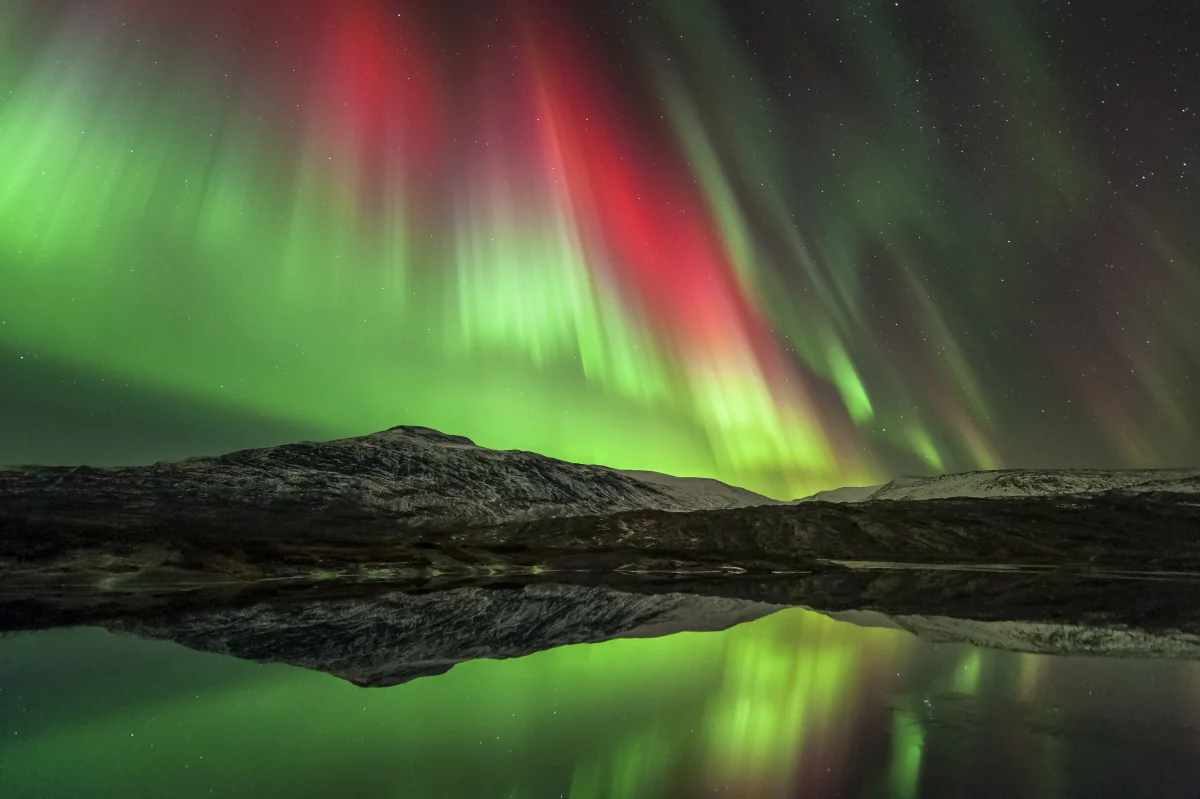
A tourist in Murmansk stands in the cold for an hour, staring at an ordinary starry sky, and is about to give up and head back — when a green ribbon unfurls over the horizon and, within a second, starts rippling as if someone were shaking it. Five minutes later, a pinkish fringe appears beneath the green, and suddenly this looks nothing like the Instagram photo that inspired the trip in the first place.
The northern lights are a rare case of a natural phenomenon with a genuinely specific, well-studied mechanism behind it — not some vague "magic of the sky."
Once you know what's actually happening hundreds of kilometers overhead, you start seeing the color, shape, and movement of the aurora differently — and understand why the exact same phenomenon can look completely different from one photograph to the next.
What's Actually Happening
It all starts on the sun, which constantly ejects a stream of charged particles — protons and electrons — into space, known as the solar wind. During solar flares and eruptions, this stream intensifies significantly, and 30–50 hours later, the resulting cloud of particles reaches Earth's vicinity.
The planet's magnetic field shields us from a direct hit, but not completely: some particles get captured by the magnetosphere and funneled along magnetic field lines toward the poles.
That's exactly why the aurora is only visible at high latitudes, not across the whole planet. Once these particles reach the upper atmosphere, at altitudes of 80 to 400 kilometers, they collide with oxygen and nitrogen atoms, transferring their energy to them.
Why the Aurora Is Usually Green
An atom that absorbs excess energy from a collision enters an excited state, and as it returns to its normal state, it emits a quantum of light at a specific wavelength. The most common scenario plays out at 100–300 kilometers, where oxygen does the colliding — and it's oxygen that produces the characteristic green glow most people associate with the northern lights.
Oxygen has a particular quirk here: returning to its ground state takes it about three-quarters of a second, and the green glow can last up to two minutes before shifting to a different color.
This is one reason the green ribbons of an aurora often look so extended and slow-moving.
Where the Red Comes From
Red and crimson flares are a much rarer sight, since they form higher up, at altitudes of 300–400 kilometers, where the air is far thinner.
Here, the same oxygen produces red light instead of green when it collides with particles — but this only happens during sufficiently powerful bursts of solar activity, which is why red aurora sightings are less common than the familiar green.
What Produces Blue and Purple
The cooler end of the palette comes not from oxygen but from nitrogen, at lower altitudes, closer to 100 kilometers and below.
Depending on exactly what happens to the nitrogen atom — whether it loses an electron or instead returns from an excited state — the resulting glow comes out either blue or reddish, and when these blend with the dominant green, they often produce the purple and pink hues along the aurora's lower edge that photographers prize the most.
Why the Aurora Looks Brighter in Photos Than in Real Life
Here's a detail that often confuses first-time aurora hunters: the human eye sees color far worse in darkness than a camera does.
In low light, vision switches over to brightness-sensitive but nearly color-blind cells in the retina — which is why the aurora often looks pale green or grayish in person, rather than as saturated as it appears in long-exposure photos.
A camera, over several seconds of exposure, gathers enough light to pull the full range of hues out of the same photons. The disappointment tourists often feel, expecting to see "what the photo showed," usually comes down to this difference, not a weak aurora.
Where and When to Catch the Aurora in Russia
The country's prime location is Murmansk Oblast, above the Arctic Circle, where the viewing season runs from late August through April, peaking November–February. Beyond Murmansk itself, the village of Teriberka, on the northeastern coast of the Kola Peninsula, is considered one of the best spots.
The key conditions for a successful hunt are clear, cloudless skies, minimal city light pollution, and ideally, tracking the geomagnetic Kp-index — the higher it climbs, the further south the aurora can appear, and the brighter the glow, even within city limits.
A cold, clear night isn't a guarantee, but it's a necessary condition: even during high solar activity, thick cloud cover can completely block the sky from view.