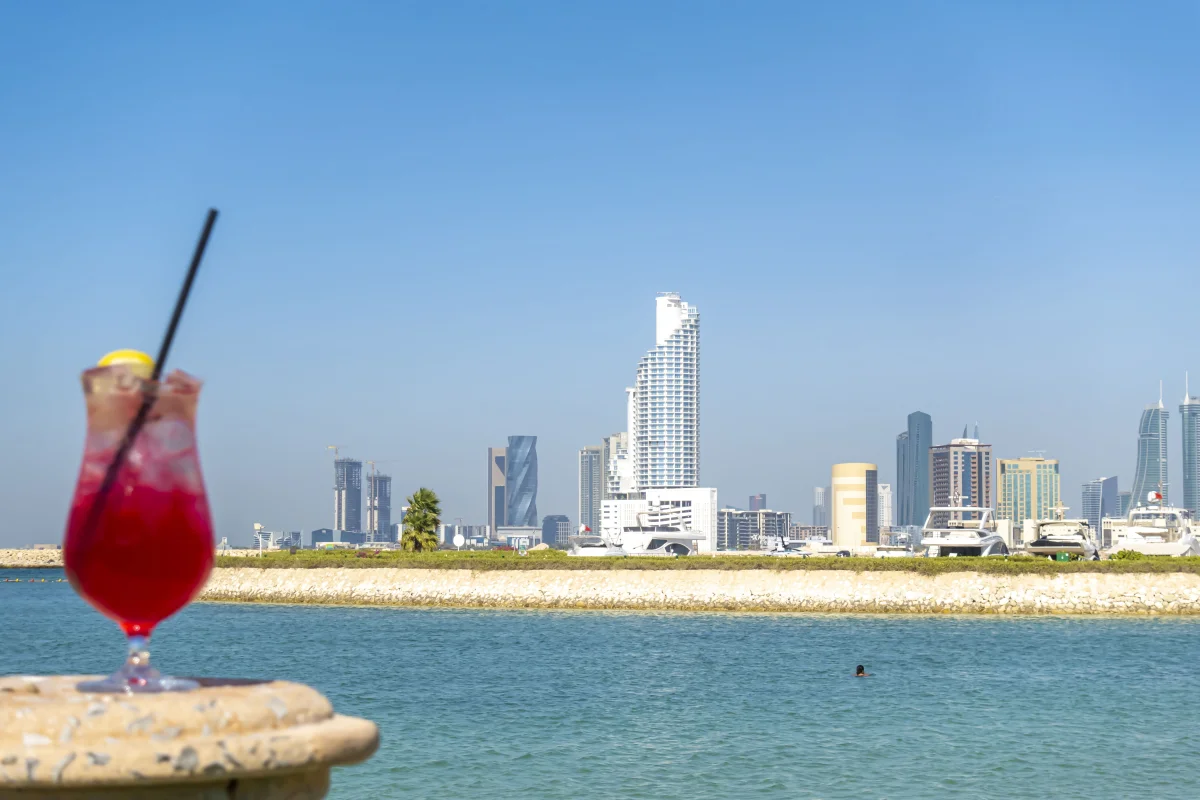
A tiny island kingdom in the Persian Gulf — 33 islands, covering an area smaller than Moscow within the Ring Road — hasn't yet become a mass destination for Russians. But those who've been compare it to the UAE: less skyscraper pomp, and the sense that you're not on a tourist conveyor belt. The key is not to get the month wrong — otherwise, instead of a beach, you'll get a scorching frying pan in the middle of the Gulf.
Bahrain doesn't have the familiar four-season cycle. There's a hot season (May–October) and a warm season (November–April). The transition between them is swift — within a couple of weeks, the air either heats to inhuman levels or cools to Mediterranean comfort.
Rainfall on the archipelago is negligible — roughly 90 mm a year. Moscow, for comparison, gets more than that in a single October. When rain does occur, it falls between December and March, but it's not prolonged drizzle — it's brief downpours, after which the sun comes right back out. An umbrella in Bahrain is almost decorative.
What Happens in Summer — and Why It's Not Beach Weather
From June through August, Bahrain becomes a place comfortable for air conditioning alone. Daytime temperature climbs to +38–42°C, occasionally reaching +48°C. At night, the air cools only to +29–32°C — even after sunset, there's no relief.
The sea in July–August warms to +33–34°C — not a typo. The water gets so hot it stops performing its primary resort function: you can't refresh yourself in it. You step in, and it's like a heated bath — you come out even more overheated than before.
Add humidity, which holds at 70–85% in summer, and since Bahrain is islands surrounded by a warm, shallow gulf, evaporation comes from every direction. The heat-and-humidity combination creates a steam-room effect: clothes soak through within minutes, glasses fog up when you step out of a building, and heatstroke risk multiplies.
Periodically, a hot southeasterly wind blows across the southern part of the main island from the desert. It brings no relief — just scorching air and suspended sand.
Locals in summer move exclusively between air-conditioned spaces — home, car, office, mall. Beaches empty out. The temperature gap between outdoors and indoors reaches 20–25 degrees, which is itself a strain on the body.
November–April: The Window Worth Flying For
November
The heat retreats sharply. Daytime temperature drops to +28–30°C, nighttime to +20–23°C. The sea still holds its summer warmth — +27–28°C. This is one of the best months for a beach vacation: water like warm milk, and air that no longer scorches. Humidity drops, and breathing gets easier.
December
Air at +22–24°C during the day, dropping to +14–16°C at night. Sea at +22–23°C: swimming is comfortable, though those sensitive to cool water will drift toward heated pools. Ideal for walks, sightseeing, and exploring Manama.
Bahrain's attractions are modest in number, but December's climate makes exploring them on foot especially pleasant.
January–February
The coolest months. Daytime: +18–23°C, climbing to +25°C by late February. Nights can hit +10–14°C — nearly cold for a Persian Gulf island. The sea cools to +18–20°C: not everyone will brave a swim, but sunbathing on the beach is pure pleasure.
Wind in January–February strengthens to 15–17 km/h — the southeasterly shamal brings humid air. A plus for kitesurfing, more of a downside for lying on a towel.
March–April
Spring restores the warmth. March brings +24–28°C, with the sea rising to +21–23°C. April is noticeably hotter: +29–33°C during the day, water at +23–25°C. April is considered the jewel of Bahrain's calendar — a balance between warm sea and heat that hasn't yet arrived. But by month's end, the warm-up begins, and May brings the first punishing +37°C readings.
Spring is also when Bahrain hosts the Formula 1 Grand Prix at the international circuit in the Sakhir desert — one of the year's marquee events.
How Bahrain Differs From Neighboring UAE
Climatically — almost identical. The same +42°C summers, the same +24°C winters, the same Persian Gulf outside the window. The difference lies in character.
- Scale
Bahrain is the smallest Arab state: 778 km². You can drive the entire archipelago in a day. There's no Dubai-style grandeur, but no Dubai-style hustle either. For a relaxed beach vacation, that's a plus.
- Atmosphere
Bahrain is one of the most liberal states in the Persian Gulf. Alcohol is permitted in licensed venues and hotels, dress codes are more relaxed than in Sharjah or Saudi Arabia (to which Bahrain is connected by a 25-kilometer bridge). Every weekend, thousands of Saudis cross that bridge — chasing the very freedom absent at home.
- Beaches
Mostly paid or hotel-affiliated, but well-maintained — showers, changing rooms, loungers. Sand is soft, nearly white, entry into the water gentle. The resort zones of Amwaj, Zallaq, and Al Seef suit families with children.
- Price
Comparable to the UAE: lunch without alcohol starts at 10–15 BHD (2,200–3,400 rubles), a night at a four-star hotel from 20 BHD (4,400 rubles). But Bahrain subsidizes its tourism sector, so package tours from Moscow sometimes end up cheaper than comparable Dubai packages.
- Flight
Gulf Air operates daily direct flights from Moscow to Manama, taking roughly 6.5–7 hours. Connections via Istanbul, Dubai, or Abu Dhabi are also available. Russian citizens receive a visa on arrival, valid for 14 days.
What to See Between Beach Days
Bahrain isn't about long lists of attractions. It's a compact country where everything sits close together, and the main sights fit into a couple of days:
- Bahrain Fort (Qal'at al-Bahrain) — a UNESCO site, ruins of the Dilmun civilization, over 4,000 years old. Some believe this was the location of the biblical Eden — at least according to Sumerian mythology.
- Al Fateh Mosque — one of the largest in the world, accommodating up to 7,000 worshippers. Open to non-Muslims, free admission.
- The Tree of Life — a solitary mesquite tree standing in the desert, thriving without any visible water source for roughly 400 years. Reachable only by car, but the route is worth it — a lunar landscape surrounds it.
- Sakhir Circuit — the Formula 1 track. Outside racing season, you can drive the track in your own (rented) car.
- Bab Al Bahrain Market in downtown Manama — spices, textiles, gold, pearls. Bargaining is expected and appropriate.
Practical Details
- Winter clothing
Shorts and a T-shirt during the day. In the evening and in air-conditioned spaces, a light sweater or windbreaker. In January, the promenade after sunset can hit +12–14°C — genuinely cool for a Persian Gulf island.
Don't skip sun protection. Even in "cool" January, Bahrain's UV index runs higher than a Moscow summer's. SPF 50 sunscreen, a sun hat, and sunglasses are the standard.
- Ramadan
If your trip falls during the holy month, note: eating, drinking, and smoking in public during the day is prohibited. Tourist hotels usually make exceptions, but restaurants outside hotels may close until sunset. Ramadan dates shift every year — check before booking.
- The Optimal Window
If you want to combine warm sea and comfortable air — November and March–April. If sightseeing, exploration, and mild weather matter more, with the sea as a pleasant bonus — December through February. There's nothing to do in Bahrain in summer, unless you're an extreme heat enthusiast chasing hotel discounts, which drop by half in low season.