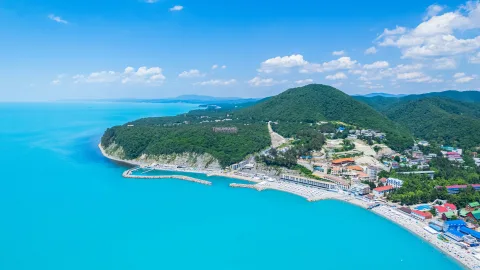
A white beach, turquoise water, and a mango smoothie — or gray skies, three-meter waves, and red flags? In Thailand, it all depends on when and which coast you choose. The country is open year-round, but its coastlines run on different weather schedules — and that's the central catch of Thai monsoons.
Thailand's climate is typically split into dry and rainy seasons, but in practice there are three:
- Cool (November–February) — +26–30°C during the day, tolerable humidity, minimal rain. Peak tourist flow and the highest prices.
- Hot (March–May) — air heats to +34–39°C, humidity rises. By April, the islands already feel muggy, but the sea is still calm.
- Rainy (June–October) — the southwest monsoon brings downpours, waves, and murky water. Prices drop 40–50%, but swimming isn't possible everywhere.
Water temperature barely changes year-round — +27–30°C. The question isn't whether the sea is warm; it's whether you can get in it.
Two Coasts, Two Schedules
This is the key rule, and without it, planning a trip is pointless. Thailand is washed by the Andaman Sea to the west and the Gulf of Thailand to the east, and the monsoons hit them at different times.
Andaman coast (Phuket, Krabi, Khao Lak, Phi Phi Islands, Koh Lanta):
- Dry season: November–April. The sea is mirror-flat, underwater visibility up to 30 meters, rainfall 20–60 mm per month.
- Rainy season: May–October. Waves up to 3–4 meters, rip currents, downpours of 250–400 mm per month. Peak is September, when Phuket gets up to 400 mm of rainfall. Red flags go up — swimming prohibited.
Gulf of Thailand (Samui, Phangan, Koh Tao, Pattaya, Hua Hin, Koh Chang):
- Dry season: the second half of December through August. Yes, nearly the entire year. Calm sea, minimal rain.
- Rainy season: September through the first half of November. Peak is October–November, when Samui specifically experiences flooding, and November rainfall totals hit their annual max.
The practical takeaway: when it's storming in Phuket, it's calm on Samui — and vice versa. Knowing this, you can visit Thailand in almost any month, simply by choosing the right coast.
Month by Month: Where and Why
December–February: The Ideal Window
The best time for both coasts simultaneously. Air at +28–32°C, rainfall 20–50 mm per month, calm seas everywhere. Crystal water in Phuket, not a cloud over Samui.
The flip side: peak prices. A package tour for two from Moscow, 10 nights with flights and breakfast, cost from 210,000 rubles to Phuket and from 190,000 rubles to Pattaya in February 2026. Book 2–3 months ahead — charter flight occupancy hits 95–96%.
Late December through early January is especially packed: New Year's on Thai beaches is no longer exotic — it's a mainstream route. If you want the same climate without the crowds, take the second half of January or February.
March–April: Hot, But Still Dry
Temperature climbs to +33–36°C, sea breeze offers relief on the islands. Seas remain calm on both coasts. Prices start easing — this is your last chance to catch the Andaman coast's dry season without winter surcharges.
By April, Phuket and Krabi may see the first rains toward month's end, but beach vacations aren't affected yet. Samui and Phangan stay dry and hot — too muggy for long walks, but fine for the beach.
May: The Season Boundary
On the Andaman coast, the monsoon kicks in: 12–14 rainy days, the first waves, underwater visibility dropping. Samui, Phangan, and Koh Tao are still dry — this is the last month of their clean season. Pattaya holds steady too.
May is a solid compromise for anyone wanting warm sea and low prices, willing to choose the eastern coast over the western.
June–August: Two Worlds
Phuket, Krabi, Khao Lak enter full rainy season. Downpours of 250–270 mm per month, murky water, waves, rip currents. Surfers come specifically for this; everyone else has no reason to be here for a beach vacation.
Samui, Phangan, Koh Tao present the opposite picture. Little rain, calm sea, temperature at +30–32°C. July and August are the best compromise for anyone tied to summer school holidays: sun, warm water, good conditions for snorkeling and diving, and prices below winter levels.
Koh Chang (eastern Gulf of Thailand) sees more rain than Samui, with showers typically falling evening or night, but beach vacations remain possible. The main bonus: prices 40–60% below winter, and the island's waterfalls become powerful and stunning during rainy season.
September–October: A Tricky Stretch
The worst months if you don't understand the geography. September on Phuket is the absolute rainfall peak (up to 400 mm). September is still tolerable on Samui, but October marks the start of its own rainy season — which can be harsher than the Andaman's. October–November is exactly when Samui experiences prolonged downpours and flooding.
Pattaya in September–October also gets its share — up to 200–250 mm per month. No coast escapes rain entirely.
If your vacation falls in these months, you have two options: fly anyway and accept the weather (prices at their lowest, hotels half-empty, fruit abundant), or choose a different country.
November: The Monsoon Flips
On the Andaman coast, the rains subside, the sea calms, and ferry service to the islands resumes by mid-month. The second half of November marks the start of a new high season for Phuket and Krabi. Prices haven't hit December levels yet, but the weather is already excellent.
On Samui and Phangan, it's the reverse — the peak of rainy season. The sea storms, rainfall is at its maximum. Better to avoid these islands in November.
Red Flags and Rip Currents: What the Brochures Don't Tell You
During rainy season, red flags go up on Thai beaches — this isn't a suggestion, it's a ban on swimming. Two red flags signal heightened danger: entering the water is prohibited, even if the waves look moderate.
The main trap is rip currents. They look like a calm patch of water amid the waves: darker, foam-free, seemingly a safe corridor. In reality, it's a current pulling you out to sea. If caught in one, don't swim against it toward shore (you won't have the strength) — swim parallel to the shoreline until you're out of the current.
Rip currents exist even in dry season, but their frequency and strength multiply many times over during monsoon.
Cheat Sheet: Which Resort, Which Month
- Phuket, Krabi, Phi Phi, Koh Lanta, Khao Lak — November through April. Best months: December–March.
- Samui, Phangan, Koh Tao — the second half of December through August. Best months: January–March, June–August.
- Pattaya, Hua Hin — November through March. Tolerable in summer, but rainier.
- Koh Chang — November through May. Doable in summer if you accept evening rains and low prices.
What Else to Consider Before Buying Tickets
- Flights
In winter 2026, direct charters from Russia to Phuket and Pattaya operated from over 20 cities. Summer options are more limited — charters mostly to Phuket from Moscow, Yekaterinburg, Krasnoyarsk, and Novosibirsk. A direct scheduled ticket Moscow–Phuket starts at 87,500 rubles; Bangkok, from 99,000 rubles per person.
- Insurance
During rainy season, injuries on wet roads increase (scooters are the main transport on the islands). Make sure your policy covers motorcycle accidents — standard packages often exclude this.
- Booking
During high season (December–February), hotels in Phuket and Samui fill to 95%+. Book 2–3 months ahead. During low season, walk-in bookings work fine, with room to negotiate at the desk for 40–50% off winter prices.
The universal rule for a Russian tourist who wants a beach vacation without surprises: November–March on any coast, July–August only Samui and Phangan. Everything else is a gamble — you might land a cheap vacation, or spend a week by the pool watching a stormy sea.