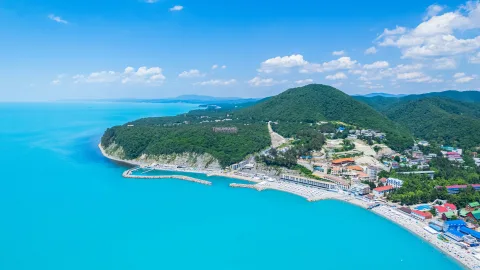
A July vacation on the Black Sea means sunburned shoulders, paid shade, and a lounger line at seven in the morning. Now picture that same place two months later: sea at +23°C, air that doesn't scorch, and a beach where you can lie wherever you please. September in Russia is a month worth shifting your vacation for.
Demand for domestic "velvet season" travel is climbing noticeably. In 2025, bookings for September–October domestic routes nearly doubled compared to previous years.
The reasons are clear: airfare drops 20–30% after September 1, hotels shed their summer markup, and the weather across most destinations holds better than June's. Meanwhile, all the routes, lodges, and excursions are still running — the season doesn't close until mid-October.
Sochi and the Krasnodar Krai Coast: Sea Without the Crowds
The classic velvet season destination. In the first half of September, Sochi runs +25–28°C during the day, and Black Sea water sits at +23–24°C — warmer than in June, when it barely reaches +20°C. The sun stops stinging, but tans still develop evenly. By September, the sea has cleared of algae and stopped blooming.
The second half of the month is a touch cooler — +20–23°C, with nights already at +15°C — but for walks and excursions, it's an ideal window. The Yew-Boxwood Grove, the Agura Waterfalls, Krasnaya Polyana without the summer swelter — an entirely different experience.
Prices in Sochi decline more slowly than at other resorts — demand stays high. The real difference kicks in after September 15. Gelendzhik and Anapa are cheaper, but their waters cool faster.
Crimea: The Velvet Season Was Invented Here
The very term "velvet season" was born in Crimea — once known as "Yalta's golden days." The southern coast in September warms to +24–27°C during the day, with water holding at +21–23°C. Rain is nearly absent — Sudak and Feodosia see at most two rainy days all month.
The eastern coast — Sudak, Koktebel, Feodosia — holds comfortable temperatures the longest, right through late September. On the peninsula's west side (Yevpatoria, Saki), steppe winds strengthen after the 20th, and evenings turn noticeably cooler.
September is grape, fig, and cornel-cherry season in Crimea. At the markets of Yalta and Simferopol, fruit prices run half of July's. And best of all — the lines for Ai-Petri and Golitsyn Trail finally disappear.
Gorny Altai: Gold You Can't Miss
If there's one place in Russia where September unambiguously beats summer, it's Gorny Altai. The heat retreats, rain is scarce, the peaks already carry snow, and the slopes blaze yellow, orange, and crimson. Daytime temperatures in the first half of the month run +18–22°C, nights +8–12°C.
Where exactly:
- Chemal — sheltered from wind by mountain ranges, warmer than the regional average. Patmos Island, the Chemal hydroelectric station, the turquoise Katun River — all accessible through late September.
- Lake Teletskoye — early in the month, water is still +16–18°C, swimmable. By late September, the lake is ringed with solid gold larch forest.
- Geyser Lake near the village of Aktash — the turquoise bottom with thermal patterns, framed by autumn forest, looks stunning specifically in September.
- The Chuya Highway to the Kurai Steppe — one of the world's most beautiful drives, and autumn adds colors that don't exist in summer.
Daily temperature swings can reach 15–20 degrees. Frost on the grass in the morning, a T-shirt by noon. Pack in layers. Most lodges are still running, but some close by October 1 — check ahead.
Baikal: Silence and the Year's Best Light
In summer, Olkhon is cramped: ferries overloaded, lines for photos at Cape Burkhan, Listvyanka packed shoulder to shoulder. In September, Baikal returns to itself. Tourist numbers drop several times over, accommodation costs 20–30% less than August prices, and the taiga along the shores erupts in gold.
Weather in the first half of September is still gentle: +12–18°C during the day, occasionally up to +25°C early in the month. Nights are already cold — +3–8°C — but for walking and photography, it's the best time. Light is softer than August's heat haze, and water clarity is at its peak.
Worth doing:
- Ride the Circum-Baikal Railway — autumn photos from this route consistently win photography contests.
- Reach Sandy Bay, Baikal's warmest spot, where September still allows comfortable walks in a light jacket.
- Climb Cape Burkhan without the crowds — worth shifting your vacation for that alone.
Weather on Baikal shifts within minutes: sun can give way to rain and return half an hour later. A warm, waterproof jacket is essential. The Olkhon ferry crossing runs in September but shifts to a reduced schedule by October.
Karelia: Mushrooms, Berries, and Golden Marble Canyons
Karelia in September means +10–17°C, transparent air, mirror-still lakes free of summer's ripples, and forests you'd want to move into. Golden autumn begins here in mid-September and lasts through early October.
Ruskeala Mountain Park — marble cliffs framed by yellow-red foliage look better than in summer. Summer draws 65% of the park's annual visitors; September is far quieter. Reachable by the retro "Ruskeala Express" train from Sortavala.
September is peak mushroom and berry season in Karelia. Spruce and pine forests yield porcini, butter boletes, chanterelles, aspen boletes. On the bogs: lingonberries, cranberries, cloudberries. For many locals, berry gathering is serious supplemental income; for tourists, it's a reason to spend the day in the forest rather than on a tour bus.
You can also raft the Shuya River — the route runs through late September, and autumn banks are far more photogenic than summer's.
It rains 6–7 days a month, sometimes heavily. A raincoat or membrane jacket is essential gear. Nights can hit +3–5°C, with morning fog clearing by noon.
The Caucasus: Mountains Without the Heat
The North Caucasus in summer means heat in the valleys and overcrowded trails. In September, the mountains finally become comfortable for hiking: +15–20°C at mid-elevations during the day, +5–10°C at night, minimal rainfall.
- Dombai — the eco-trails in Teberda Nature Reserve operate all September. Routes to the Baduk Lakes, Alibek Waterfall, and Chuchkhur Waterfalls are accessible without snow gear. Slopes of golden larch — a scene that simply doesn't exist in summer.
- Arkhyz — gentler than Dombai, suitable for families with children. The cable car runs, and the overlook on the Abishira-Akhuba Ridge offers a panorama of autumn mountains stretching for dozens of kilometers.
- Elbrus Region — the cable car ride to the "Mir" station (3,500 m) remains possible through late October. September skies here are clearer than summer's, and Elbrus is visible in full, without its cloud cap.
- Caucasus Mineral Waters — in autumn, the parks of Pyatigorsk, Kislovodsk, and Zheleznovodsk turn crimson and gold, and you can finally walk outside without a hat or a liter of water in your backpack.
In the mountains, dress in layers: T-shirt + fleece + membrane jacket. By late September, snow becomes possible above 2,500 meters.
Kaliningrad: The Smart Choice
Kaliningrad in September brings +19–22°C in the first half of the month — nearly summer weather still — and a city that finally belongs to you, not the tourist flow. In summer, the Curonian Spit sees 3-kilometer parking lines; in September, it's just you and nature.
The first half of the month even works for beach vacations: the Baltic warms to +17–19°C, and if you're not someone who needs +25°C, swimming is doable. Zelenogradsk and Svetlogorsk without the August crowds are an entirely different pleasure.
Toward late September, the autumn program kicks in: golden lanes, old Prussian castles in the mist, hot mulled wine at cafés in Kneiphof. The Museum of the World Ocean, Fish Village, boat rides along the Pregolya — all far more enjoyable without the summer crush.
The weather is changeable — sun can turn to rain within half an hour. An umbrella or raincoat should always be with you. Better to visit the Curonian Spit on a weekday — even in September, weekends draw bigger crowds.
Quick Cheat Sheet: Where, When, and Why
- Want sea and warmth — Sochi or Crimea's southern coast, first half of September.
- Want nature and golden autumn — Altai or Baikal, second half of September.
- Want mushrooms, berries, and silence — Karelia, mid-September.
- Want mountains without the heat — Dombai, Arkhyz, or Elbrus region, all of September.
- Want a European feel inside Russia — Kaliningrad, first half of September.
One rule applies everywhere: book accommodation 1.5–2 months out. September has stopped being the "dead season" — demand climbs every year, and the best options get snapped up well before departure.