Beneath four kilometers of Antarctic ice, in absolute darkness, under a pressure of 350 atmospheres, lies a freshwater lake the size of Lake Ladoga. Its temperature sits around –3°C, and yet it never freezes.
The water in this hidden lake hasn't seen sunlight in 15 million years. Soviet scientists discovered it purely through radar anomalies detected within the ice sheet.
Lake Vostok: A Record-Holder You Can Never See
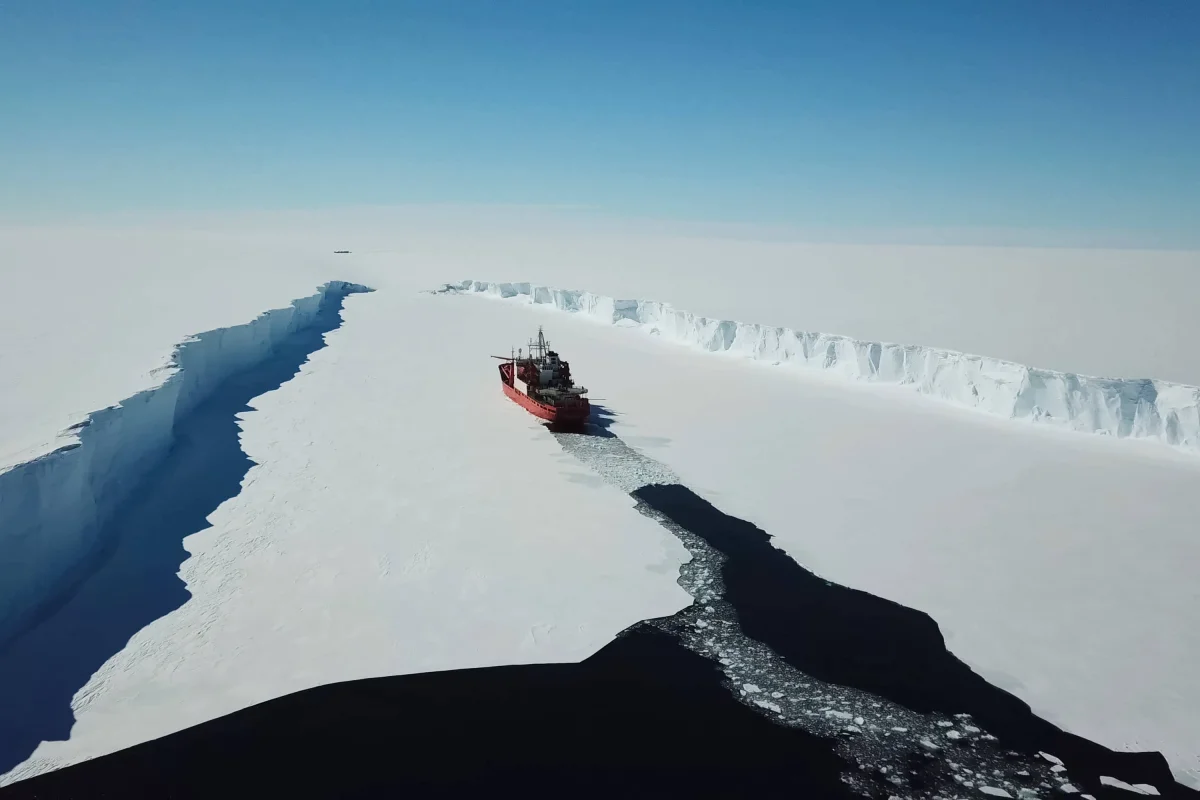
The coldest lake on Earth is Lake Vostok in Antarctica. It lies beneath the Russian Vostok research station in the eastern part of the continent, in a region meteorologists call the Pole of Cold.
It's here that, on July 21, 1983, scientists recorded –89.2°C — the lowest air temperature ever measured on the planet.
The lake itself sits roughly 4,000 meters beneath the ice, about 500 meters below sea level. It's 250 km long, up to 50 km wide, with a maximum depth of 1,200 meters. By surface area — roughly 15,800 km² — it's larger than Lake Onego. By water volume, Vostok ranks among the top five largest freshwater bodies in the world.
And through all of that, its temperature stays around –3°C. Minus three degrees — and the water remains liquid.
Why It Doesn't Freeze at Subzero Temperatures
Basic physics is at work here, just on a breathtaking scale. Water's freezing point depends on pressure: the higher the pressure, the lower that point drops. Lake Vostok bears the weight of a four-kilometer ice sheet, generating pressure of roughly 350 atmospheres. At that pressure, water stays liquid even several degrees below what we'd normally consider zero.
The second factor is geothermal heat. The Earth's crust warms the lake from below, preventing it from freezing solid to the bottom. And the ice shell above acts like a giant thermos: it insulates the water from surface temperatures that drop to –60 to –80°C in winter at Vostok Station.
The result is a paradox: above the lake sits the coldest place on the planet, while the water inside — icy by everyday standards — stays liquid.
How It Was Found — and Why Scientists Drilled Ice for 20 Years
Soviet glaciologist Igor Zotikov proposed the existence of subglacial lakes in Antarctica back in the 1960s. He calculated that in the central regions of the ice sheet, pressure and geothermal heat should cause continuous melting at the base — meaning liquid water could accumulate there.
In the early 1970s, British researchers conducted radar sounding — the signal, passing through the ice, reflected off a flat surface the way water does, not rock. It became clear: there was a lake beneath Vostok Station.
Drilling began during the Soviet era. The borehole deepened slowly — just tens of meters per season. In February 2012, Russian drillers finally reached the lake's surface at a depth of 3,769.3 meters. Ice from the lake water froze onto the drill bit — the first samples raised to the surface in 15 million years.
In January 2014, a second penetration was performed, extracting a 71-cm core of frozen lake water for laboratory analysis.
Is There Life in a Lake That Hasn't Seen Sunlight in 15 Million Years?
This is the central question behind the entire endeavor. Lake Vostok is a place of absolute darkness, extreme pressure, subzero temperature, and extremely low nutrient content. By its conditions, it resembles the subsurface oceans of Jupiter's and Saturn's moons — Europa and Enceladus — more than any body of water on Earth.
Core analysis produced ambiguous results. Samples contained DNA from thermophilic bacteria — organisms that typically live at +40 to +60°C, which sounds absurd for a subzero lake. One hypothesis holds that hydrothermal vents may exist on Vostok's floor, creating localized warm zones.
Metagenomic analysis identified traces of thousands of organism species: 94% bacteria, 6% eukaryotes (including fungi), plus two archaea species. But some scientists believe this data could be a contamination artifact — the drilling fluid contained kerosene and freon, and contamination can't yet be fully ruled out.
A definitive answer awaits the next generation of boreholes, drilled using "clean" technology. Work continues.
The Coldest "Ordinary" Lakes
Lake Vostok is the absolute record-holder, but it's inaccessible (unless you're a polar researcher with Antarctic station clearance). Among lakes a person could theoretically reach or drive to, competition for the "coldest" title is fierce as well.
- Lake Taymyr (Krasnoyarsk Krai) — Russia's largest lake above the Arctic Circle.
Even in August, water warms to a maximum of +8°C, and its average annual temperature is negative. The lake stays ice-covered from late September through July — ice-free water exists for fewer than three months a year. In winter, Taymyr loses more than half its volume: water levels drop, and the ice sheet breaks and stacks up with a roar audible for kilometers.
- Lake Labynkyr (Yakutia) — a remote body of water at 1,020 meters elevation in the Oymyakon district, 100 km from the nearest settlement.
Summer surface water temperature never exceeds +9°C; near the bottom, +2°C. In winter, surrounding air drops to –60°C. Yet Labynkyr almost never fully freezes over — an open patch remains at its center, giving rise to the legend of the "Labynkyr devil," a local counterpart to the Loch Ness Monster. Yakuts attribute the open water to underground warm springs.
- Lake Khantayskoye (Krasnoyarsk Krai, Putorana Plateau) — Siberia's deepest lake after Baikal, reaching 420 meters.
Water never exceeds +7 to +9°C in the upper layers, even in summer. Its shores are basalt canyons, waterfalls, and a complete absence of roads. Accessible only by helicopter or by water from Norilsk.
Lake Vorota (Yakutia) — Labynkyr's neighbor, connected to it, according to local legend, by an underground tunnel. Maximum water temperature reaches +8°C on the hottest days.
Why This Matters Beyond Science
Lake Vostok isn't just a geographical curiosity. It's a model for the search for life beyond Earth. Europa's subsurface ocean, Jupiter's moon, resembles Vostok in its conditions — pressure, darkness, isolation. If living organisms are confirmed in the Antarctic lake, uncontaminated by drilling, it would reshape our understanding of where life can exist at all.
For climatologists, the ice core above Vostok is an atmospheric archive spanning hundreds of thousands of years: air bubbles trapped in the ice layers reveal atmospheric composition, temperature, and CO₂ concentration across different eras.
And for the ordinary person, Vostok is a reminder of the planet's sheer scale. Beneath Earth's most inhospitable point, under four kilometers of ice, in total darkness and subzero temperature — fresh water sits, quietly liquid. And perhaps something lives in it. Has, for 15 million years.