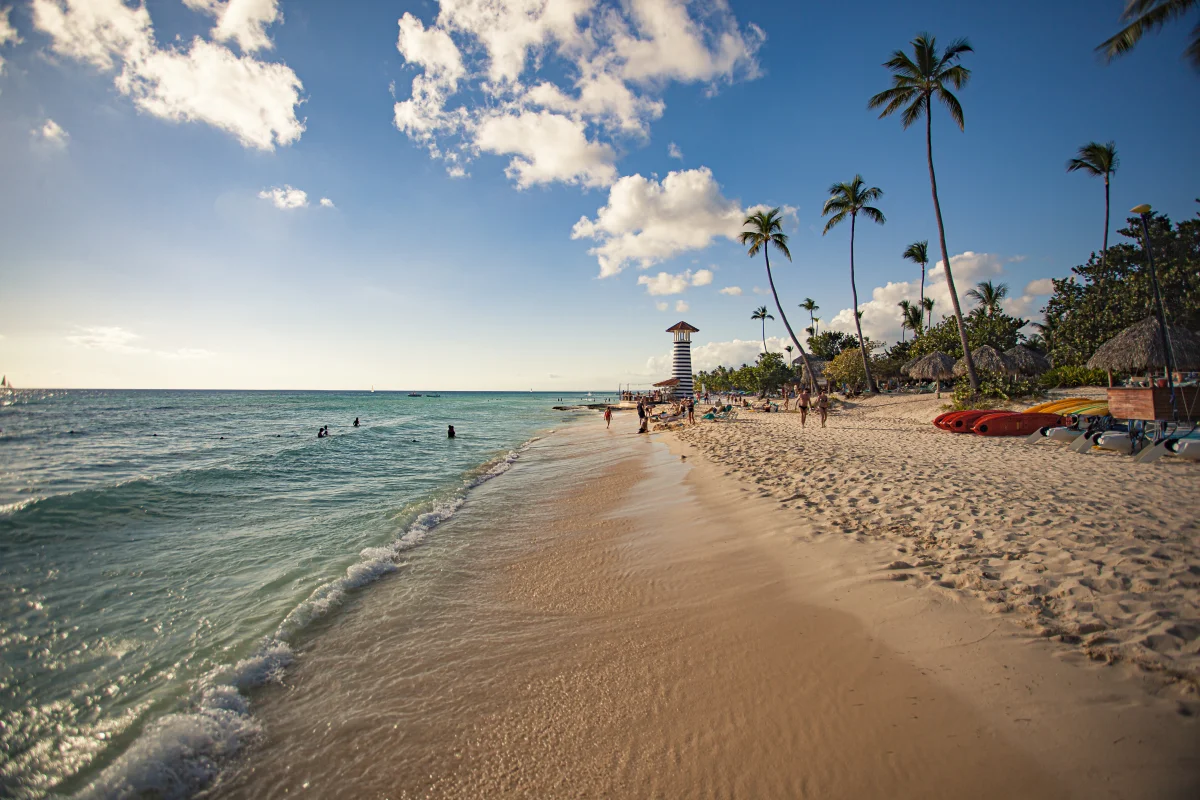
86°F, palm trees, white sand, a turquoise ocean. It sounds like a dream — and in the Dominican Republic, it genuinely can be. But it can also look different: a downpour that eats half your day, waves dumping seaweed onto the beach, and a hurricane alert buzzing on your phone. The difference between those two pictures comes down to one thing: picking the right month.
The Dominican Republic is a tropical country that stays warm year-round. Air temperatures range from 79°F to 91°F (26–33°C), and the water never drops below 79°F (26°C), even in January. It would seem like you could fly there whenever you please.
But in the tropics, the seasons aren't defined by temperature — they're defined by rainfall, wind, and hurricanes. In December, the Dominican Republic looks like a postcard Caribbean paradise. In September, that same Punta Cana can greet you with a storm and a week of rain.
Two Seasons Instead of Four
The Dominican climate splits into two periods:
- Dry season (November–April) — the high tourist season. Little rain, tolerable humidity, no hurricanes. Temperatures run 81–88°F (27–31°C), water at 79–82°F (26–28°C). Prices peak, hotels fill up, beaches get crowded.
- Rainy season (May–October) — the low season. Precipitation rises, humidity climbs, and hurricane risk lingers from June through November. Temperatures run 86–91°F (30–33°C), water at 82–84°F (28–29°C). Hotel prices can drop 25–40%.
But the line between the two seasons is blurry. Rain in the Dominican Republic isn't an Asian monsoon — it's brief, lasting 20–40 minutes, usually in the evening or overnight, and it rarely ruins a beach day entirely. The real difference between a "dry" and a "rainy" month isn't catastrophe — it's 6–12 rainy days versus 3–4.
Month by Month
January–February: Peak Season
The most popular months. Air at 81–84°F (27–29°C), water at 79–81°F (26–27°C), just 3–5 rainy days a month. Nights can turn cool (68–72°F / 20–22°C), so pack a light layer for evening walks.
January–February is the best window if weather is your top priority. Wind can be noticeable, especially on the northern coast (Puerto Plata, Cabarete), but it's gentler in the east (Punta Cana, Bávaro) and south (La Romana, Boca Chica).
A special bonus: from mid-January through late March, humpback whales gather in Samaná Bay to breed after migrating to Dominican waters. Whale-watching excursions from Punta Cana and Samaná are among the country's biggest draws.
The downside is price. Hotels peak in January, and so do flights. Book 2–3 months ahead.
March–April: Warm, Dry, a Little More Relaxed
Temperatures climb (84–88°F / 29–31°C), water stays at 79–81°F (26–27°C). Rain increases slightly compared to winter, but showers remain brief and don't get in the way of your plans. March is often considered one of the most comfortable months: the winter winds are gone, and summer humidity hasn't arrived yet.
April marks the start of the shift toward the rainy season. Rainy days climb to 6–7, and the ocean can get choppier at times. But April is still high season, and the weather still lets you enjoy the beach without restrictions.
May: The Turning Point
May is the rainiest month of the first half of the year. Downpours become more frequent (up to 12 days with rain), humidity rises, and the air at 90°F (32°C) starts to feel heavy and sticky. Most rain falls in the evening or overnight, though daytime showers do happen.
At the same time, prices drop sharply: tour operators begin offering significant discounts on Dominican packages. If you can tolerate a handful of rainy days, May can be a genuine bargain.
June–July: Hot, Humid, but Manageable
Air at 88–91°F (31–33°C), water at 82–84°F (28–29°C), humidity at 80–85%. Rain falls 8–10 days a month, usually brief. Hurricane season officially begins June 1 and runs through November 30, but strong storms near the Dominican Republic are rare in June and July.
This is when sargassum seaweed starts appearing on beaches — brown floating mats the ocean pushes ashore. It's not pollution, just a natural phenomenon, but it's unsightly and has a distinctive smell.
Hotels clear the seaweed daily, but during peak periods (July–September) they often can't keep up. The least seaweed shows up on the southern coast (Boca Chica, Juan Dolio, La Romana) and in Samaná Bay.
August–September: Peak Risk
These are the two months experienced travelers tend to avoid. Temperatures hit 90–91°F (32–33°C), humidity climbs above 85%, and the mugginess is constant. Rain falls 10–14 days a month and can last for extended stretches.
The main threat is hurricanes. Statistically, September is the most dangerous month: of the 11 major hurricanes that have struck the Dominican Republic over the past 80 years, 9 hit in September. The most recent major one was Hurricane Irma in September 2017, which battered the Punta Cana coastline.
A hurricane doesn't mean guaranteed disaster — most storms pass by the Dominican Republic, brushing it with strong wind and rain rather than a direct hit. But the risk is real, and travel insurance with natural disaster coverage is a must.
The upside: rock-bottom prices. Five-star hotels in September can cost 1.5 to 2 times less than in January. With a bit of luck on the weather, you can land a luxury trip for a fraction of the cost.
October: Coming Out of the Rainy Season
Rain starts to taper off, though October technically still falls within hurricane season. Temperatures at 86–88°F (30–31°C), water at 82–84°F (28–29°C). Wind calms down, and the seaweed recedes. Many travelers consider October a smart compromise: prices are still low, and the weather is already improving.
The second half of October is noticeably better than the first. By month's end, the Dominican Republic starts sliding into high season.
November: The Start of the Best Stretch
November kicks off the dry season. Rain drops sharply, humidity falls, and the air feels fresher. Temperatures sit at 84–86°F (29–30°C), water at 81–82°F (27–28°C). Wind is almost nonexistent, and the sea stays calm.
Prices start rising but haven't reached the December peak yet. November is one of the best months for travelers who want good weather without January's price tag.
December: Holiday Boom
The weather is spectacular: 82–86°F (28–30°C), water at 81°F (27°C), minimal rain. But December is the most expensive month of the year — New Year's and Christmas holidays pack hotels solid. Book 3–4 months out, since tour and flight prices hit their annual peak.
The Coasts: Not All Created Equal
The Dominican Republic has three distinct coastlines, and the weather differs across each.
- East (Punta Cana, Bávaro, Uvero Alto)
The most popular region. Coral reefs shield the beaches from the open ocean, and the surf stays moderate. Wind can pick up in winter, and seaweed shows up in summer. The rainy season here is milder than in the north.
- South (Boca Chica, Juan Dolio, La Romana, Saona Island)
The Caribbean Sea here is calmer than the Atlantic. Fewer waves, less seaweed, gentler wind. Summer is more comfortable here than in the east or north — the best pick for a low-season trip.
- North (Puerto Plata, Cabarete, Sosúa)
The Atlantic coast: higher waves, stronger wind, and overcast skies in winter. On the plus side, it offers excellent conditions for surfing and kitesurfing (especially in Cabarete). One quirk worth noting: the north actually sees more rain in winter than in summer — its rainy season runs on a different schedule.
- Samaná Peninsula (northeast)
Green, hilly, less built-up. More rain than Punta Cana, but home to the country's best beaches (Rincón, Frontón) and the best winter whale-watching.
Flights and Visa
Russian citizens don't need a visa — visa-free entry for up to 60 days. There are currently no direct flights from Russia to the Dominican Republic; travelers connect through Istanbul (Turkish Airlines, roughly 18 hours).
Punta Cana Airport (PUJ) is the country's main tourist gateway. From the airport to the hotels in Bávaro takes 20–30 minutes, and transfers are usually included in package deals.
The currency is the Dominican peso (DOP). Hotels and tourist zones accept dollars. Cards from Russian banks don't work — bring cash in dollars or euros.
Seaweed: What the Brochures Don't Mention
Sargassum seaweed is a topic that can dampen a Dominican vacation more than any rainstorm. The brown mats the ocean washes ashore appear from May through October, peaking July–September. The problem mainly affects the eastern coast (Punta Cana, Bávaro).
Hotels fight back — hiring crews, installing boom barriers, hauling seaweed away with tractors. But on peak days, the volume washing ashore outpaces their ability to clear it. The smell of decomposing seaweed is an unwelcome bonus.
If you're traveling in summer, head for the southern coast (La Romana, Bayahíbe, Saona Island), where seaweed is far less of an issue — or check hotels' social media for real-time conditions before you go.
The Bottom-Line Cheat Sheet
- Ideal months: January, February, March, November. Dry, comfortable, calm seas.
- Good months: April, December, late October. Weather is nearly perfect, with minor caveats (wind, transitional conditions, high prices).
- Risky but rewarding: May, June, early October. Some rain, but brief. Lower prices.
- Not recommended without reservations: July, August, September. Hot, humid, seaweed, hurricane risk — but the lowest prices of the year, and with a bit of luck, the trip can still turn out great.
The Dominican Republic is a country where "bad weather," in the usual sense, barely exists. Even in the worst month, the water sits at a balmy 82°F (28°C), and the sun still shows up every day. But here, the gap between "good" and "perfect" isn't measured in degrees — it comes down to whether it rained that evening, and whether the ocean decided to deliver another load of brown seaweed to the beach.