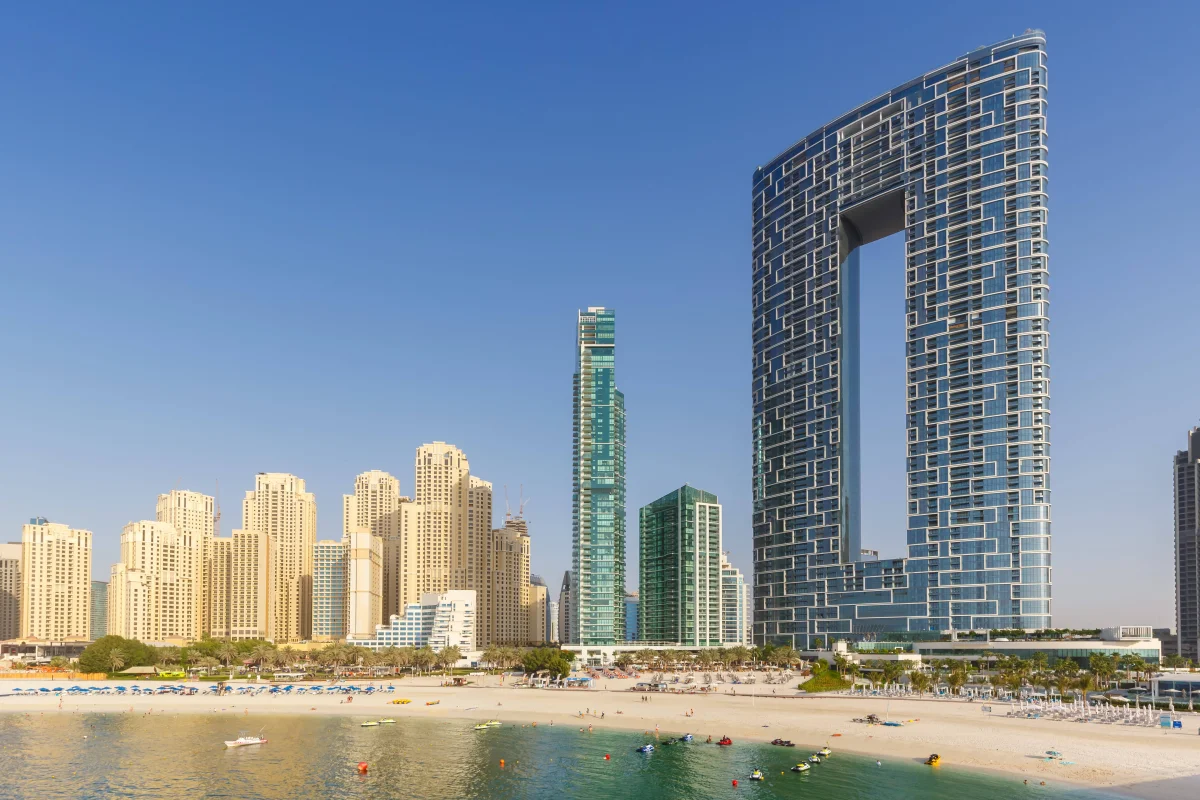
Dubai in August with a child: +45°C outside, scorching sand impossible to walk on barefoot, and shuttling from one air-conditioned space to the next. Dubai in January: +25°C, warm sea, sandcastles on the beach, and not a single heatstroke. The difference isn't the destination — it's the date on the ticket.
Dubai is one of the most popular family destinations among Russians, and for good reason: a 5-hour flight, no visa required, top-tier safety, and the best child-friendly infrastructure in the region. But this city works in a way where it's ideal for families half the year and genuinely dangerous for them the other half. And the line between the two is sharp.
Why Summer With Kids Is a Bad Idea
Summer Dubai isn't just "hot." It's an extreme environment that puts a child's body at real risk.
Air temperature from June through September runs +40–48°C. Sand and asphalt surface temperature hits +60–70°C. A child running barefoot from a towel to the water can suffer foot burns within seconds. That's not an exaggeration — burns from scorching surfaces show up in Dubai hospitals every summer.
Humidity sits at 60–80%, and combined with the heat, perceived temperature climbs past +50°C. Sweat doesn't evaporate; the body can't cool itself.
An adult's adaptive reserve lasts several hours. A child under five has significantly less: thermoregulation is still immature, and body surface area relative to mass is greater, so overheating sets in faster.
The sea sits at +32–34°C. It sounds like a dream; in practice, it's like a hot bath. The water doesn't refresh, and after getting out, the heat feels even more intense. For children, swimming at this temperature provides no cooling at all.
A typical summer day with a child in Dubai looks like: wake up — the pool's air-conditioned zone — an air-conditioned mall — an air-conditioned restaurant — the pool — an air-conditioned room. The beach is off-limits: the sand burns, the air scorches, and the sun is aggressive. Whether it's worth a five-hour flight for a hotel pool is a question every family answers for itself.
Winter Dubai — and Why It's Built for Families
From November through March, Dubai transforms into an entirely different city, and for children, this is one of the best periods at any resort in the world.
Air temperature runs +24–28°C during the day, +16–20°C in the evening. For a child, that's a comfortable zone: not too hot, not too cold, allowing outdoor time all day without overheating risk. Sunlight is bright but not aggressive — sunburn is possible, but not within fifteen minutes like in summer.
The sea sits at +22–25°C depending on the month. December brings +24–25°C; January–February, +21–23°C. For an adult, January's +21°C might feel bracing, but children are generally less sensitive to water temperature and splash around happily while parents hesitate on the shore.
The sand is warm, not scorching. Building castles, digging holes, running barefoot — everything kids love about the beach is available without restriction in winter. In summer, it's water shoes only, and only in the morning, before the surface overheats.
The Best Months, Week by Week
Not all winter months are equal, and for a family with a child, a two-to-three-week difference is felt.
- November
The heat fades but stays warm — +28–30°C, water at +25–26°C. One of the best months: the beach works all day, the sea is warm, tourist numbers are lower than December's. Prices run 25–30% below the Christmas peak.
- December
+24–26°C, water at +23–24°C. The city is decorated for the holidays, the atmosphere festive. But from the second half of the month, occupancy peaks: New Year's holidays, sky-high prices, everything booked out. If going in December, the first two weeks are cheaper and calmer.
- January
The coolest month — +22–24°C, water at +21–22°C. For the beach, it's right at the edge: mornings and evenings are cool, swimming comfortable from 10 a.m. to 3 p.m., when the sun is highest. But it's maximally comfortable for walks and theme parks.
- February
A bit warmer than January — +24–26°C, water at +22–23°C. Warming begins. The holiday rush has subsided, prices are back to normal. By overall factors, one of the best months for families: warm, calm, affordable.
- March
+26–28°C, water at +23–24°C. Noticeably warmer, the beach in full swing. But by month's end, heat starts building, and for heat-sensitive children, it's already at the upper limit of comfort.
What to Do With Kids Beyond the Beach
Dubai has invested billions in family infrastructure, and in winter it runs at full capacity.
1) Water parks
Aquaventure at Atlantis and Wild Wadi near Burj Al Arab rank among the largest in the world. Slides for every age, from infant-friendly to extreme. In winter, pool water is heated, making rides comfortable even in January.
2) Theme parks
IMG Worlds of Adventure, Motiongate, Legoland — indoor, air-conditioned, operating year-round. But winter logistics are simpler: no need to dash from an air-conditioned bus to an air-conditioned entrance, and the walk from parking to the door doesn't become an ordeal.
3) The desert
Jeep safaris, camel rides, dinner at a Bedouin camp under the stars. Impossible in summer (sand at +70°C), one of the most memorable experiences for a child in winter. Desert temperature by evening: +18–20°C, clear skies, stars invisible in the city.
4) Dubai Frame, Burj Khalifa, museums
In winter, you can step outside after the observation deck and continue walking. In summer, it's straight back into an air-conditioned taxi.
5) Beaches
JBR Beach, Kite Beach, La Mer are equipped with children's zones, lifeguards, and cafés. In winter, Kite Beach runs children's playgrounds on the sand, trampolines, bike rentals. In summer, all of that sits shaded or closed.
What to Watch For
A few points specific to a family vacation in winter Dubai.
After sunset, temperature drops to +14–18°C. A child needs a sweater or light jacket for evening walks. Many parents who packed only shorts and T-shirts discover this on the first evening at the waterfront.
Not all hotels heat their pools in winter — confirm this when booking. For families with young children who spend more time in the pool than the sea, it's a critical factor.
Winter Dubai sun is gentler than summer's, but UV is still strong enough to burn a child's skin in 40–60 minutes. SPF 50 sunscreen is mandatory, reapplied every two hours and after each swim.
The gap between Moscow's –15°C and Dubai's +25°C is 40 degrees. A child's body adapts more slowly than an adult's. Keep the first day free of beach, pool, and active excursions — a walk, an early bedtime, a gentle start.
What It Costs — and When It's Cheaper
Winter is high season, and prices reflect that. But even within winter, the spread is significant.
The priciest dates are December 20 through January 10. Hotels run 50–100% higher, restaurants add a markup, and park tickets go at full price. If your budget is tight, avoid these three weeks.
The best value winter dates are the second half of January, February, and November. The weather is identical, but prices sit 25–40% below the holiday peak. For a family not tied to school holidays, this is the optimal choice.
The flight from Moscow takes roughly 5 hours, with direct flights from several airlines. No visa needed for Russian citizens — visa-free entry for up to 90 days.
One Final Thought
Dubai is a city designed for winter. The waterfronts, parks, beaches, and open-air restaurants — all of it was built for +25°C, not +45°C. In summer, the city retreats indoors — into malls, hotels, and air-conditioned spaces. In winter, it lives outside.
For a child, outdoor Dubai — the beach, the sand, camels, fountains, the promenade — is a hundred times more interesting than Dubai seen through mall glass. And the only thing needed to experience it is booking the right dates.