Greece has over two thousand islands, three seas, and a climate that shifts not just north to south but east to west too. Choosing "just Greece" means losing the game before you've even flown: on one island in August, it's flat calm and +26°C water; on another, squalling wind and canceled ferries.
The typical mistake is booking July–August because "it's summer, so it'll be hot and great." On the mainland during these months, it's +35–40°C in the shade, asphalt melts, and Athens becomes unbreathable.
On the Cyclades, the meltemi wind blows at force 6–7, kicking up 1.5-meter waves and knocking over beach umbrellas. On Corfu, humidity turns thirty-degree heat into a steam bath. Greece needs choosing not by month, but by island — and vice versa.
Three Seas, Three Personalities
Greek islands are washed by the Aegean, Ionian, and Mediterranean (Cretan and Libyan) seas. Each has its own climatic signature.
The Aegean Sea (Cyclades, Dodecanese, North Aegean Islands) — the windiest. In summer, the meltemi dominates — a persistent northerly wind blowing from mid-June through mid-September, peaking in July–August. Gusts up to 40–50 km/h, waves, canceled ferries — all routine.
The meltemi tempers the heat but wrecks beach time: sand flies in your face, towels blow away, umbrellas turn inside out. Water stays cooler than the Ionian Sea: +23–25°C at peak season.
The Ionian Sea (Corfu, Zakynthos, Kefalonia, Lefkada) — warmer, calmer, greener. Mainland mountains shield the western islands from the meltemi, so it's quieter here. But humidity runs higher — 70–80% in summer — making the heat harder to bear. Water at +25–27°C in August. On the upside, these islands stay lush: olive groves, cypresses, citrus — unlike the sun-scorched Cyclades, there's shade even in August.
The Mediterranean (Cretan and Libyan) Sea — the warmest. Off Crete's southern coast, autumn water runs 2–5°C higher than the north. Beach season here is Greece's longest — from May through late October.
Why August Isn't Always the Best Choice
August in Greece brings peak prices, peak crowds, and peak heat simultaneously. Greeks themselves take vacation from August 1 to 15, and resort towns fill with locals as well as foreigners. Hotel rates climb 40–60% above June's, ferries are packed, restaurants run at capacity.
On the Cyclades (Mykonos, Santorini, Paros, Naxos), the meltemi adds to the heat and crowds. Force 6–7 winds can blow continuously for 3–5 days. Interisland ferry service gets canceled, boats don't run, beaches post warnings.
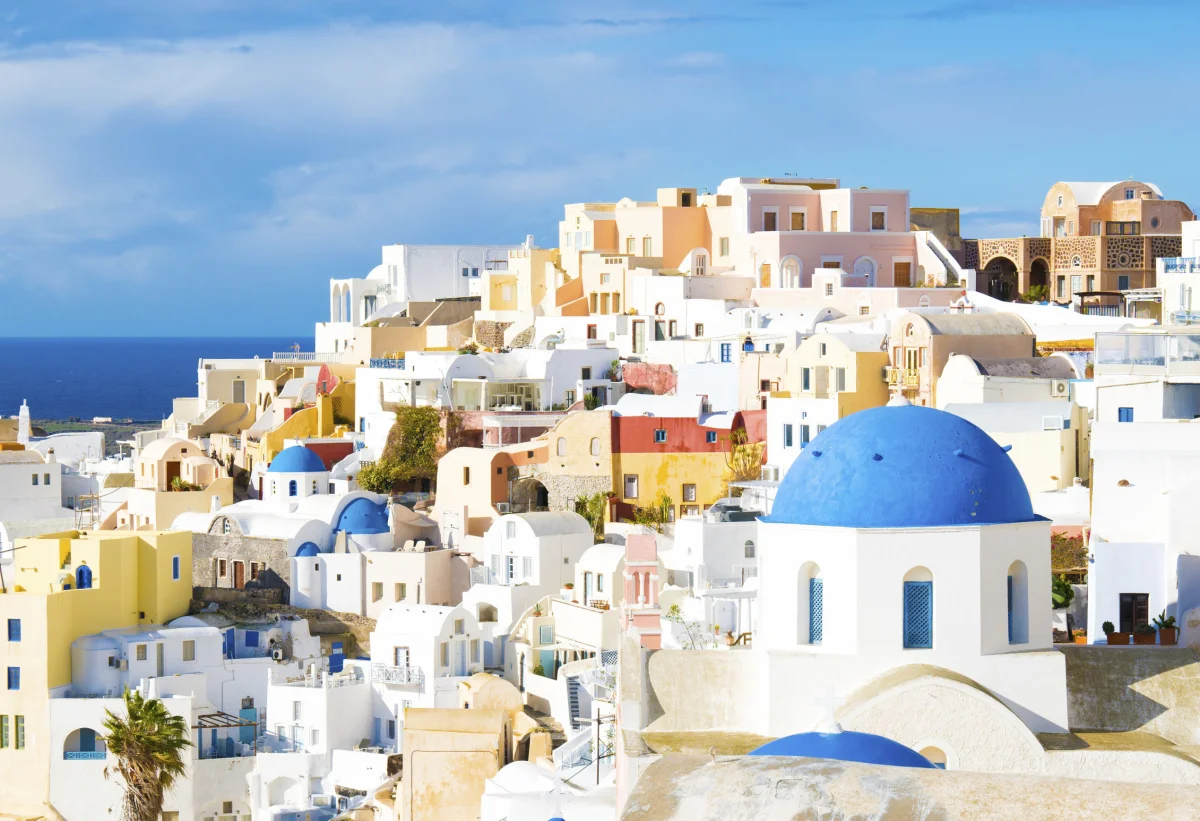
For hiking and photo shoots against white-washed houses, it's still manageable. For lying on the beach with a child, it's an ordeal.
On the mainland (Halkidiki, the Peloponnese, the Attica coast), August means +35–40°C and mugginess. Excursions to the Acropolis, Delphi, and Olympia turn into a forced march across scorching stone.
Corfu's heat is gentler (+30–33°C), but humidity makes it feel heavier than Crete's dry +35°C. Air conditioning in your room isn't a luxury — it's a necessity.
June: A Gentle Season Start
June is one of Greece's best months, if you're not chasing the warmest possible sea. Air runs +28–32°C on the islands, water at +22–24°C. The meltemi hasn't built up strength yet, and the Cyclades are relatively calm. No crowds, prices run 20–30% below peak.
An added bonus is bloom season. In June, Greece is still green, hillsides haven't burned out, wild poppies are finishing their bloom while oleanders and bougainvillea are in full color. On Crete and Rhodes, the landscape looks dramatically different from August's picture: instead of scorched ochre earth, vivid colors.
In early June, water in the northern Aegean (Thassos, Lesbos) is still +20–21°C — cool for many. On Crete and Rhodes, it's already +22–23°C, entirely comfortable.
September: The Golden Window
If choosing one month for Greece, most experienced travelers name September. Here's why:
- Water runs +24–26°C — warmer than June, and on some islands, warmer than July.
- The meltemi subsides: by mid-September, wind on the Cyclades weakens, ferries run reliably, and beaches return to normal life.
- Air sits at +27–30°C — the heat retreats, but sunbathing is still comfortable. Prices drop 20–30% from August's max.
- On Crete, young wine season begins, and rural harvest festivals take place across the island.
- The Samaria Gorge on Crete (16 km on foot) can be walked in September without heatstroke risk — in summer, the route closes on especially hot days.
The second half of September is slightly riskier: the Ionian Islands (Corfu, Zakynthos) may see the first autumn rain. Crete and Rhodes stay dry through month's end.
Island by Island: When to Go
Crete: The Longest Season
Greece's southernmost and largest island. Beach season runs May through late October — longer than anywhere else in the country. Even in October, water sits at +23–24°C, air at +24–26°C.
The northern coast (Chania, Rethymno, Heraklion) is the main resort zone, but summer brings meltemi, and the sea there gets rough more often than the south. The southern coast (Matala, Plakias, Ierapetra) runs 2–5°C warmer, the sea calmer, but infrastructure is thinner and access takes longer.
Insider tip: if the northern beach is choppy, get in a car and reach the south in 40–50 minutes. This trick works nearly every time on Crete.
Best months: June and September. Elafonisi Beach (pink sand) and Balos (turquoise lagoon) are accessible during these months without a two-hour parking wait.
Rhodes: The Sunshine Record Holder
300 sunny days a year — Rhodes is considered the sunniest spot in Europe. Beach season runs May through October, with water at +24°C in September–October. The eastern coast (Mediterranean side) is calmer and warmer; the western coast (Aegean side) is windier, with waves, popular among windsurfers.
Rhodes's medieval Old Town — a UNESCO site — can be wandered for hours in June and September without gasping for breath. In August, those same streets turn into a scorching stone labyrinth.
Best months: June and September–early October.
Santorini: Not for the Beach
A paradox: one of the world's most photographed islands is a poor beach destination. Santorini's beaches consist of volcanic black and red sand that heats to burning temperatures in the sun. Water entry is often rocky, and the beach strips are narrow.
People come to Santorini for the views, sunsets, wine, and architecture. May–June and September–October are ideal for that, without crowds and without the meltemi interfering with caldera walks.
In July–August, the narrow streets of Oia and Fira are jammed, restaurants book out weeks in advance, and wind knocks people over at the overlooks.
Corfu: Green and Humid
The northernmost of the major islands, and Greece's coolest. But "cool" is relative: summer brings +30–33°C at 70–80% humidity. Feels like a steam room. On the upside, Corfu is the only Greek island that doesn't burn out: olive groves, cypress forests, orange gardens — greenery year-round.
Its beaches are among the country's best: Paleokastritsa (rocky coves with emerald water), Sidari (Canal d'Amour, a rock-cut channel). Water at +25–27°C in August, +24–25°C in September.
Best months: June (green, no crowds, not yet muggy) and September (heat easing, sea warm, just 3 rainy days a month).
Zakynthos: Turtles and Navagio Bay
The island's southern portion is a national marine park, home to nesting loggerhead sea turtles. Swimming at certain beaches is restricted: after sunset, turtles come onto the sand, and tourists are asked not to disturb them.
Navagio Bay (Shipwreck Bay) — the postcard beach with a rusted smuggler's ship on white sand. Reachable only by water, with excursion boats running May through October.
Water at +25–27°C at peak season. Best months: June and September. In August, Zakynthos is hot and crowded, and boats to Navagio line up.
Kos: Budget Dodecanese
A small island near Turkey, one of the warmest in the Aegean. The season runs May through late October. Water in September sits at +24–25°C. The meltemi is weaker here than on the Cyclades — Turkish mountains partially shield the island.
Kos is a cheaper alternative to Rhodes: accommodation runs 15–25% less, beaches are just as good, and from the port, it's a 40-minute ferry to Turkey's Bodrum.
October: The Last Chance
On most islands, October marks the season's close. But in southern Greece, the beach is still running:
- Crete — air at +24–26°C, water at +23–24°C in the first half. The southern coast holds through month's end.
- Rhodes — +24°C air, +24°C water early in the month. By the second half, the first rains arrive.
- Kos — similar to Rhodes, with the season officially closing November 1.
On the Cyclades and Corfu, October is already risky: rain, short daylight, and some hotels and restaurants close until spring.
What to Consider Before Buying Tickets
If you're a windsurfer or kiter — July–August on Paros, Naxos, and western Rhodes are made for you. Waves, wind, no lulls — exactly what you're chasing.
Southern Crete and southern Rhodes are the warmest options at the season's start and end. If your trip falls in May or October, look for accommodation on the southern coast.
Direct flights from Moscow in 2026 operated to Crete (Heraklion and Chania), Rhodes, Corfu, Kos, and Athens. Flight time: 3.5–4.5 hours. Visa: Schengen.
Renting a car is nearly essential on Crete and Rhodes if you want to see more than one beach. On Santorini and Mykonos, a scooter or ATV suffices. On smaller islands (Kos, Zakynthos), buses and taxis work fine.
Greek cuisine is among the most affordable in the Mediterranean. A taverna dinner for two runs €20–35 with wine. September–October adds a seasonal menu: young wine, fresh figs, and the new olive harvest.