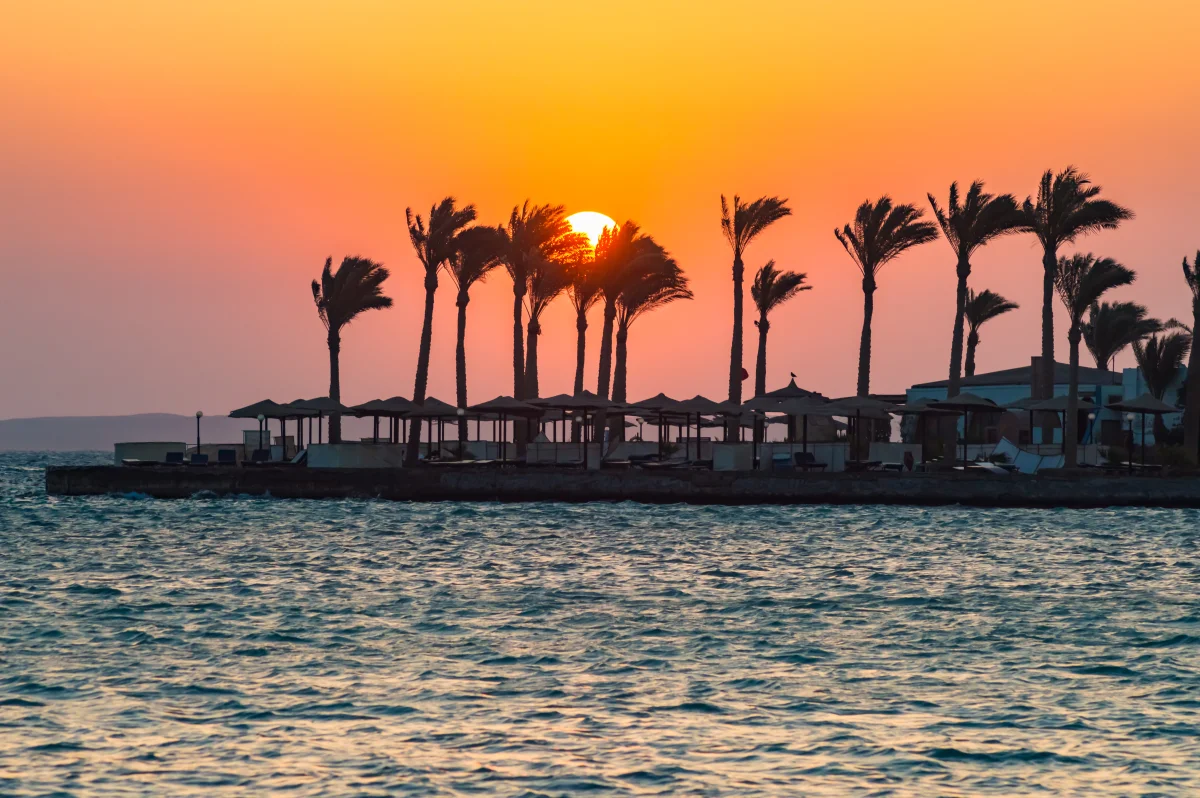
Hurghada sits on an exposed stretch of Red Sea coast, without mountain-enclosed bays or protective reefs. That means at the same +28°C on the thermometer, a day can be a perfect beach day — or one where sand blasts your face and the sea chases you out in five minutes.
Unlike Sharm el-Sheikh, where the Sinai Peninsula's mountains shield the coast from wind, Hurghada occupies a flat shoreline. Air masses move freely along the coast, and wind is a factor that shapes the quality of your vacation every bit as much as water temperature or the number of sunny days.
Why Wind Matters So Much Here Specifically
The Red Sea near Hurghada is open and shallow close to shore. Broad sandy flats extend for tens of meters, and wind stirs up fine chop on the surface — and in stronger gusts, real waves. Water turns cloudy, and snorkeling visibility drops.
On shore, wind creates a different problem: Hurghada's beach sand is fine and light, and at gusts above 7–8 m/s it flies horizontally, getting into eyes, ears, and food. Lying on the beach in those conditions is a questionable pleasure. After swimming, wind evaporates moisture from the skin and creates a sensation of cold even at +30°C.
In Sharm, this problem barely exists — the resort is tucked into bays between mountains. That's why Sharm feels warmer than Hurghada in winter, even though the thermometer readings are nearly identical.
October–November: The Best Time to Visit
Two months when everything in Hurghada aligns: warm but not scorching, wind moderate, the sea warm and calm.
October. Air at +28–30°C, water at +26–27°C. Summer heat has departed, but the Red Sea still holds its summer warmth. Winds are light, the beach is comfortable. Fewer tourists than in November–December, prices are reasonable. For many, this is the ideal month.
November. Slightly cooler — air +25–27°C, water +25–26°C. Wind picks up but hasn't reached winter levels yet. High season begins, prices climb, but the weather is worth it.
Winter: Warm on Paper, Windy in Practice
December through February is high season by occupancy, but not by comfort. This is where wind becomes the dominant factor.
December. Air +20–23°C during the day, dropping to +12°C at night. Water +23–24°C — warmer than the air, and swimming feels great until you step out. Wind at 5–8 m/s is noticeable, especially in the afternoon. Standing on the beach at +20°C in the wind after a swim, you feel genuinely cold. A windbreaker at the beach isn't a whim.
January–February. The coolest months. Air +17–21°C, nights +10–12°C. Water +20–22°C. Wind strengthens to 6–10 m/s, and sandstorms are possible — lasting a day or two at most, but unpleasant. Sunbathing is doable on calm days, but they alternate with days when going to the beach is pointless.
Winter Hurghada suits those who aren't coming solely for the beach: snorkeling in sheltered coves, excursions to Luxor and Cairo, poolside relaxation with heated water. But counting on lying on the beach every day isn't realistic.
How Spring Weather Shifts in Hurghada
- March. A transitional month. Air +22–26°C, water +22–23°C. Wind still occurs, but less often and more weakly. Mornings and evenings are cool; by midday it's already warm. For the beach — a matter of personal tolerance; for excursions — excellent.
- April. A noticeable turning point. Air +27–30°C, water +23–25°C. Wind dies down, and solid beach days become consistent. Prices haven't yet hit summer peak.
- May. Already hot — +30–33°C, water +25–27°C. Wind is minimal, the sea is calm. By the ratio of weather to price, it's one of the best months. But the heat intensifies with each passing week.
Why Summer Loses the Wind but Keeps the Problems
June through September brings extreme heat: air +33–38°C, and on excursions inland it reaches +45–50°C. Water sits at +27–29°C — warm, but no longer refreshing. Wind during this period is light, which eliminates Hurghada's main winter issue but introduces another — stifling air.
Summer suits those who handle heat well and spend most of the day in the water or an air-conditioned room. Prices hit their annual low. But being on the beach from 11 a.m. to 4 p.m. is physically punishing.
Hurghada or Sharm: How to Choose by Weather
The question everyone asks when flying to Egypt in winter:
- Winter (December–February) — Sharm is more comfortable. Mountains block the wind, and at the same +20°C the sensation is softer. For a winter beach vacation, Sharm is the safer bet.
- Spring and autumn (April–May, October–November) — the difference is minimal. Both resorts are equally good.
- Summer (June–September) — both are equally scorching. Hurghada's advantage: more affordable hotels and wide sandy beaches with a gentle slope for children.
Which Month to Choose
Want a guaranteed beach without extreme heat — October or April–May. Want warmth in winter and can handle the wind — November or March. Want the cheapest possible trip — January–February or June–August, with the understanding that the first option means wind and the second means serious heat.
And above all: don't compare Hurghada and Sharm by the thermometer. Compare them by wind — that's what determines what your day at the beach will actually look like.