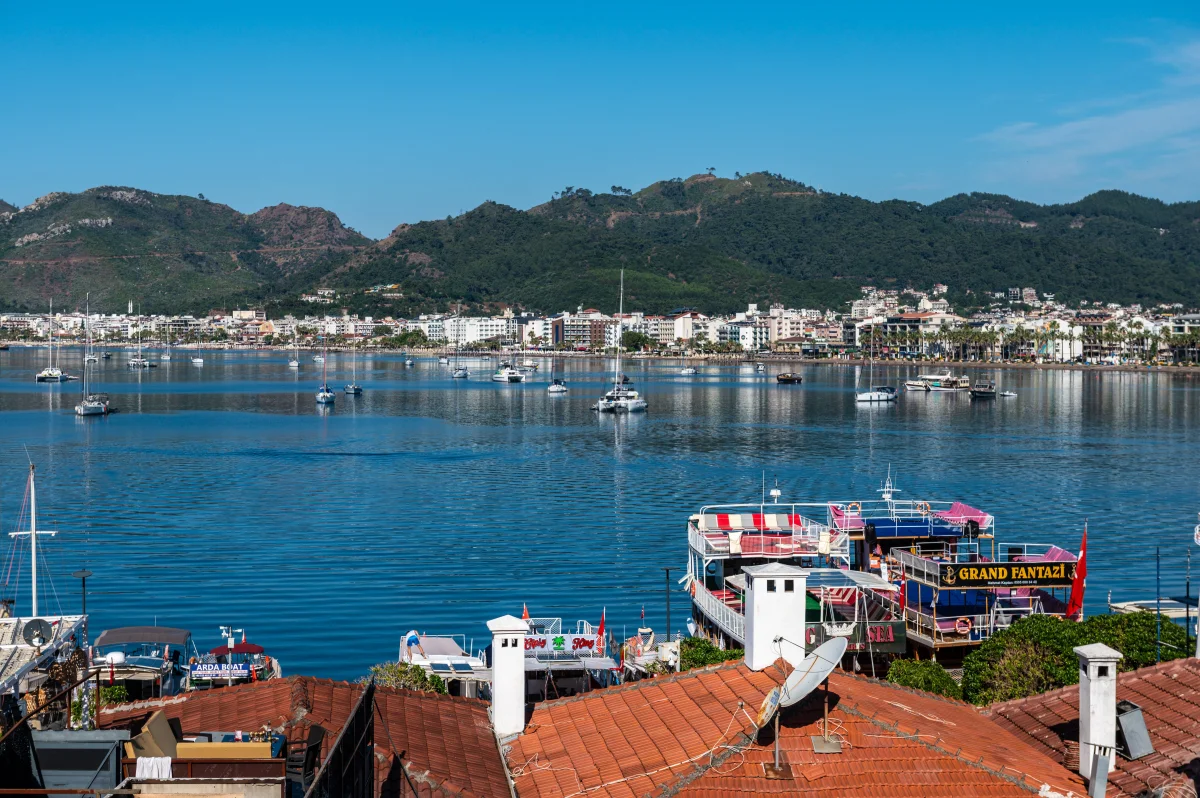
Marmaris in August: +34°C, packed-solid beaches, prices at their ceiling. The same Marmaris in June: +30°C, empty loungers, hotels 30% cheaper. The sea is almost identical: +23°C versus +26°C. The difference is three degrees of water — and an entirely different quality of vacation.
Marmaris sits at the meeting point of two seas — the Aegean and the Mediterranean — in a deep bay surrounded by mountains and pine forest. That's what gives the resort its key advantage: a milder climate than the Mediterranean coast.
Less humidity, more shade, and a mountain breeze that cools the evenings. But "milder" doesn't mean "cool" — at the height of the season, Marmaris turns into a furnace too.
How the Water Warms Month by Month
Marmaris Bay is semi-enclosed, so the water heats up slower than the open sea — but it also cools down slower. That stretches the comfortable swimming window to five months — June through October.
In May, water sits at +20°C: the hardy already swim, most people don't yet. Air at +25°C, little rain — ideal for waterfront strolls and sightseeing. But full beach vacationing starts later.
June is the start. Water at +22–23°C, air at +30–31°C. The heat is noticeable but not exhausting — pines and mountains provide shade, and evenings turn fresh. Tourist numbers are noticeably lower than July–August, and the beaches still breathe.
July raises the bar: water at +25–26°C, air at +33°C. Rain is essentially absent — the entire month might not see a single drop. Swimming works all day, but from noon to four on an open beach, the heat gets uncomfortable.
August is the peak across the board. Water at +26–27°C, air at +34°C. The sea is at its annual warmest, but so is the heat. By midday, you'd rather be in an air-conditioned room than on the beach.
September brings comfort back. Water at +24–25°C — just a degree or two below August's peak. Air at +30°C, but dry, without the oppressive mugginess.
Beaches thin out, evenings turn gentle, markets fill with figs and pomegranates. Many seasoned travelers consider September the best month for Marmaris.
October is the finale. The first half is still beachworthy: water at +22–23°C, air at +25°C. By the second half, the sea cools, rain arrives, and some hotels close. For swimming — an acquired taste; for sightseeing — excellent.
Why August Isn't the Best Choice
August is Marmaris's most popular month among Russian and European tourists — and simultaneously the least comfortable, for three reasons.
- Heat
A temperature of +34°C at 55–60% humidity isn't catastrophic (the Mediterranean would be worse), but it's enough to turn midday into a battle against the swelter. With children under five, beach time is only possible morning and evening — four or five hours in the middle of the day get spent indoors.
- Crowds
Marmaris is a compact city. The central beach in August is packed to capacity. Loungers get claimed by nine in the morning, Bar Street buzzes until 3 a.m., and the promenade is a dense stream of people. For anyone seeking calm, this is the opposite of relaxation.
- Prices
Hotels in August cost 30–50% more than in June or the second half of September. Yet the service level is the same, the sea is nearly identical, and the weather is objectively less comfortable.
When to Go for the Perfect Combination
Two windows when Marmaris shows itself at its best.
The first: the second half of June. Water is already warm (+23°C), the heat isn't oppressive (+30°C), beaches are open, hotels offer discounts. School holidays have just started, and the family wave hasn't built up yet.
Evenings on the promenade bring a pleasant mountain coolness, and you can walk until midnight in a T-shirt.
The second: September. Water matches July's level (+24–25°C), while the air runs 3–4 degrees cooler. The sea has soaked in summer's warmth and cools slowly, so the swimming difference from August is minimal. But the crowds are gone, prices drop, and nature starts reviving after a dry summer.
Where to Swim: Beaches of Marmaris and Around
Marmaris's town beach stretches along the promenade — long but narrow, and cramped in season. For the best beaches, you need to venture beyond the center.
- İçmeler — a town 8 kilometers west, essentially part of Marmaris. The bay is smaller and calmer, water cleaner than downtown. Pebble beach with sandy patches, gentle entry. One of the best options in the area for families with children.
- Turunç — farther out, in an enclosed bay beyond the mountain. Turquoise water, far fewer people. Reachable by dolmuş (shared minibus) or by boat. The beach carries a Blue Flag.
- Kumlubük — a wild bay past Turunç. Pebble beach, transparent water, not a single hotel. Just a couple of cafés and nature. For anyone willing to travel 30 minutes for solitude.
- Dalyan and İztuzu Beach — an hour and a half from Marmaris. A sandy spit where loggerhead sea turtles lay their eggs. The beach operates by day (at night it's turtle territory). Water at the mouth of the Dalyan River runs warmer than the open sea.
How Marmaris Differs From Antalya
The comparison every traveler makes when choosing a Turkish resort.
Marmaris sits at the junction of two seas; Antalya is pure Mediterranean. That's the key difference: Marmaris is drier and fresher. Humidity is lower, nights are cooler, and pine forest reaching down to the water provides natural shade and a scent of pine you won't find on the Antalya coast.
Marmaris's water runs 1–2 degrees cooler than Antalya's or Alanya's. For anyone wanting the warmest possible sea, that's a drawback. For anyone who wants the sea to refresh rather than "cook" them, it's a plus.
The vacation format differs too. Antalya has massive hotel complexes spanning several hectares. Marmaris hotels are more compact, but the city itself is livelier: promenade, Bar Street, bazaar, a marina full of yachts. Marmaris suits anyone who cares about stepping beyond the hotel.
Which Month to Choose
- Want warm sea without crowds — the second half of June or September. Water at +23–25°C, no oppressive heat, open beaches.
- Want the warmest possible water — August. But brace for heat, crowds, and peak prices.
- Traveling with small children — June. Heat isn't extreme yet, few people, and İçmeler has shallow, clean water.
- Want sightseeing plus swimming — May or October. The sea is right at the edge of comfortable, but Dalyan, Ephesus, and Rhodes Island (an hour and a half by catamaran) are accessible without grueling heat.
Above all: don't choose Marmaris by the logic of "hotter is better." This resort reveals itself not in the peak swelter but during the weeks when the pines smell of resin, the evening brings mountain coolness, and the beach at Turunç holds just you and turquoise water. No third party required.