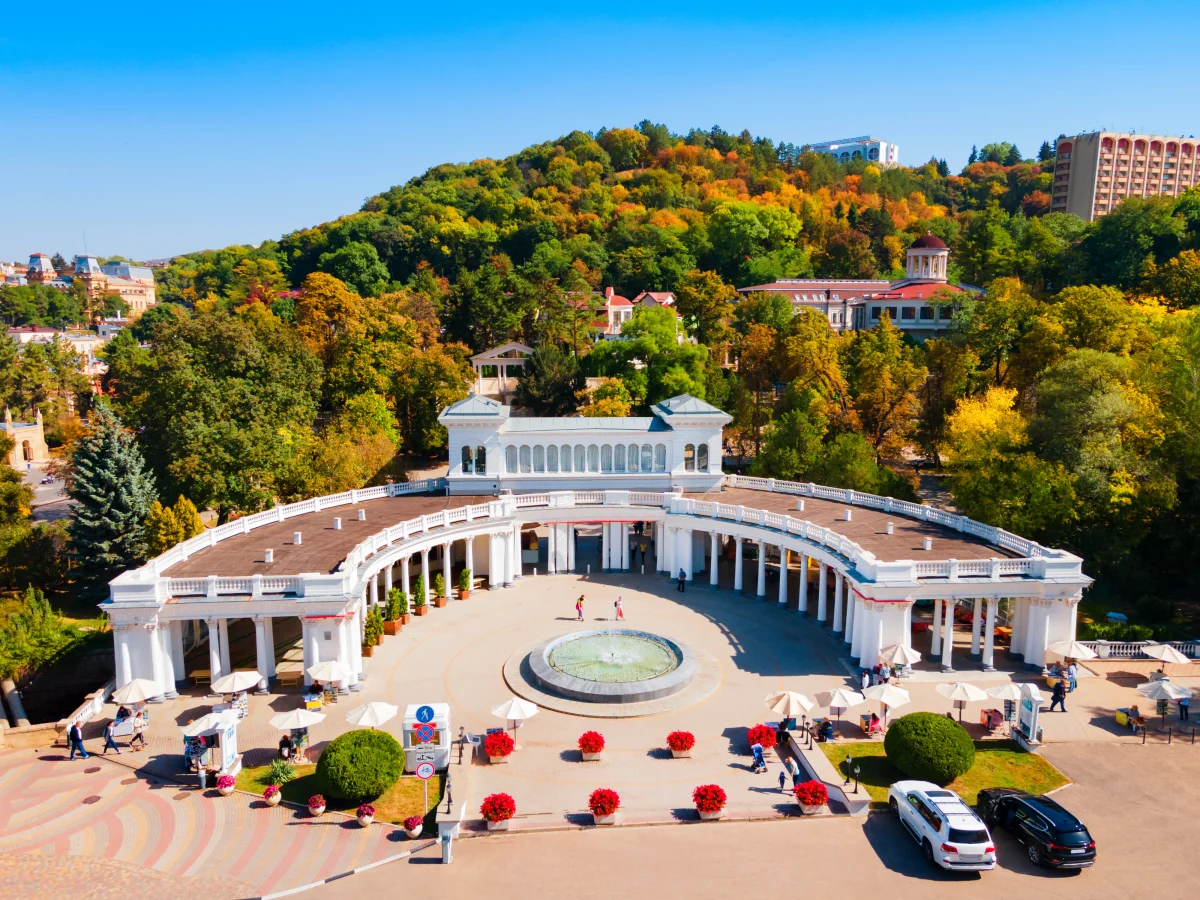
Morning, Kislovodsk, October. The sun's already up, and there's not a single person at the mineral water pump room. You fill a glass of Narzan, step out onto the health trail — and spend the next two hours walking a path with Elbrus in view the whole way. No crowds, no heat, no lines. That's roughly how the Caucasian Mineral Waters region works, when you time it right.
The Caucasian Mineral Waters (KMV) region consists of four spa towns: Kislovodsk, Pyatigorsk, Yessentuki, and Zheleznovodsk. The town of Mineralnye Vody itself isn't a resort — it's a transit hub, home to the airport and railway station where visitors disperse toward their respective sanatoriums.
The region operates year-round, but each season offers something different — and the difference between a great trip and a mediocre one often comes down to why you're going: to receive treatment, to walk and sightsee, or to combine both.
Four Towns, Four Microclimates
The KMV towns sit just 30–40 minutes apart by car, but their weather differs noticeably. The reason is terrain: each town sits at a different elevation, in its own valley, shielded by the mountains in its own particular way.
Kislovodsk is the highest (800–1,000 m above sea level) and the sunniest. The town sits in a sheltered valley ringed by spurs of the Caucasus range that block cold winds and rain clouds.
The result is roughly 300 sunny days a year, mild winters, and cool summers. Even when neighboring Pyatigorsk is overcast and windy, the sun can still be shining in Kislovodsk.
Pyatigorsk sits lower (500–600 m) and is more exposed. It tends to be windier and hotter in summer (up to 86–95°F / 30–35°C in July and August), and slightly colder and damper in winter than Kislovodsk. On the plus side, Pyatigorsk is the most developed of the four towns — cafés, restaurants, shops, and nightlife.
Yessentuki sits on the foothill plain (600 m). Its climate is milder than Pyatigorsk's, but without Kislovodsk's sunshine advantage. The town is quieter and calmer — a classic balneological resort where the rhythm is set by treatments, not sightseeing.
Zheleznovodsk is the greenest and smallest, tucked between Mount Beshtau and Mount Zheleznaya, surrounded by the Beshtau forest. The air here is the most humid of the four resorts — good for respiratory conditions, but it can feel damp and raw on overcast days.
Spring: The Resort Wakes Up
- March
Technically spring, but the weather is still wintry: 41–50°F (5–10°C) during the day, with possible frost and snow. The parks are still bare, and the health trails can be icy in places. Great for treatment — sanatoriums are running, prices are low, and there are no lines — but too early for extended walks.
- April
The town comes alive. Temperatures climb to 54–61°F (12–16°C), and almonds, quince, and lilac come into bloom. Pyatigorsk hosts its Tulip Festival — tens of thousands of flowers planted in beds at the foot of Mount Mashuk. The trails are dry, the air is fresh, and the sun already has some warmth. One of the best months for combining treatment with sightseeing.
- May
Full-fledged warmth: 64–72°F (18–22°C), greenery in full swing, and Kislovodsk Park drowning in flowers. The resort season picks up speed, but the summer crowds are still far off. May is arguably the ideal month for a first visit to KMV: warm, beautiful, comfortable.
Summer: Hot but Crowded
- June
The start of high season. Air temperatures at 72–79°F (22–26°C), sunny and dry. The parks are lush, and the rose gardens bloom. Sanatoriums start filling up, but not to capacity yet. June is a comfortable month for everything — treatment, walks, excursions.
- July–August
The hottest months: 82–91°F (28–33°C) in Pyatigorsk and Yessentuki, 77–86°F (25–30°C) in Kislovodsk (cooler thanks to elevation). The sun is intense, UV exposure is high. Long walks on exposed routes are better saved for morning or evening — being out in the sun between noon and 4 p.m. gets uncomfortable fast.
July and August mark peak tourist season. Sanatoriums fill up, prices hit their maximum, and lines form at the pump rooms. It's not the best time for treatment: the heat reduces the effectiveness of some procedures, and the body spends its energy adapting to the swelter instead of recovering.
Summer, though, is prime time for excursions: Elbrus, Dombay, Arkhyz, the Bermamyt plateau — all the mountain routes are open, the roads are dry, and the mountain passes are accessible.
Autumn: KMV's Golden Season
- September
Many KMV regulars will tell you: this is the best month. The heat retreats (68–75°F / 20–24°C), the air turns crisp, and the parks begin to turn yellow. There are noticeably fewer tourists than in August. Sanatoriums run at full operation but without being overbooked. Prices drop below summer levels.
In Kislovodsk Park, September marks the start of golden autumn: maples, ashes, and lindens change color gradually, and the palette holds all the way into mid-October. The trails are dry and comfortable, and the elevation gain on the upper routes (up to 1,300 m) feels much easier than in the summer heat.
- October
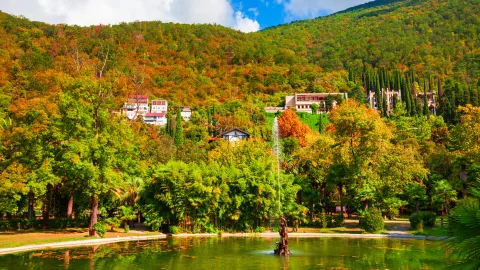
Temperatures at 54–61°F (12–16°C) by day, 39–46°F (4–8°C) overnight. The parks are in full autumn blaze, especially Kislovodsk Park — 966 hectares of yellow, orange, and crimson. The air is crystal clear, and Elbrus is visible in sharp detail from the park's upper viewpoints.
By late October it gets colder, and some of the trails close or turn slippery with fallen leaves. But for treatment purposes, October is one of the best months: the body isn't fighting heat or cold, and procedures are tolerated easily.
- November
A transitional month: 41–50°F (5–10°C), overcast, with possible rain. The leaves have fallen, and the resort quiets down. It's already too cool for extended walks, but still excellent for treatment: sanatoriums are half-empty, staff attention is at its peak, and prices sit among the lowest of the year.
Winter: Quiet, Cheap, and Therapeutic
- December–February
Average temperatures range from 27°F to 36°F (–3 to +2°C), but thanks to its sheltered valley, Kislovodsk often sees 41–46°F (5–8°C) even in January. Snow falls, but it doesn't always stick around for long. The town looks festive on such days, and the trails in the lower park remain accessible for walking.
Winter is the best time for treatment in terms of price and occupancy. Sanatorium packages run 30–40% cheaper than in summer, there are no lines for procedures, and doctors work without being rushed. The mineral water in the pump rooms is the same year-round — Narzan doesn't care about the calendar.
The New Year holidays are the exception: KMV fills up, prices spike, and the calm evaporates. If treatment is your goal, it's better to arrive in the second half of January or in February.
A winter bonus: outdoor thermal pools. Soaking in mineral water at 100–108°F (38–42°C) while the air around you is freezing is an unforgettable sensation. Several such complexes operate in Pyatigorsk, Zheleznovodsk, and around Suvorovskaya.
Treatment or Sightseeing — What Works When
The question of "when to go" comes down to what you're going for.
For sanatorium treatment, the best windows are November, February, March, April, and October. The body is comfortable, procedures are well-tolerated, occupancy is low, and prices are reasonable. A treatment course typically runs 14–21 days — that's the timeframe over which mineral water, mud therapy, and physiotherapy produce a cumulative effect. A week-long trip is more of an introduction than actual treatment.
For active sightseeing, excursions, and health-walk trails — May, June, September, and the first half of October. Warm, dry, the parks at their best, mountain routes open.
For combining both — September and May. Both months offer comfortable weather for hours of walking and a calm enough pace for treatment procedures. If you had to pick just one month, it would be September: golden autumn, gentle sun, empty parks, and sanatoriums running at full capacity without the crowds.
Getting There
Mineralnye Vody Airport (MRV) receives flights from Moscow (~2.5 hours), St. Petersburg (~3 hours), Novosibirsk, Yekaterinburg, and other cities. Tickets from Moscow start at 4,000 rubles one-way with early booking.
A direct train also runs from Moscow to Kislovodsk, taking about 24 hours, with third-class (platzkart) tickets starting at 4,000 rubles. The "Lastochka" express from Mineralnye Vody to Kislovodsk takes 55 minutes, to Pyatigorsk 40 minutes, and to Yessentuki 30 minutes. Local trains and shared vans connect the towns, with taxis running 800–1,200 rubles per trip.
What to Know Before You Go
- Drink mineral water only as directed
Narzan, Yessentuki-4, Yessentuki-17, Slavyanovskaya, Smirnovskaya — each type has its own indications, dosage, and recommended temperature. Drinking mineral water freely and in large volumes isn't healthy — it's a strain on the kidneys.
- The terrenkur isn't just a walk
The routes in Kislovodsk Park are marked by difficulty level (from first to third): length, elevation change, and pace. Start with the first level, especially if you're arriving from a low-altitude city — mountain air at 800–1,000 meters puts a strain on the body that you won't notice until you're out of breath.
- Kislovodsk Park is enormous
At 966 hectares, it's the second-largest urban park in Europe. Its upper section (Gorny Park, or "Mountain Park") offers genuine trekking with elevation gains of up to 500 meters. Walking the whole park is a 3–5 hour undertaking — bring comfortable shoes and a bottle of water.
Allergy sufferers should check the local bloom calendar: in spring, everything blooms at once across KMV, and April–May can be difficult for people with pollen allergies.
The Caucasian Mineral Waters region is one of those rare corners of the country where the climate itself is the treatment. Mountain air, sunshine, Narzan straight from the ground, and parks you'll want to stay in forever. The task is simply to catch the right season — the one where the body gets the most out of the place, instead of spending its energy fighting heat, crowds, or slush.