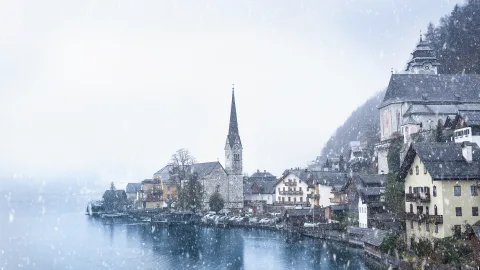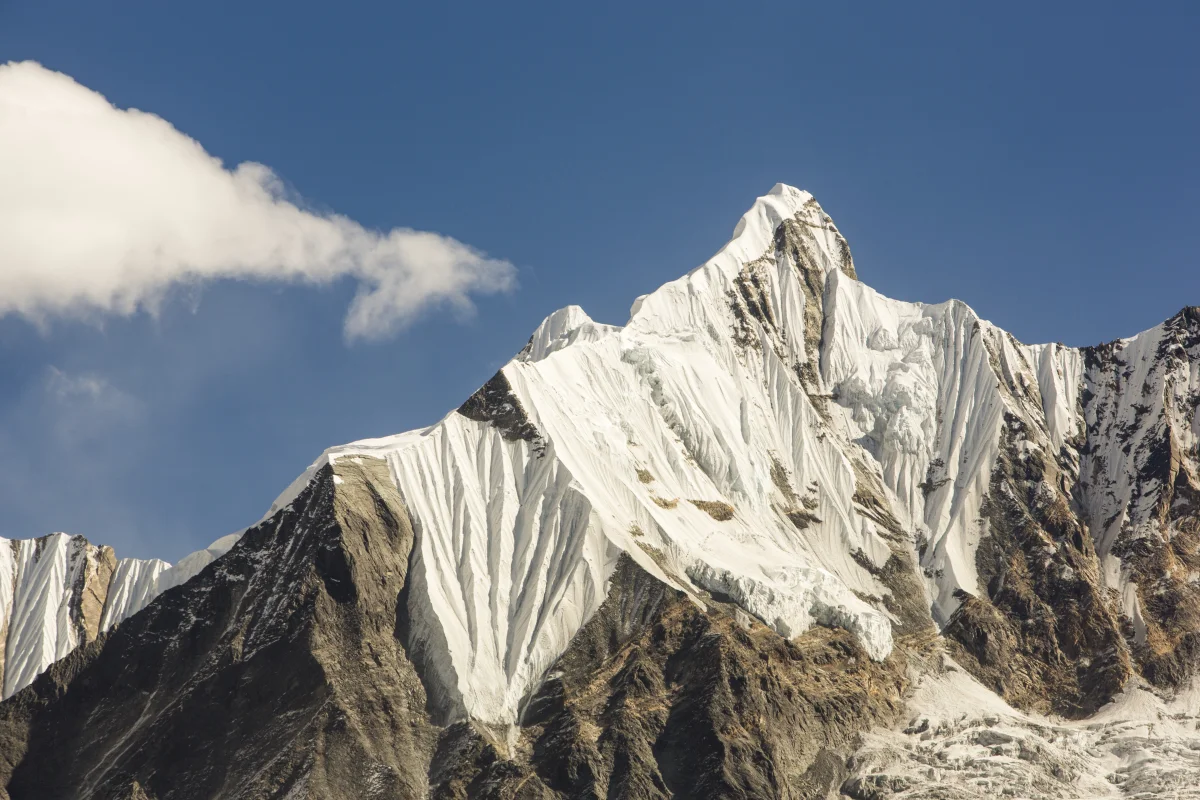
The same trek to Everest Base Camp in October gives you a crystal-clear sky, a panorama of eight-thousanders, and one of the most powerful experiences of your life. That same trek in July gives you clouds, downpours, and not a single mountain on the horizon. You walked the same kilometers, paid the same money, but saw two different countries.
Nepal holds eight of the planet's fourteen eight-thousand-meter peaks, including Everest, Annapurna, Kanchenjunga, Makalu, and Dhaulagiri. Trekking here isn't a sport — it's a pilgrimage: thousands of people walk trails hundreds of years old every year, sleep in mountain lodges, and wake each morning to peaks blanketed in eternal snow. But only if they arrive in the right month.
Two Seasons — and a Chasm Between Them
Nepal's year splits not into four seasons but into two: monsoon and everything else. The southwest monsoon arrives in June and departs in September, bringing up to 80% of annual rainfall. Between its departure and arrival lie two short windows of ideal weather — and hitting them is essential.
- Autumn (October–November)
The main trekking season. The monsoon has left, air is at its clearest of the entire year, and visibility stretches for hundreds of kilometers. Mountains stand fully exposed from early morning until noon, before the afternoon clouds roll in. At 3,000–4,000 meters, daytime temperatures run +5 to +15°C; nights hover around zero or slightly below. Trails are dry, passes are open, lodges are operating.
October is the absolute favorite. Stable weather, maximum air clarity, comfortable temperatures. It's during October mornings that the postcard Himalayan shots get taken — the ones that make people buy plane tickets.
November is a touch colder, days shorter, but the weather remains stable. By the second half of the month, snow can settle on the higher passes (above 5,000 m), and some routes close.
- Spring (March through mid-May)
The second window. Snow on the passes melts, trails open, days grow longer. The main bonus is the blooming of rhododendrons: the slopes of Annapurna and Langtang in March–April turn bright pink, red, and white. A spectacle some travelers specifically plan the spring season around.
But spring has a weakness: haze. As the plains of India heat up, dust and vapor rise into the atmosphere, veiling the horizon in a milky film. By noon, mountains often disappear — visibility is noticeably worse than October's. By May, the haze thickens, valley heat rises, and comfort declines.
Why the Other Months Don't Work
- June–September (Monsoon)
Four months when heading into the mountains is pointless and dangerous. Downpours daily, trails turn to mud, rivers flood, landslides block roads. Leeches aren't a metaphor — they're literal: hundreds of tiny bloodsuckers attach to your legs right through your boots.
But the main problem is visibility, or the lack of it. Clouds completely obscure the mountains, and you walk the trail knowing Annapurna is somewhere nearby without seeing even the nearest ridge. What's the point of going, then?
- December–February (Winter)
Trekking is technically possible, but with serious restrictions. High passes are buried in snow. Thorong La Pass on the Annapurna Circuit (5,416 m) is often closed in winter. Temperatures at 4,000–5,000 meters run –15 to –25°C at night. A significant number of lodges shut down.
Low-altitude routes (under 3,000 m) still operate in winter: Poon Hill, the lower Langtang region, the Annapurna trek without the pass. Daytime is sunny with excellent visibility, but nights are cold, and unheated lodges require a proper sleeping bag.
Why the Month Matters More Than the Route
At first glance, choosing the route seems like the main decision: Everest or Annapurna, the Manaslu circuit or the Langtang valley. But any of these routes in October delivers a stunning experience, while any of them in July is a disappointment.
Compare two scenarios.
The Everest Base Camp trek in October: a clear morning, Everest gleaming on the horizon, transparent air, a dry trail, hot tea on a terrace in Namche Bazaar overlooking Thamserku. Photos worthy of a magazine cover.
The same route in August: clouds in the morning, rain by afternoon, a muddy trail, a river bridge washed out, Everest invisible. You walked the same 130 km, spent the same money, slept in the same lodges — but never saw a single mountain you came here for.
The takeaway is simple: choose the month first, then the route. A mediocre route in a good month beats a perfect route in a bad one.
Which Route Suits Which Season
Not all routes are equally weather-dependent. Some are more resilient; others, more temperamental.
- Annapurna Circuit. Best time: October through early November. Thorong La Pass is open, visibility at its maximum. Spring (April) is good too — rhododendrons on the southern side. In winter, the pass is often snow-closed.
- Everest Base Camp. October–November is the classic. Spring (March–April) is also excellent, but haze reduces the panoramas' clarity. Winter is cold but technically doable.
- Langtang. The mountain route closest to Kathmandu. Good in both autumn and spring. Lower altitude (up to 4,300 m), and one of the few routes that operates in winter.
- Manaslu. Remote, authentic, requiring a permit. Best time: October. Spring access is limited due to snow on the Larkya La pass.
- Poon Hill. Short (4–5 days), low altitude (3,210 m), suitable for beginners. Operates nearly year-round except the monsoon peak. Sunny and quiet in winter, but with cold nights.
What to Know Before You Go
A few practical points that shape your planning as much as the weather does.
A visa can be obtained on arrival in Kathmandu: $30 for 15 days, $50 for 30 days. Russians need no advance application. Most routes require two documents: TIMS (trekker's card) and a conservation area permit. Both can be arranged in Kathmandu within a day — faster still through an agency.
On popular routes, independent trekking is possible — trails are marked, lodges appear every 2–3 hours. But a porter isn't a luxury — it's a sensible choice: they carry your bag while you walk light and enjoy the mountains. Cost: from $20–25 a day.
On routes above 3,500 meters, there's a genuine risk. The rule of "no more than 500 meters of elevation gain per day" isn't a suggestion — it's a life-saving precaution. Symptoms of altitude sickness: headache, nausea, insomnia. If they worsen, descend immediately.
Flying from Moscow to Kathmandu takes at least 8 hours with one layover (Delhi, Doha, Istanbul, Dubai). No direct flights exist.
Which Month to Choose
- Want the best weather and the best views — October. The absolute favorite, no caveats.
- Want the Himalayas in bloom — late March through April. Rhododendrons, greenery, long days. But visibility is worse than autumn's.
- Want a quiet trail — November or March. Fewer trekkers than peak October, weather nearly as good.
- Want a winter trek — January–February, but only low-altitude routes (Poon Hill, lower Langtang). Cold, but not a soul around.
Definitely don't plan a trip for June–September. Monsoon, rain, leeches, zero visibility. The mountains aren't going anywhere — wait for October.
And if you're still unsure — just look at photos of the Himalayas taken in October versus July. One set belongs on magazine covers. The other is a gray wall of clouds. That's enough to understand: in Nepal, the month decides everything.