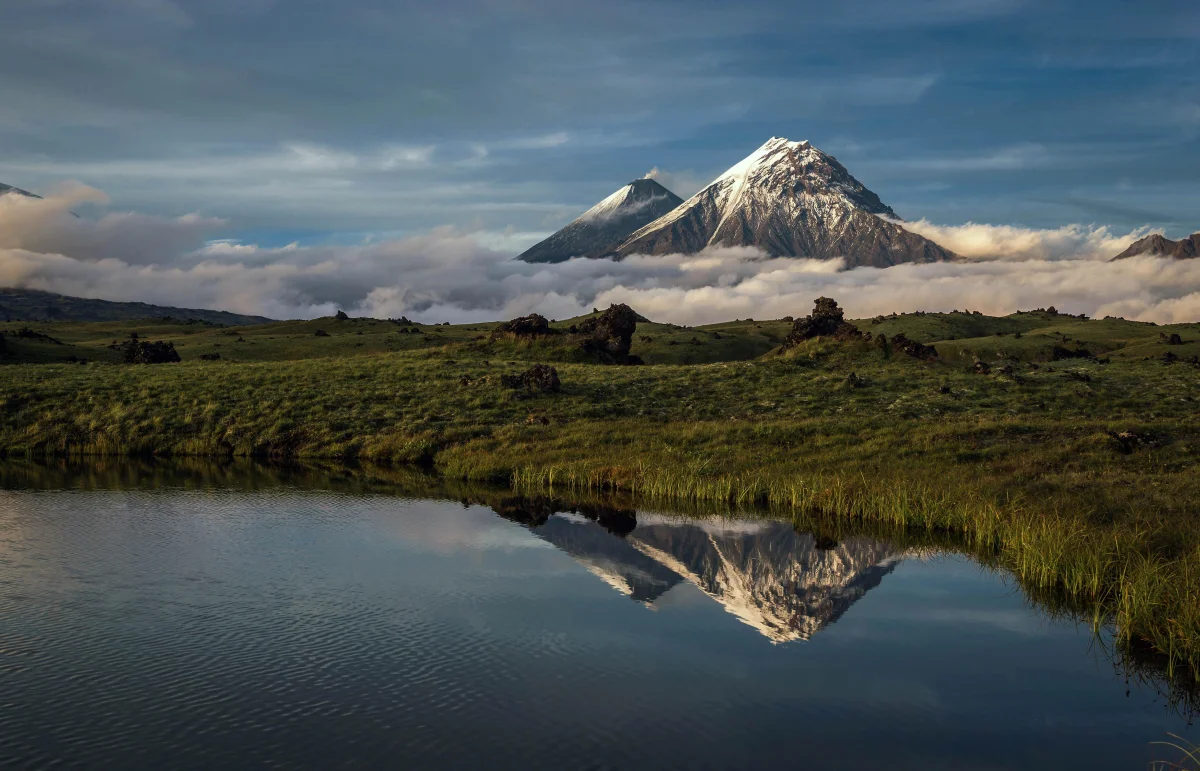
Kamchatka isn't a place people visit for the beach. People fly here for volcanoes, bears, geysers, and the sensation of standing at the edge of the inhabited world. But seeing all of it isn't possible in any given month: winter buries the peninsula up to its rooftops, spring turns it to mud, and the summer window is shorter than it looks.
Nine hours from Moscow, a +9-hour time difference, an average summer temperature of +12°C — Kamchatka doesn't forgive planning mistakes. Arriving in June to find the passes still under snow and the road to a volcano impassable is a standard scenario for those who haven't studied the local calendar.
Arriving in October and getting caught in a prolonged cyclone with 25 m/s winds is another. But those who hit the right window take home experiences no other Russian region can offer. Let's break down that window month by month — and what opens up in each.
Climate: Why Everything Works Differently Here
Kamchatka is a peninsula between the Pacific Ocean and the Sea of Okhotsk. The ocean and sea dictate the weather: moist maritime air brings precipitation, fog, and wind, while the mountain ranges — the Sredinny and Vostochny — create sharp contrasts between the coast and inland valleys.
Winter in Petropavlovsk-Kamchatsky is milder than Moscow's: average January temperature runs –7 to –8°C, but blizzards are fiercer. Snow covers the ground from November through May, with depths reaching 2.5 meters.
Summer is cool and short: average July temperature is +12–13°C, peaking at +18–20°C on rare clear days. In the Kamchatka River valley (the peninsula's interior, sheltered from sea winds), summer runs warmer — up to +25°C.
Precipitation is heavy — up to 1,200 mm a year in the southeast. Fog is frequent, especially in June and July: warm ocean air meets the cold surface, and the coast gets wrapped in haze. Weather shifts several times a day: sun in the morning, fog by noon, wind and rain by evening, clear again by night.
June: The Peninsula Wakes Up, But Not Completely
June in Kamchatka is spring, not summer. Snow still covers the mountains, passes remain closed, and roads to volcanoes are washed out by meltwater. Average temperature in Petropavlovsk runs +10–12°C, around 0°C in the mountains.
But it's exactly in June that the peninsula bursts into vivid green within days. Kamchatka honeysuckle blooms, and fields between snowfields turn emerald. The contrast — white volcano peaks, green valleys, blue sky — looks especially striking in June.
What's available: boat trips around Avacha Bay (one of the world's most beautiful), an ascent of Avachinsky Volcano (2,741 m) — one of Kamchatka's most accessible volcanoes, taking 6–8 hours to climb. The Paratunka and Malki hot springs operate year-round.
What's closed: the Valley of Geysers (helicopter tours depend on weather, often grounded in June), and many dirt roads to volcanoes remain impassable.
Who it suits: those wanting to see Kamchatka without crowds (tourist numbers are minimal in June), and willing to accept cool temperatures and unpredictable weather.
July: Season Opens
July marks the start of high season. Snow clears from the passes, roads dry out, and routes to volcanoes and calderas open. Average temperature runs +13–15°C, reaching +20°C on clear days. Coastal fog remains frequent, but valleys stay sunny.
Major events:
- Salmon spawning begins in July. Rivers fill with pink salmon, chum, sockeye, and chinook. Brown bears appear on the banks, hunting fish — observable from safe viewing platforms. The main spot is Kuril Lake, reachable by helicopter from Petropavlovsk.
- Alpine meadows on volcano slopes are in full bloom. Carpets of rhododendrons, irises, and Kamchatka's diverse wildflowers — a spectacle photographers book tours six months in advance for.
- The route to Mutnovsky Volcano (2,322 m) opens — one of the most striking: a crater with fumaroles, boiling lakes, and sulfur fields. The ascent takes 5–6 hours and requires no mountaineering experience.
A nuance: by July, tourist numbers are already high, and helicopter tour and package prices peak. Book 3–4 months ahead.
August: Peak Season
August is the best month for most travelers. It's the warmest (average +13–15°C, peaking at +22°C), the most weather-stable, and offers the maximum number of open routes.
What opens up:
- Bear salmon fishing is at its peak. Up to 200 bears feed simultaneously at Kuril Lake. August is the ideal month for observation: bears are accustomed to people on the viewing platforms and approach within 20–30 meters.
- The Valley of Geysers — helicopter tours run reliably (August offers the best flying weather). Around 30 geysers and 100 hot springs across 6 km² — one of the largest geyser fields on the planet.
- Berries: honeysuckle finishes, but blueberries, crowberries, lingonberries, and mushrooms ripen. Hiking trails become a natural buffet underfoot.
- Minimal snow remains in the mountains — routes to Tolbachik, Gorely, and Mutnovsky are fully open.
A nuance: August is the rainiest summer month (more precipitation than July). But rains are usually brief — a burst, a rumble, and sunshine again. Pacific cyclones are also possible, bringing storm-force wind to the coast.
September: Gold and Crimson Slopes
September is Kamchatka's most beautiful month, and that's no exaggeration. Mountain vegetation — dwarf pine, birch, tundra shrubs — turns orange, maroon, and scarlet. Volcanoes set against autumn colors look so vivid photos seem photoshopped.
Temperature runs +8–12°C in the first half, dropping to +3–5°C by month's end. Morning frost is common. But skies are more often clear, and air is transparent, with visibility stretching dozens of kilometers.
What to do:
- Fishing — September is considered the best month for river fishing in Kamchatka, coinciding with the late coho salmon run.
- Volcano trekking — routes remain open, but crowds are far smaller than August's. The colors are incomparable.
- Kamchatka's rowan berries ripen — tart-sweet, unlike mainland varieties.
A nuance: weather is volatile. Early in the month it's nearly summer; by the end, nearly winter. Late September can bring mountain snowfall. Build buffer days into your itinerary — if a cyclone closes a pass, you'll need to wait it out.
October–April: Winter Kamchatka
By mid-October, the peninsula slides into winter. Temperature in Petropavlovsk runs –5 to –10°C, with blizzards and short daylight. Most summer routes close until June.
But winter Kamchatka isn't dead time:
- Ski season runs from late February through April. Several bases near Petropavlovsk, freeriding on volcano slopes. Heli-skiing — a descent from a volcano summit after a helicopter drop-off — starts at 180,000 rubles for a group of up to three.
- Snowmobiling — routes through frozen valleys and to volcano bases. The best months are February–March: abundant snow, sunny weather, and lengthening days.
- Hot springs operate year-round. Paratunka (30 minutes from the city), Malki (2.5 hours). The contrast: –15°C outside, +40°C in the pool, snow-covered volcanoes all around.
- Dog sledding — Kamchatka's traditional mode of transport, turned tourist attraction. In March, the Beringia sled dog race takes place — one of the longest in the world.
What It Costs and How to Get There
- Flights
Direct flights from Moscow to Petropavlovsk-Kamchatsky operate via Aeroflot and S7. Flight time: 8.5–9 hours. Round-trip tickets in summer 2026 started at 35,000 rubles with early booking; at peak season (July–August), from 50,000–70,000 rubles. Winter is cheaper, from 25,000 rubles.
The time difference from Moscow is +9 hours. Jet lag is significant — adaptation takes 3–5 days. Spend the first day calmly, without planning any active excursions.
- Tours
Day trips start at 5,000–8,000 rubles (a boat trip around Avacha Bay, ascending Avachinsky Volcano). Multi-day tours with lodging and meals run 18,000–25,000 rubles a day. Helicopter tours (Valley of Geysers, Kuril Lake, Uzon Caldera) start at 55,000 rubles per person — helicopters are the only way to reach most iconic sites.
- Accommodation
In Petropavlovsk, mid-range hotels start at 3,500 rubles a night. During peak season, book 2–3 months ahead — the city is small and rooms are limited.
What to Pack
Kamchatka isn't a suitcase of shorts, even in summer.
- Layered clothing: thermal base + fleece + membrane jacket (wind- and waterproof). Daily temperature can swing from +5 to +20°C and back. Membrane pants if you're planning trekking. A warm hat and gloves are useful even in August at altitude.
- Footwear: hiking boots with high ankle support and non-slip soles. Kamchatka's trails involve rocks, mud, streams, and volcanic ash. Sneakers won't cut it.
- Rain protection: a membrane raincoat or a hooded jacket. Umbrellas are useless in Kamchatka — the wind will turn it inside out within seconds.
- Repellent: July–August brings aggressive mosquitoes and midges. Without repellent, a forest walk turns into a retreat.
- Binoculars: for watching bears, whales, orcas, and birds. Indispensable on the Avacha Bay boat trip.
Kamchatka is a destination worth rebuilding your vacation calendar around. The optimal window runs from mid-July through mid-September, with each month offering something different: July brings blooms and the first bears, August offers the maximum open routes, and September brings colors found nowhere else.
The key is accepting that weather here doesn't follow forecasts, and any day can start sunny and end in a blizzard. That's not a bug. That's Kamchatka.