You've flown to Kyoto for crimson maples, and outside your window: green trees and +26°C. Or the reverse: you've made it to Nikko, but the leaves have already fallen, lying in a brown carpet underfoot. Two weeks' difference — and instead of postcard Japan, you get an ordinary park in the off-season. Momiji doesn't forgive timing mistakes.
The red maple season — momiji — is Japan's second most significant natural event after cherry blossoms. The Japanese treat it with the same seriousness: weather services publish maps and forecasts tracking the "red front's" progression, TV channels report live from parks, and tour operators build itineraries around the peak coloring.
The key difference is direction: while cherry blossoms move south to north, momiji does the opposite — moving north to south and from mountains down into the valleys. This process stretches over three months, from late September through early December. But at any given location, the peak lasts no more than two weeks. Hitting that window is the main challenge.
How It Works: The Physics of a Red Leaf
Maples don't turn red simply because "autumn arrived."
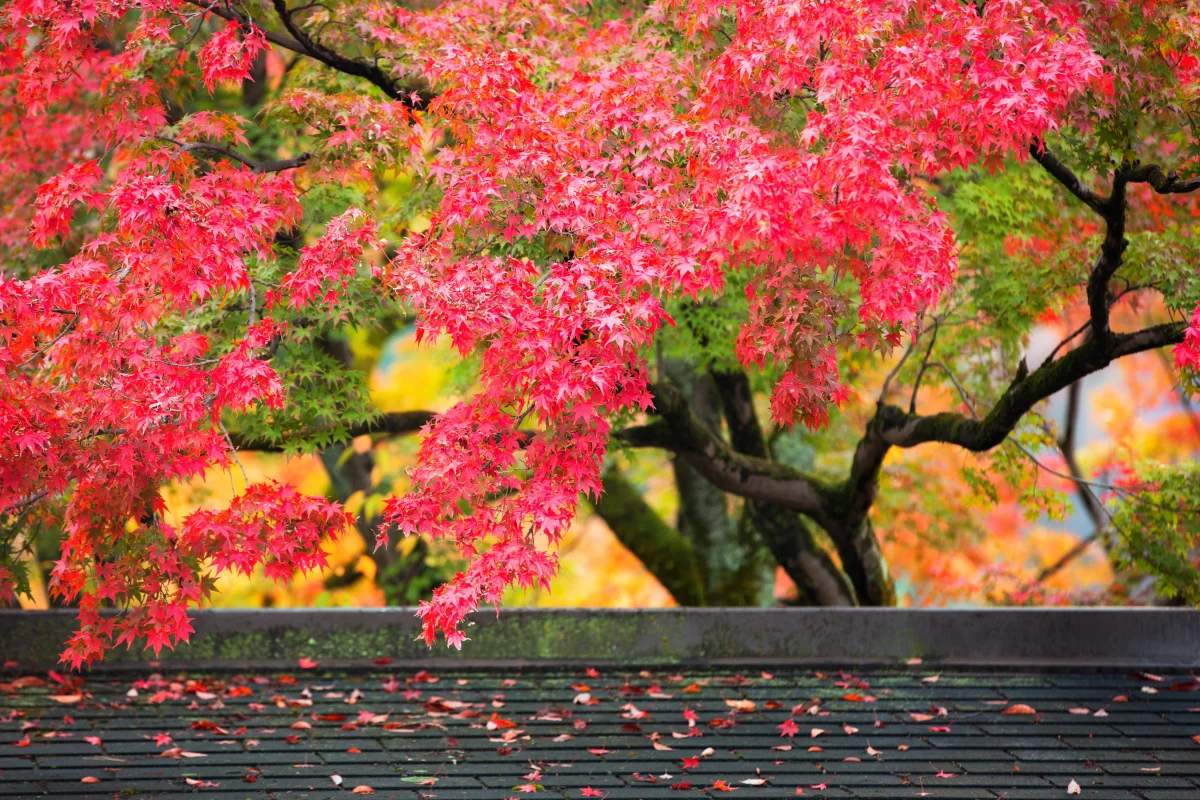
The trigger is falling temperature: once nighttime temperatures consistently drop below +8–10°C, the tree stops producing chlorophyll (the green pigment), and anthocyanins — red and purple pigments present in the leaf all along but masked by green — come to the forefront.
That's exactly why momiji begins in the mountains (where it cools first) and gradually descends toward the coast. And why a warm autumn pushes the peak later, while early cold accelerates it. Timing shifts slightly every year, and a forecast published in September may need correcting by October.
Vibrant foliage requires three conditions: cool nights, warm sunny days, and moderate humidity. If autumn turns rainy and overcast, leaves can turn brown and fall before ever reaching saturated red. Ideal momiji happens when sunlight illuminates the canopy and the air stays transparent and dry.
The Season Map: North to South
Hokkaido (late September–mid-October)
The northernmost island ignites first. Mount Asahidake in the Daisetsuzan range peaks as early as mid-September — Japan's earliest momiji.
By early October, the colors descend into Sounkyo Gorge, to the Jozankei onsen near Sapporo, and to Onuma Park in the island's south. Temperature: +8–15°C during the day, with frost possible at night.
Tohoku and Nikko (mid-October–early November)
The Tohoku region — northern Honshu — takes the baton next. Nikko is one of the most popular momijigari (leaf-viewing) destinations: mountain temples, Kegon Falls, and Lake Chuzenji ringed in crimson maples.
The peak here usually falls around late October, holding through early November. Temperature: +10–18°C, colder in the mountains.
Tokyo and Kanto (mid-November–early December)
The capital region runs late. Peak coloring at Rikugien Garden, Mount Takao, and Shinjuku Gyoen is typically expected November 15–30, occasionally stretching into early December. Temperature: +12–18°C during the day, +5–8°C in the evening.
Kyoto and Kansai (late November–early December)
Kyoto is momiji's main stage. The temples of Tofukuji, Kiyomizu-dera, the Arashiyama bamboo grove, and Kodaiji Temple with its evening illumination all reach peak around November 22–28. Osaka follows a few days later. Temperature: +10–16°C, dry and sunny — ideal conditions.
Kyushu (late November–mid-December)
The southernmost of the main islands catches up last. At the Dazaifu shrines near Fukuoka and the Takachiho Gorge in Miyazaki, peak colors can hold through December 10–15. Temperature: +12–20°C, warm enough to walk without a heavy coat.
Why October Is Most Travelers' Mistake
The most common error is booking tickets for October expecting "Japan's golden autumn." If your itinerary covers Tokyo, Kyoto, and Osaka — the classic route — you'll see green trees with the first hints of yellow in October. Maples haven't started turning red yet, and Tokyo's temperature runs +18–22°C, closer to late summer than autumn.
October only works for mountain routes: Nikko, Hakone, the Japanese Alps, Hokkaido.
If you're willing to build your trip around these locations, October is excellent. But if Kyoto is on the itinerary, it's the second half of November — no exceptions.
Optimal Dates: Where and When
For the classic route — Tokyo, Nikko, Hakone, Kyoto, Nara, Osaka — the most reliable window is November 10–30. Across these three weeks, the coloring front passes through all the key destinations, and moving east to west, you can catch up with momiji as it travels.
More specifically:
- Nikko: peak — October 20–31. Starting your itinerary here in late October lets you catch mountain momiji, then move on to Tokyo, where the peak is still ahead.
- Mount Takao (Tokyo): peak — November 15–30. An hour and a half from downtown, easy trekking, spectacular views.
- Shinjuku Gyoen (Tokyo): peak — November 20–December 5. One of the capital's best parks for momiji — maples, ginkgo, ponds with reflections.
- Kyoto (Arashiyama, Tofukuji, Kodaiji): peak — November 22–December 8. The evening illumination of maples at Kodaiji is its own event: red leaves reflected in the pond's dark water is one of the most photographed images in Japan.
- Nara: peak — November 25–December 10. Deer in the park among red maples — a momiji classic.
Momiji ≠ Sakura: Why Autumn Is More Forgiving
Cherry blossoms bloom for 5–7 days at each location, and missing them is remarkably easy. Momiji lasts longer — the peak at any given spot can hold for 10–14 days, with attractive colors visible both before and after the peak. If leaves have already fallen in one region, you can head south or to lower elevation and catch the colors there.
Autumn in Japan is a comfortable season for walking. Summer's heat and humidity retreat, typhoons usually wrap up by mid-October, and rain is less frequent than spring. Temperature at +10–18°C is ideal for hiking. A backpack instead of an umbrella, a light jacket instead of a raincoat.
Tourist numbers in autumn are lower than sakura season — but not by much. Kyoto in the last week of November is packed: hotels book out 3–4 months ahead, and popular temples have lines. Book accommodation for November no later than August.
Evening Illumination: A Genre of Its Own
Many temples and parks in Japan hold lightup events — evening illumination of autumn foliage. Maples are lit from below, canopies reflect in ponds, and the landscape takes on a completely different character — quiet, almost theatrical.
The most famous lightups happen at Kyoto's Kodaiji, Eikando, and Kitano Tenmangu temples, plus Rikugien Garden in Tokyo. Entry is usually paid (500–1,000 yen, roughly 300–600 rubles), running from 5 p.m. to 9 p.m. Lightups operate only during season — typically mid-November through early December.
Flight, Visa, and Practical Details
Visa
Russians need a visa for Japan, arranged through the Japanese embassy or consulates in Russia. A tourist visa is single-entry, valid for stays of up to 15 or 30 days.
Processing takes 5–7 business days, and the consular fee is free (Japanese visas carry no fee, though intermediaries charge their own commission).
Flights
No direct flights from Russia to Japan exist at time of publication — connections are required. Main routes: via Istanbul (Turkish Airlines), via Beijing or Shanghai (Air China, China Eastern), via Seoul (Korean Air). Moscow to Tokyo takes 12 to 18 hours with a layover. November tickets run 50,000 to 90,000 rubles round-trip, depending on route and dates.
Money
Currency is the Japanese yen (JPY). Japan is a cash-heavy country: many small restaurants, temples, and shops don't accept cards. Russian cards don't work — bring cash (dollars or euros to exchange), or get a UnionPay card, accepted at some ATMs and shops.
Transport
For a multi-city route, a Japan Rail Pass (covering shinkansen bullet trains) is worthwhile. A 7-day pass costs around 50,000 yen (~30,000 rubles). It pays for itself on a route covering at least Tokyo–Kyoto–Osaka.
What to Pack
Autumn Japan calls for layered clothing. Sunny days at +15°C, cooling to +5–8°C by evening. A light down jacket or fleece, a scarf, comfortable shoes for extended walking — the basic kit. An umbrella just in case, though November in Japan is usually dry.
Momiji is one of the most photogenic seasons on the planet.
Maple reflections in ponds, red torii gates amid crimson foliage, deer in Nara against golden trees — it all photographs itself, but the best shots come in the morning (before the crowds) and during evening lightups.
How to Track the Forecast
The Japan Meteorological Agency and private weather companies publish momiji maps with regional peak forecasts, updated every 1–2 weeks from September through December. Check before buying tickets, and again a week before departure. If the forecast shifts, you can adjust your route accordingly.
Useful resources: the Weathernews app (Japanese, but with maps), plus social media livestreams — Japanese bloggers post real-time photos from parks under the hashtag #紅葉 (kōyō).
Momiji isn't a vacation in the usual sense — it's a hunt. With a specific target, a short season, and the need to be in the right place at the right time. But standing by Kodaiji's pond at six in the evening, maples lit from below, the water perfectly still — you understand why the Japanese have pursued this exact hunt for over a thousand years.