Statistically, Zelenogradsk averages about 14 days a year when the water is comfortable for swimming. Two weeks — and not a day more. But those who hit that window get vast beaches of white sand, pine-scented air, and a complete absence of southern swelter.
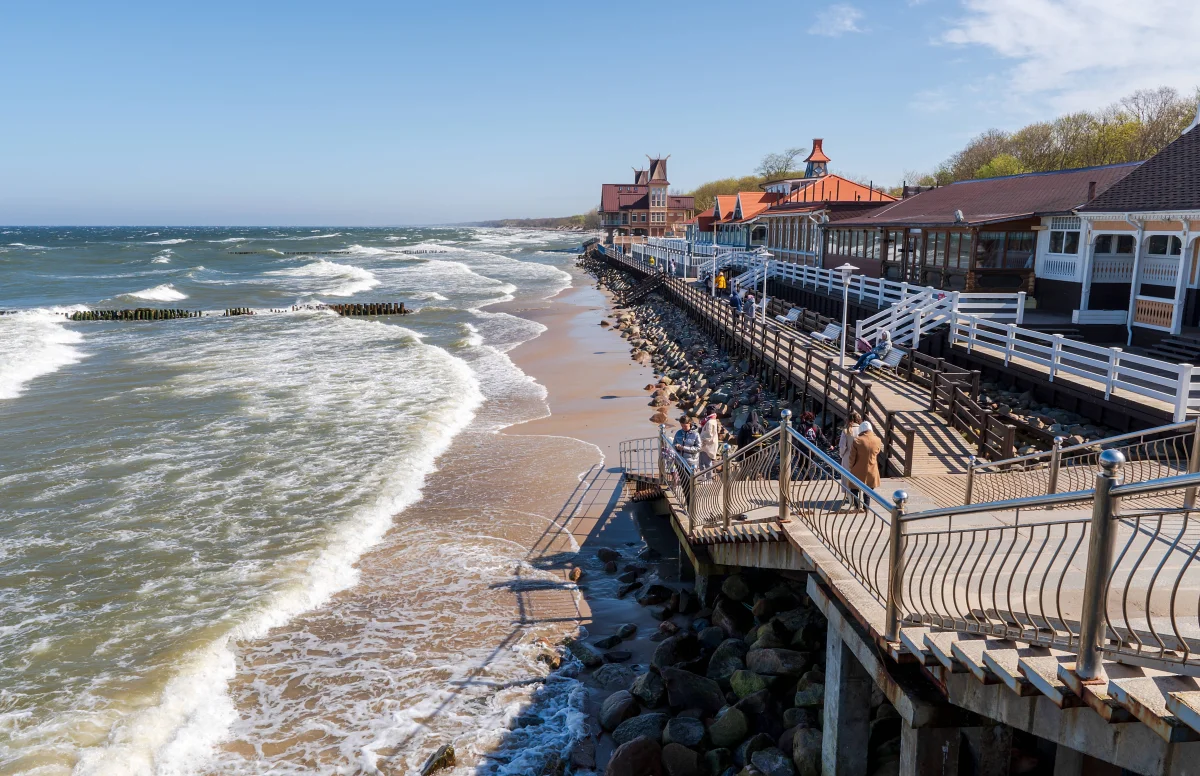
Zelenogradsk — formerly the German resort town of Cranz — sits 30 minutes by commuter train from Kaliningrad. A sandy spit, a seaside promenade, early 20th-century architecture, cats on every sign, and a Baltic Sea that warms up slowly, reluctantly, and unpredictably.
Coming here for guaranteed swimming is a mistake. Coming for the atmosphere, the walks, and a chance at warm water is the right calculation.
When the Water Becomes Comfortable
The Baltic off Zelenogradsk cools to +1–3°C in winter and doesn't begin warming until May — but by month's end barely reaches +10°C. June adds a little: +14–16°C, enough for a knee-deep dash accompanied by shrieking.
The turning point is late July. If the summer has been hot and the wind hasn't been pushing cold water in from the open Baltic, the last week of July brings temperatures up to +19–20°C. That's the threshold where swimming stops being an act of bravery — though it still won't feel like the Black Sea.
August is the best month. Water hits its annual peak: +20–22°C, in lucky years up to +23°C. Air at +25–28°C, occasionally reaching +30°C. August is when Zelenogradsk comes closest to a "real" beach resort — but even now, one westerly wind can cool the water by 5 degrees overnight.
September is pure roulette. The first half sometimes delivers an Indian summer with water at +18–20°C — warmer than June. But by the second half, the sea cools to +14–15°C and the season shuts down.
Why Two Weeks Is an Honest Number
The average annual water temperature in Zelenogradsk is 10.1°C. The summer average is 17.9°C. That means even in the warmest months, the water is cool more often than it's comfortable. Days at +20°C or above are the exception, not the rule.
But averages are misleading. In any given year, everything hinges on two things.
The Baltic is shallow, and wind churns the water in hours. An easterly wind presses warmed water toward shore — and the beach reads +22°C. A westerly pushes cold masses in from the open sea — and by evening it's +15°C. Locals check wind direction before heading to the beach, not air temperature.
Weather variability matters just as much. In hot years — like 2021 or 2024 — the Baltic warms to +22–23°C and holds for a week or two. In cool ones, it may not cross +18°C all summer.
The "Hot Frying Pan" Hack
Near Zelenogradsk, by the village of Malinovka, there are natural sand depressions along the coast — locals call them "frying pans." The sea fills them at high tide, and then the shallow standing water heats up in the sun far faster than the open sea. A "frying pan" can sit at +24–25°C when the sea itself is +17°C.
For families with children, it's a goldmine: warm water at knee depth, shelter from the wind, sandy bottom. Reachable by commuter train from Zelenogradsk.
What to Do When the Sea Is Cold
Zelenogradsk isn't a city where a failed swim means a failed vacation. Cold water is simply a cue for an alternative program that's no less rewarding.
- The Curonian Spit
A national park 20 minutes from town. Dunes rising to 60 meters, the "Dancing Forest" with its eerily contorted pines, the Fringilla ornithological station. One of the most beautiful natural sites in Russia — and it works in any weather.
- The Promenade and the Town
Zelenogradsk is a city of cats: graffiti, sculptures, a museum, a cat café. German architecture, a water tower with an observation deck, a local history museum in a former mansion. Good for two or three days without setting foot in the water.
- Cycling
A bike path runs along the coast from Zelenogradsk to the Curonian Spit — flat, well-maintained, with sea views. Bike rentals start at 300 rubles per hour.
What's New in 2026
This season, Zelenogradsk's beaches charge an eco-fee of 100 rubles per person. Payment is card-only or via Russia's instant payment system — no cash accepted. Showers and restrooms have also switched to QR codes. Without a bank card, an equipped beach can be an uncomfortable experience.
Accommodation prices continue to climb: in 2026, travelers report they're comparable to Turkey. A paradox for a resort with 14 swimmable days, but people come for the atmosphere, not the water.
A useful tip from locals: Polish weather forecasts (ICM, Meteopl) are often more accurate than Russian ones for the Kaliningrad region — especially for wind warnings.
When to Go Depends on Your Priorities
Want a chance at swimming — the last week of July or the first two weeks of August. No guarantees, but the odds are at their highest.
Want atmosphere without crowds — June or September. The sea is cold, but the town is beautiful: long evenings, an uncrowded promenade, cafés without lines.
Want both swimming and tranquility — the second half of August. Families with children start heading home, and the water still holds its summer warmth.
And above all: don't compare Zelenogradsk to Anapa. This is a different genre entirely — not a beach resort, but a seaside town where the sea is part of the scenery, not the sole reason for the trip. And in that genre, 14 days of warm water is a pleasant bonus, not the minimum requirement.