In 2026, jellyfish appeared on the Sea of Azov a month and a half earlier than usual. By mid-June, vacationers in Golubitskaya and Yeysk were already complaining about "jelly" near the shore, and by July, large rhizostomes with purple domes and meter-long oral arms had filled the coastal waters from Rostov Oblast to the Crimean shore.
Jellyfish on the Sea of Azov aren't news — they show up every summer. But in recent years, there are noticeably more of them, they arrive earlier, and they stay longer. The cause isn't a catastrophe — it's a slow shift in the sea itself, making it increasingly hospitable to these creatures.
Where the Jellyfish Come From
The main fact that surprises many people: jellyfish in the Sea of Azov aren't natives. Both species found here migrate in from the Black Sea through the Kerch Strait.
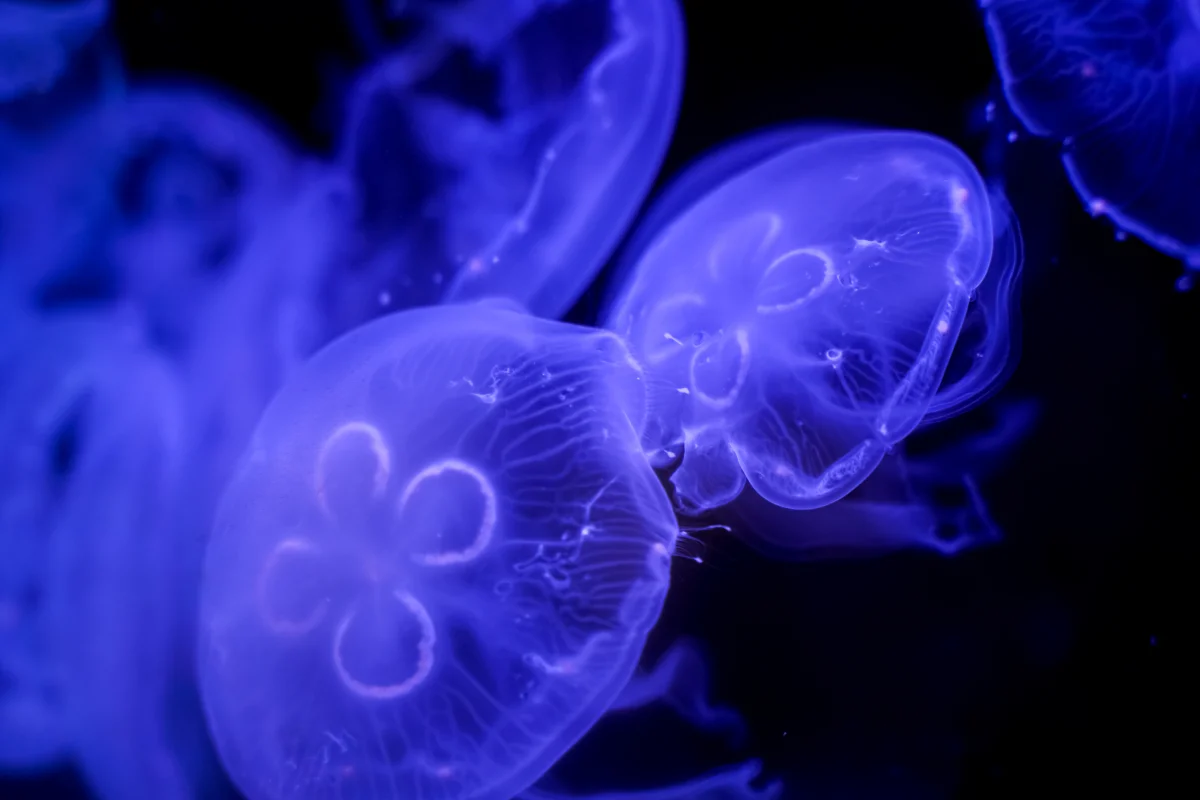
Aurelia (moon jellyfish) — transparent, with four purple rings visible inside the dome, growing to 25–40 centimeters. Nearly harmless: its stinging cells are weak, and a burn can only occur on contact with mucous membranes — eyes, lips. Safe for the skin of the hands and body.
Rhizostome — larger and more serious. Its dome reaches up to 60 centimeters in diameter, weighing up to 10 kilograms. Colored white-blue or white-purple, faintly glowing in the water. Instead of long tentacles, it has branched oral lobes covered in venom-bearing stinging cells.
Touching the outer dome is safe, but contact with the lobes causes a burn comparable to a nettle sting.
Currents and wind push jellyfish from the Black Sea through the strait, and the warm, shallow waters of Azov become an ideal feeding ground: plankton, warmed water, and no large predators.
When They Appear and When There Are Most
In typical years, the first jellyfish are spotted on the Azov coast in early to mid-July, once the water warms to +24–25°C. The peak falls in late July through August, when temperatures reach +26–28°C. By September, as the sea cools, jellyfish gradually leave, and they vanish by October.
In 2026, the timeline shifted. According to biologists, the first rhizostome clusters were recorded as early as mid-June — a month and a half ahead of schedule. The reason: an abnormally warm spring — the water warmed early, and the jellyfish followed the heat.
"The peak in numbers usually falls in late July through early September, when the water is warmest," explains Dmitry Fedorov, a candidate of biological sciences and member of Rosprirodnadzor's public council. But each year, this peak window widens: starting earlier, ending later.
Why There Are More Jellyfish Every Year
Over recent decades, the Sea of Azov has changed — and those changes are working in the jellyfish's favor.
The primary factor is rising salinity. The Sea of Azov was historically one of the freshest seas in the world — around 11‰. Reduced flow from the Don and Kuban rivers (due to water diversion for irrigation) has pushed salinity up to 14–15‰ and rising. For jellyfish accustomed to the Black Sea's 18‰, Azov has become more hospitable: salt water is their natural environment.
The second factor is warming water. The Sea of Azov's average temperature has risen over the past 30 years, and the period when water stays above +24°C has lengthened by several weeks. More heat means longer comfortable conditions for jellyfish.
The third is the decline of anchovy and sprat populations, which compete with jellyfish for plankton. Fewer fish means more food for jellyfish — and more jellyfish.
How Dangerous Is Contact With a Jellyfish?
For most people, a jellyfish encounter is an unpleasant nuisance, not a genuine danger. But the degree of unpleasantness depends on the species.
Aurelia is essentially harmless to the skin — mild tingling, occasionally slight redness. The only danger is contact with mucous membranes: eyes, mouth. Children who grab jellyfish with their hands and then rub their eyes are the main risk group.
Rhizostome produces a noticeable burn: redness, stinging, welts similar to nettles. It clears within a few hours, occasionally taking a day or two. For a healthy adult, it's painful but not dangerous. For those with allergies, it can trigger a serious reaction, including angioedema. Anyone with a known jellyfish venom allergy should carry an antihistamine.
Small children are especially vulnerable — thin skin, a tendency to touch everything, and panic when stung. A rhizostome burn for a three-year-old is genuine stress and a potentially painful reaction.
What to Do If You Get Stung
If a jellyfish stings you, the process is simple.
Don't rub the sting site with your hands and don't rinse with fresh water — that activates the remaining stinging cells and worsens the burn. Rinse with seawater instead — it's neutral to the cells and washes away residual mucus.
If tentacle fragments remain on the skin, remove them with a plastic card, the dull side of a knife, or a stick — never your fingers. Apply a cold compress — ice wrapped in a towel, a frozen bottle. Take an antihistamine if the redness spreads.
"Touching the outer surface of the dome is safe, but if you touch the tentacles, you'll get a burn comparable to a nettle sting," explains dermatologist Ekaterina Guzman.
If you experience a severe allergic reaction — shortness of breath, facial swelling, dizziness — call an ambulance: 103 or 112.
How to Swim Once Jellyfish Have Arrived
Avoiding jellyfish entirely at peak season is impossible. But minimizing contact is doable.
Morning is the best time to swim. At night, jellyfish sink deeper, and daytime breezes and waves push them toward shore. Before 10 a.m., the coastal strip is usually cleaner than in the afternoon.
Watch the wind. Onshore wind pushes jellyfish toward the beach; offshore wind carries them out to sea. If the wind is blowing onshore and "jelly" has accumulated at the water's edge, it's better to wait for the wind to shift or move to another beach.
Protective clothing. A thin lycra rash guard and leggings provide sufficient barrier against stinging cells — especially useful for children.
Don't panic at the sight of a jellyfish in the water. Aurelia is completely safe unless you grab it with your hands. Rhizostome is only dangerous through its tentacles — if you spot one, simply swim around it without touching.
When the Jellyfish Leave
Mass departure begins in September, when the water cools below +22–23°C. By mid-month, numbers drop noticeably; by October, only a handful remain. With the first autumn storms, currents carry the stragglers back to the Black Sea through the Kerch Strait.
For anyone wanting the Sea of Azov without jellyfish, the optimal window is June (in a normal year) or late September. But 2026 proved that "normal years" are a blurry concept: jellyfish arrived in mid-June, and the old benchmarks now need shifting two to three weeks earlier.
The Sea of Azov keeps growing warmer and saltier with each passing decade, and jellyfish are an indicator of that shift. They won't disappear — if anything, they'll become as familiar a part of the scenery as gulls and gobies. The real question is learning to coexist with them.