Every June, the same scenario unfolds in Russian cities: white flakes drift through the air, clog noses, pile up in stairwells, and gather in drifts along curbs. Poplar fluff is a seasonal phenomenon tied to weather just as tightly as ice breakup or the first snowfall. But its start date shifts every year.
In 2026, the fluff hit Moscow as early as late May — several weeks ahead of schedule. The culprit was an abnormally warm spring: poplars accumulated the necessary heat sum earlier than usual and cracked open their seed capsules by mid-June, right when residents typically only just start pulling out window screens.
Meanwhile, fluff season is entirely predictable, once you understand what triggers it and which factors make it short or agonizingly long.
What Poplar Fluff Actually Is
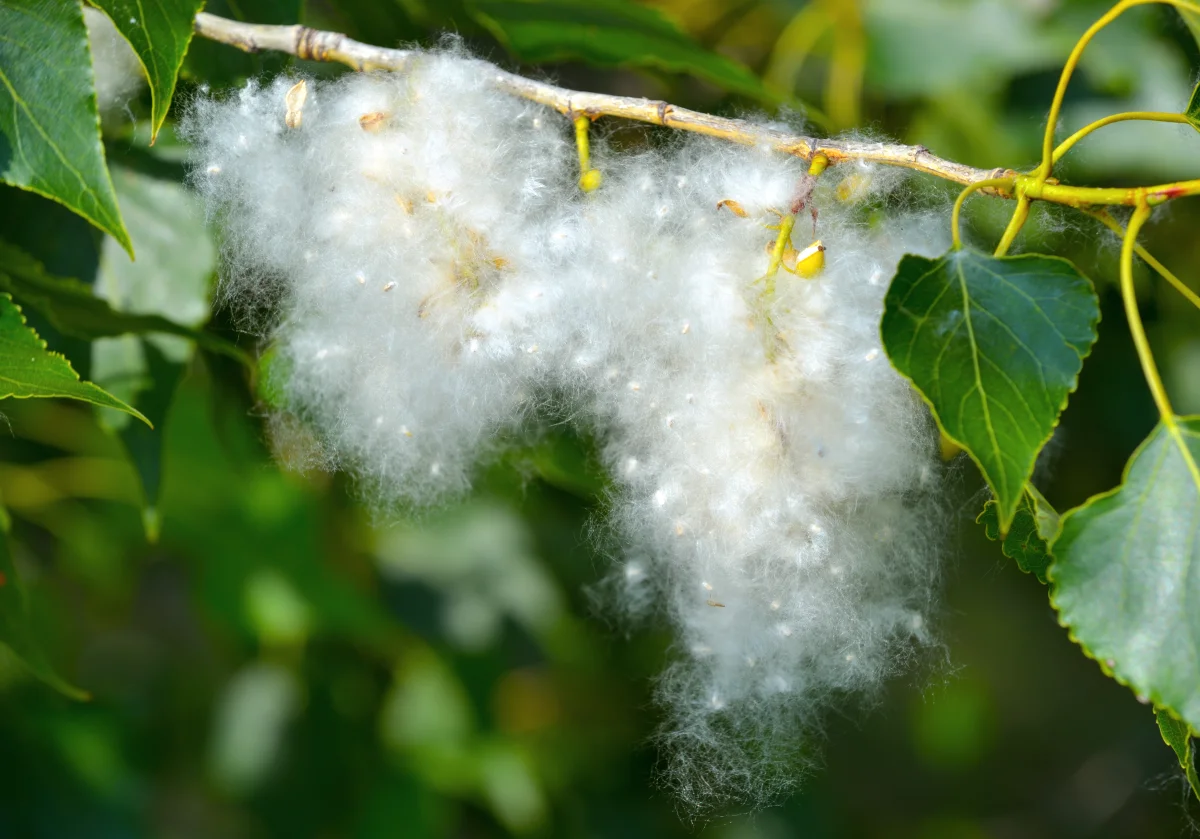
What floats through the air isn't pollen. It's poplar seeds wrapped in the finest cellulose fibers. Each fiber acts as a natural parachute, making the seed nearly weightless: wind catches it and carries it several kilometers from the parent tree.
The poplar is a dioecious plant — male and female flowers grow on separate trees. In early spring, before leaves unfurl, male poplars shed catkins loaded with pollen. Wind carries it to female trees, where seed capsules form, gathered into clusters.
Roughly two months after flowering, the capsules mature and burst open — releasing millions of fluff-borne seeds into flight.
Only female trees produce fluff. A single mature tree can release up to 30 million seeds per season. The older the poplar, the more seeds it produces, and Russian cities are home to poplars planted back in the 1950s–1970s — trees now 50–70 years old or older, sitting at the peak of their "productivity."
Why Cities Have So Many Poplars
The short answer: post-war urban greening. After World War II, the USSR launched a massive program to restore urban green spaces. It needed to plant trees fast, cheap, and at scale across ruined and newly built districts.
The poplar fit perfectly: low-maintenance, no supplemental watering needed, grows faster than most other species — up to 2 meters a year in its first decades. A single mature tree produces up to 30 kg of oxygen per season and efficiently absorbs dust and exhaust fumes. On these metrics, the poplar outperforms birch, maple, and linden alike.
The plan called for planting male specimens, which don't produce fluff. But determining a young poplar's sex from external features is extremely difficult — it's only possible during flowering, and saplings are planted long before that stage arrives. As a result, a significant share of what was planted turned out to be female.
On top of that, it emerged that under aggressive pruning and stress, male poplars can switch sex — female catkins appear on their branches, and a formerly "harmless" poplar begins producing fluff.
When the Season Starts by Region
Timing is tied to the cumulative sum of active temperatures — the amount of heat accumulated since spring began. The farther south the region, and the warmer the spring, the earlier capsules burst open.
- Southern Russia (Krasnodar Krai, Rostov Oblast, the Caucasus) — fluff appears as early as mid-May. Peak: late May–early June.
- Central Russia (Moscow, the Central Black Earth region, the Volga area) — usually mid-June. In 2026, due to the early warm spring, Moscow noticed fluff as early as late May — 2–3 weeks ahead of normal.
- The Urals and Western Siberia (Yekaterinburg, Novosibirsk, Tyumen) — late June, peaking in early July.
- Eastern Siberia (Krasnoyarsk, Irkutsk) — the first half of July.
- St. Petersburg — timing close to central Russia, but due to a cooler climate, the peak more often falls in the second to third week of June.
An individual tree's active fluff-release phase lasts 10–14 days. But since cities host poplars of different species and ages, the overall season stretches to 3–4 weeks: as some trees finish, others are just getting started.
What Determines an Early or Late Season
The primary factor is spring temperature. Poplars "count" heat: capsules burst open once the sum of active temperatures (above +10°C) crosses a certain threshold. A warm April and May mean early fluff. A cold, prolonged spring pushes it to late June or even July.
In 2026, warmth arrived early, and fruit on female poplars matured faster than usual.
Maria Kirienko, a candidate of biological sciences at the Sukachev Institute of Forest, Siberian Branch of the Russian Academy of Sciences, confirmed that poplar flowering timing directly depends on accumulated heat and shifts year to year in step with the weather.
The second factor is the previous summer. If it was warm and humid, poplars set more flower buds, resulting in abundant fluff the following season. A dry or cold summer, conversely, reduces the "yield."
The third factor is tree age. Young poplars (under 20 years) produce little fluff. Peak seed production comes from trees 30–60 years old — which make up the majority of urban plantings.
What Makes a Season Prolonged or Short
Here, weather during the season itself decides everything.
Dry, hot weather keeps fluff airborne longer. Hot updrafts carry it high, and wind scatters it for kilometers. The season stretches: fluff flies for 3–4 weeks, with peak airborne concentration occurring daily between 1 and 5 p.m. — the hottest part of the day.
Rain is a city dweller's best ally. A single good downpour pins fluff to the ground and washes it into storm drains. If 2–3 days of heavy rain occur mid-season, the bulk of fluff clears within 1.5–2 weeks instead of three.
Wind is a double-edged sword. Moderate wind disperses fluff but also helps trees shed their seeds faster. Calm weather, oddly enough, is worse: fluff hangs in the air like a cloud, going nowhere, and settles more slowly.
Fluff Isn't an Allergen — but the Problem Is Real
One of the most persistent myths: "I'm allergic to poplar fluff." In reality, fluff itself isn't an allergen — the cellulose fibers contain no proteins capable of triggering an immune response.
The real issue lies elsewhere. Fluff acts as transport: its fuzzy structure collects and carries pollen from grasses that flower at the same time — timothy grass, orchard grass, fescue, bluegrass. Their pollen is the genuine allergen, causing sneezing, watery eyes, and nasal congestion. The fluff simply delivers it straight to your face.
Additionally, fluff is a mechanical irritant. It gets into the nose, eyes, and airways, triggering reflexive sneezing, itching, and redness — even in people without allergies.
Why EMERCOM Ramps Up Operations During Fluff Season
Dry poplar fluff is an extremely flammable material. Accumulations along curbs and fences ignite from a single spark or a discarded cigarette. Fire spreads along a fluff-covered path at speeds of several meters per second, and flames easily jump to parked cars, wooden fences, and dry grass.
In dry, hot weather, EMERCOM shifts units to heightened readiness. Every year during fluff season, dozens of fires are recorded nationwide, some resulting in serious damage.
Don't set fluff on fire — not for fun, not "to clean it up." That's an administrative offense, and if fire spreads to someone else's property, a criminal one.
How to Get Through the Season
- At home
Window screens are a bare minimum — they trap most of the fluff. Air out rooms early morning or late evening, when dew pins fluff to the ground. Do wet cleaning daily: vacuuming stirs fluff back into the air, while a damp cloth collects it. A humidifier in the bedroom helps settle fine particles.
- Outdoors
Sunglasses (preferably close-fitting) protect the eyes. A medical mask reduces fluff inhalation — especially relevant for those allergic to grasses. After a walk, wash your face and rinse your nose with saline solution, and change clothes.
- While driving
Fluff clogs the radiator and cabin air filter. At the height of the season, check your filter's condition and blow out the radiator — engine overheating from a fluff-clogged radiator in traffic happens every summer.
- In the yard
Never set fluff on fire under any circumstances. If it accumulates, sweep it up or wash it away with a garden hose.
When the Season Ends
Benchmark for central Russia: the bulk of fluff clears by June 20–25 in a normal weather year. Individual flakes may persist into the first ten days of July — these come from late poplar species and shaded trees, whose capsules mature more slowly.
If prolonged rain falls in the second half of June, the season ends 5–7 days earlier. If dry heat sets in, fluff can linger through early July.
For southern regions, everything shifts 2–3 weeks earlier; for the Urals and Siberia, the same amount later. Watch the forecast: once meteorologists predict heavy rain after several dry days, it's most likely the fluff storm's finale.