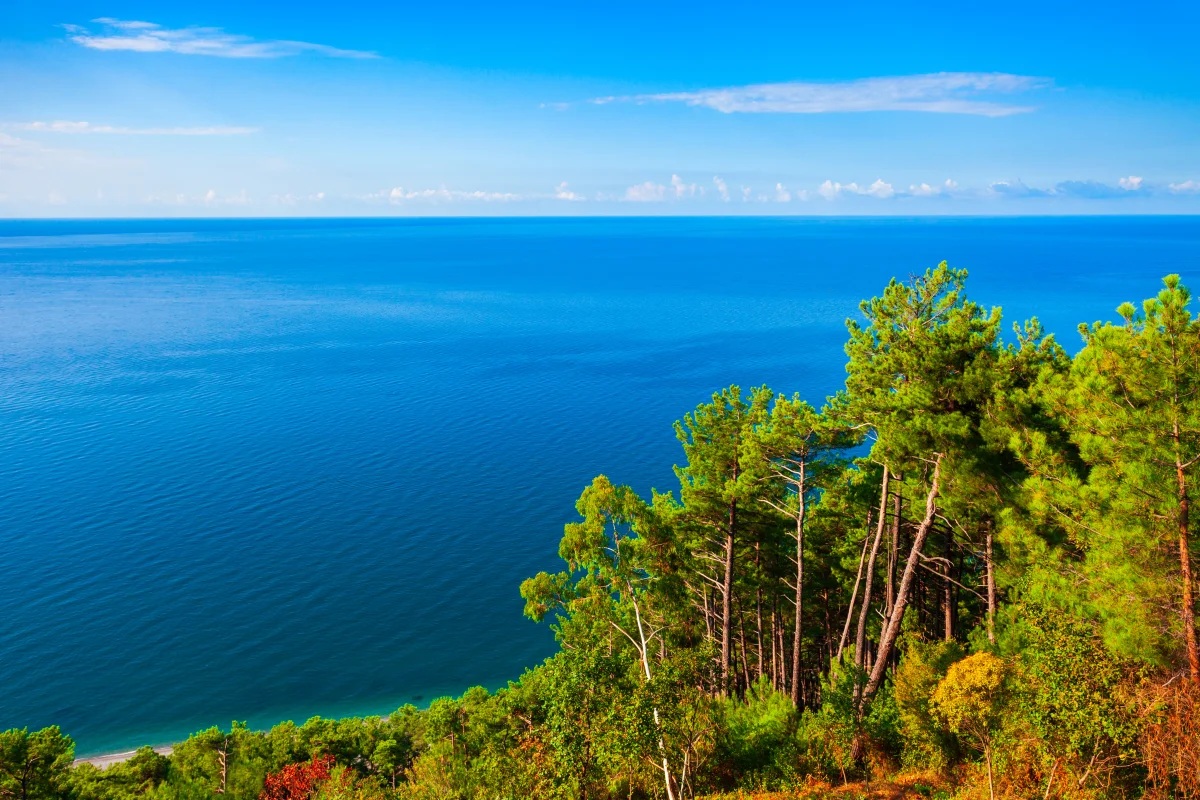
Officially, from the start of June. In practice, hardy tourists wade in as early as mid-May, when the thermometer reads +18°C and the beaches are still empty. But the sea genuinely becomes comfortable for most people only by the third week of June — and then holds its warmth through October.
A familiar scenario: you arrive on the Abkhazian coast in late May, the sun is blazing, the air is +27°C, the sand burns your feet — and your first step into the water sends a shock through your legs. The sea hasn't warmed yet, and the gap between the scorching shore and +16–18°C at the water's edge feels like a bucket of cold water poured over your head.
Two weeks later, the picture changes — but those two weeks separate "too early" from "just right." Let's break down how the Black Sea warms along the Abkhazian coast, which month you can swim without gritting your teeth, and where the water warms first.
Why the Sea Warms Slower Than the Air
Every spring, the same deception repeats: the coastal air already feels like summer, while the water is still winter.
The reason is thermal inertia. Warming a massive body of water takes far longer than warming air and soil. Air responds to heat within hours, the ground within days, water within weeks and months.
The Abkhazian coast has an extra brake. In January–February, the Black Sea's temperature drops to +6–8°C — colder than Crimea's southern coast, because the Caucasus's mountain rivers dump meltwater into the sea, further cooling the coastal strip in spring. Until those rivers quiet down, warming proceeds slowly.
Starting in April, the process accelerates: the sun climbs higher, daylight lengthens, winds weaken. By mid-May, the surface water near shore reaches +17–18°C. By early June, +20–22°C. And the maximum — +26–28°C — arrives in late July and August.
Month by Month: From Cold to Warm
April: Admire, Don't Swim
Daytime air runs +18–20°C, evenings +12–13°C. The sea sits at +12–16°C — swimming is for polar plunge enthusiasts only. On the upside, nature is at its blooming peak: mimosa, magnolia, wisteria, citrus orchards in white and pink.
April is the best month for sightseeing without heat or crowds. Lake Ritsa, the New Athos Cave, Yupshara Canyon — all accessible and nearly empty of people.
May: The First Attempts
The first half of May: air at +20–23°C, sea at +15–17°C. Only a handful dare to swim — the water still burns with cold. But beaches are empty, accommodation is cheap, and you can claim any spot along the coast.
The second half of May: air at +24–28°C, climbing to +30°C by month's end. The sea reaches +18–20°C, occasionally hitting +21–22°C. This is the borderline: some people go in and swim; others test with a foot and retreat. The best swimming window in May is noon to 3 p.m., when the shallows warm the most. Morning water runs 2–3°C colder.
In 2026, by late May, water off Gagra and Pitsunda had already reached +22°C — the official resort season opening was scheduled for June 5.
June: The Season Opens
June is when the sea finally surrenders. In the first week, water sits at +20–22°C — swimmable, but after an extended session, you'll want to warm up in the sun. By mid-June, it's +22–24°C, and this is genuinely full-fledged beach vacationing.
Air runs +25–28°C, with no exhausting heat yet, pleasant sunshine, and even tanning. Rain is minimal — 3–4 days a month, brief afternoon showers followed by sunshine again.
June is the best month for anyone who can't handle heat. The sea is already warm, crowds haven't arrived, and prices run 20–30% below the July–August peak. Beaches at Pitsunda and Novy Afon are spacious, with no need to claim a lounger at dawn.
July: Peak Warmth and Peak Crowds
Air runs +28–32°C, occasionally hitting +35°C. The sea sits at +24–26°C — an ideal temperature for swimming for hours. Humidity runs high — 70–80% — and by noon the heat turns dense and enveloping. The sea breeze, almost always present on the coast, offers relief.
July is peak tourist season. Gagra's beaches are packed, the promenade is crowded every evening, and accommodation and food prices are at their maximum. For anyone seeking quiet, Novy Afon or Ochamchira (farther from the border, fewer people, more modest infrastructure) work better.
August: The Sea Like Warm Milk
Air runs +29–33°C, sea at +26–28°C — the annual peak. The water feels like a warm bath, and you won't want to get out. August is the warmest month for Abkhazia's sea, and it suits children best of all: they can wade in without flinching and splash around without limits.
The flip side is the mugginess. Sukhumi in August can be so humid and hot that walking the city is comfortable only in the morning and after sunset. For sightseeing, August isn't the best time: climbing to Lake Ritsa or hiking the Kodori Gorge trails at +34°C is an ordeal.
Where the Sea Warms First
Abkhazia's coastline stretches 214 km, from Psou to Inguri. The water temperature gap between resorts is small — 1–2°C — but in May and June, when every degree counts, it matters.
Gagra is warmer than the rest. Mountains press right up to the sea, creating a natural trap for warm air. Winds barely reach here, and the sun heats the shallows faster. In late May, water in Gagra typically runs 1–1.5°C warmer than Sukhumi. Its swimming season is the longest of all — from late May through late October, and in warm years, into November.
Sukhumi — thanks to its bay, water here warms slightly better than the open coastline to the north. Sukhumi Bay is shallower than the waters off Pitsunda, and by mid-June, temperature stably reaches +22–23°C.
Pitsunda sits on a cape, exposed to wind. Its sea is the cleanest on the entire coast (thanks to currents and no river runoff), but it warms slightly slower. In May, water can be 1–2°C colder than Gagra's. By July–August, though, the gap evens out.
Novy Afon — closer to Sukhumi in water temperature. A small bay, gentle entry, moderate current — by mid-June it already reaches +22°C.
Why June Beats July
June is the month experienced travelers call the "golden window" of Abkhazia's season. Here's why:
- The sea is already warm — from mid-month, +22–24°C, comfortable for most people.
- The heat hasn't arrived — air at +25–28°C, perfect for walking and sightseeing all day.
- Beaches are half-empty — the main crowds arrive in July, after schools let out and corporate vacations begin. Prices are lower — hotels and private rentals run 20–30% cheaper than July–August.
- Fruit — cherry, strawberry, and the first Abkhazian mulberry season, priced lower at Sukhumi and Gagra markets than at any Russian store.
The only downside: the first week of June can still bring days with +20°C water, when extended swimming feels less than comfortable. But by the second week, that fades.
What to Bring to the Beach Early in the Season
In May and early June, an Abkhazian beach day requires two wardrobes at once. Daytime: swimsuit and flip-flops, but grab a towel the instant you step out of the water — wind on wet skin at +22°C feels cold.
- SPF 50 sunscreen is essential even in May. UV on the coast is intense, and the cool breeze creates a deceptive sense that "I'm not burning." Sunburn in May happens just as easily as in August — people just notice it later.
- Water shoes — Abkhazia's pebble beaches require footwear for entering the water. Gagra and Pitsunda have fine pebbles, but Novy Afon and Sukhumi have stretches of sharp stones.
- A light sweater or windbreaker helps in the evening. After sunset in May–June, temperature drops to +14–17°C, with a chill coming off the sea. By July–August, this won't be necessary.
Quick Cheat Sheet
- Mid-May — you can swim if you're hardy. Water at +17–19°C. Empty beaches, low prices.
- Late May — water at +19–22°C. Most people are already swimming, especially midday.
- First ten days of June — water at +20–22°C. Official season opening.
- Mid-June — water at +22–24°C. Full comfort, extended swimming works.
- July — +24–26°C. Warm, crowded, expensive.
- August — +26–28°C. Maximum warmth, maximum humidity.
If your goal is swimming without discomfort while avoiding crowds and markup, the optimal window is June 10–30. The sea has surrendered — and summer's just getting started.