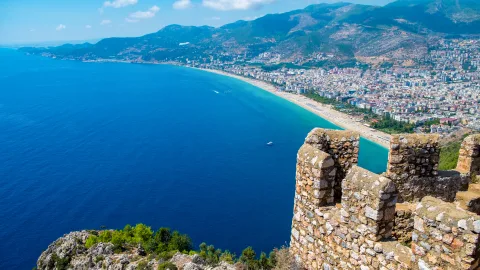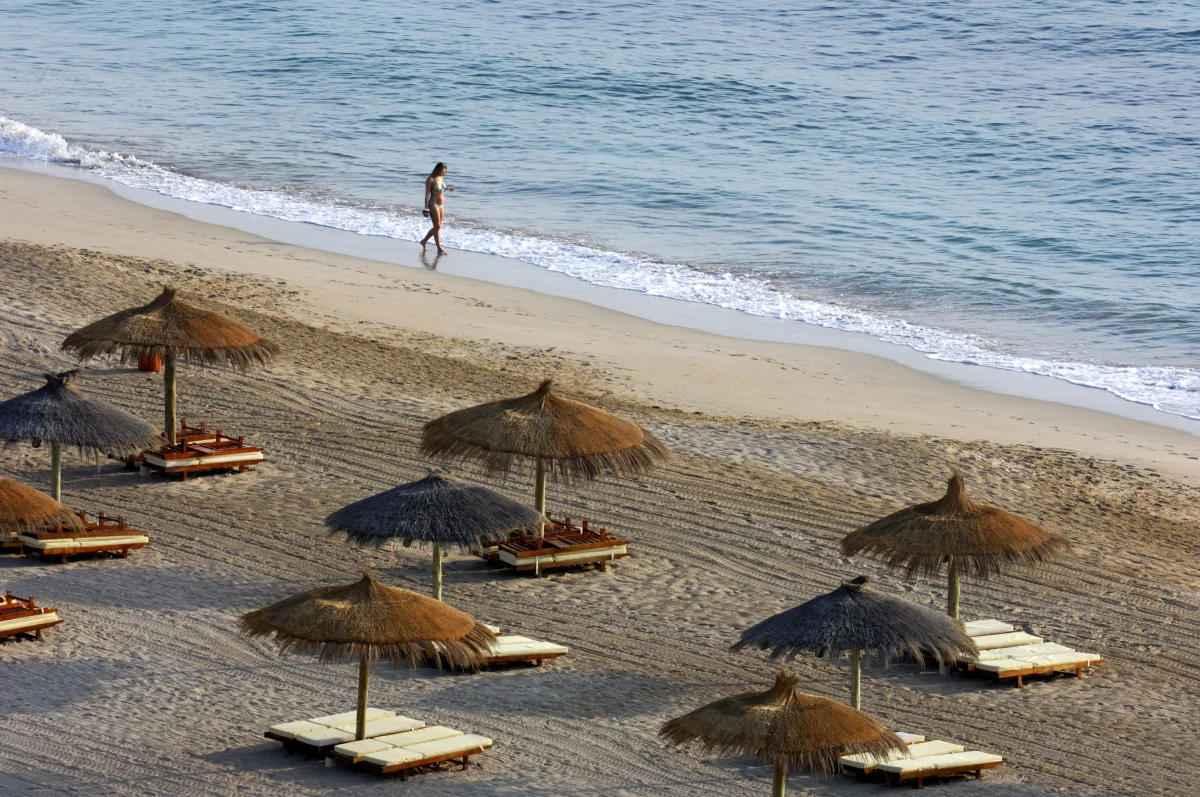
Fujairah is the only emirate that sits not on the Persian Gulf, but on the Gulf of Oman. That's not just a trivia line from a guidebook — it's the reason weather here behaves differently than in Dubai: slightly warmer in winter, slightly cooler in summer, and water that stays clearer year-round.
Tourists choosing between emirates for the first time usually focus on hotel price and distance from the airport. The weather feels like a given — "it's all hot in the UAE anyway." In reality, Fujairah sits on a different sea, at the foot of a different landscape, within a different microclimate.
A few degrees' difference between the gulfs isn't a minor detail — it's what determines whether swimming feels refreshing or like stepping into a heated bath.
Two Gulfs, Two Different Seas
Six of the seven emirates sit on the Persian Gulf — shallow, enclosed, with almost no current. In summer, it warms to 91–95°F (33–35°C) and stops feeling refreshing at all: getting in the water is like stepping into a heated pool. In winter, it cools to 70–72°F (21–22°C).
Fujairah faces the Gulf of Oman — effectively part of the Indian Ocean. Its water is replenished by ocean currents that bring cooler water up from the depths.
In summer, the sea in Fujairah warms to 86–90°F (30–32°C) — hot, but two to three degrees cooler than Dubai's. In winter, it holds at 72–75°F (22–24°C) — the reverse pattern, running warmer than the Persian Gulf.
The paradox is that swimming in Fujairah is more comfortable in winter than in Dubai, and less punishing in summer. The Gulf of Oman smooths out the extremes in both directions.
The Hajar Mountains: A Wall That Reshapes the Climate
The second reason for the weather difference is the Hajar mountain range, which runs along the UAE's eastern coast and separates Fujairah from the other emirates. Peaks rise to 1,500–2,000 meters, acting as a barrier that holds back the scorching desert air and keeps it from reaching the coast.
The result shows up clearly in the numbers. In summer, Dubai hits 104–113°F (40–45°C), while Fujairah runs 97–104°F (36–40°C). A four-to-five-degree gap doesn't sound revolutionary, but at that level of heat, every degree makes a genuinely noticeable difference.
The mountains also intercept some moisture off the Gulf of Oman, which is why Fujairah has more greenery than desert-bound Dubai and Abu Dhabi — its slopes carry sparse shrubs, and streams appear in the wadis (dry riverbeds) after occasional rain.
Weather by Season
The best period runs December–February. Daytime air sits at 75–81°F (24–27°C), nights at 61–66°F (16–19°C), water at 72–75°F (22–24°C). Sunny, dry, comfortable for anything — from a beach day to a mountain hike. A light jacket is needed in the evening: the gap between day and night temperatures reaches 10 degrees, noticeably more than in Dubai, where nights run warmer.
In March–April, air warms to 82–91°F (28–33°C), water to 75–81°F (24–27°C). Still comfortable, but the heat is approaching. March is the last genuinely pleasant month for long hikes through the mountains and wadis. By April, daytime already calls for shade.
May–September is low season. Air runs 97–104°F (36–40°C), water at 84–90°F (29–32°C), humidity up to 85–90%. Thanks to its ocean proximity, Fujairah's humidity actually runs even higher than Dubai's. Morning fog is common in July–August. Swimming remains possible, but comfortable only early morning or after sunset.
The transitional period arrives in October–November: heat gradually retreats, humidity drops. By mid-November, weather returns to "winter" mode. October suits anyone hoping to catch the start of the season at discounted prices: air at 90–93°F (32–34°C), water at 82–86°F (28–30°C), evenings already bearable.
Five Differences From Dubai You Notice Immediately
- Clearer water
The Gulf of Oman is an open body of water with ocean currents that refresh it constantly. The Persian Gulf is enclosed, shallow, with slow water exchange. Underwater visibility in Fujairah runs 10–15 meters in season; in Dubai, it rarely exceeds 3–5 meters.
- Richer marine life
Coral reefs, reef sharks, rays, turtles, moray eels — all present off Fujairah's coast, and practically absent in the Persian Gulf near Dubai. The Shark Island snorkeling spot ranks among the best in the UAE, just half an hour by boat from Al Aqah Beach.
- More noticeable wind
Dubai's dense urban development dampens wind. Fujairah sits exposed to the ocean, and its breeze is a constant presence — a plus in summer (refreshing) and a minus on winter evenings (can feel chilly).
Instead of skyscrapers and artificial islands, the surroundings offer scenic landscapes — mountains fading into haze, pebble coves with gray volcanic sand, and quiet. Fujairah is the antithesis of Dubai's glamour.
- More modest infrastructure
No dozens of malls, no Dubai-level nightlife, a limited choice of restaurants. This is a resort for travelers who prioritize the sea over shopping.
Where to Swim
- Al Aqah is Fujairah's main beach: several kilometers of sand, mountains at your back, Shark Island nearby for snorkeling. Most of the good hotels sit right here.
- Dibba is a town at the emirate's northernmost tip, on the border with Oman. Its beach is quieter than Al Aqah's, and dive boats to the reefs of Musandam Peninsula depart from its bay.
- Khor Fakkan, an exclave of Sharjah wedged into Fujairah's territory, offers an amphitheater-shaped bay with a promenade and a mosque; the water here runs calmer than along the open coast.
Getting There and What to Know
Fujairah essentially has no international airport serving flights from Russia — travelers reach it via Dubai (about 2 hours by car) or Sharjah (about 1.5 hours). The route runs through the Hajar Mountains — scenic switchbacks, but ones that call for extra attention after dark.
Beyond standard beach gear, a snorkel mask is worth packing — buying or renting one locally costs more, and Fujairah's underwater world is worth bringing your own for. On winter evenings, pack a jacket or hoodie: the mountain breeze after sunset cools the air noticeably faster than in Dubai.
And anyone traveling May through September should be prepared for morning fog: it clears by 9–10 a.m., but coastal visibility can run low in the early hours.