The claim that no two snowflakes are alike sounds like a charming bit of folklore. But behind it sits real physics and math, with numbers substantial enough to make your head spin.
Everyone's heard "every snowflake is unique," but few people stop to ask: who actually checked that? Who compared every snowflake on Earth and confirmed that no two pairs ever matched? The answer is: no one. But scientists have solid grounds for believing a match is essentially impossible — and it comes down not to faith, but to exactly how a snowflake grows.
How a Snowflake Is Born
It all starts in a cloud, several kilometers up. A supercooled water droplet (below freezing, but still liquid) encounters a tiny particle — dust, soot, pollen — and freezes around it. This ice seed, just a few microns across, is the starting point for the future snowflake.
Water molecules in the ice crystal arrange themselves into a hexagonal lattice — a property of the H₂O molecule itself and the angles between its hydrogen bonds.
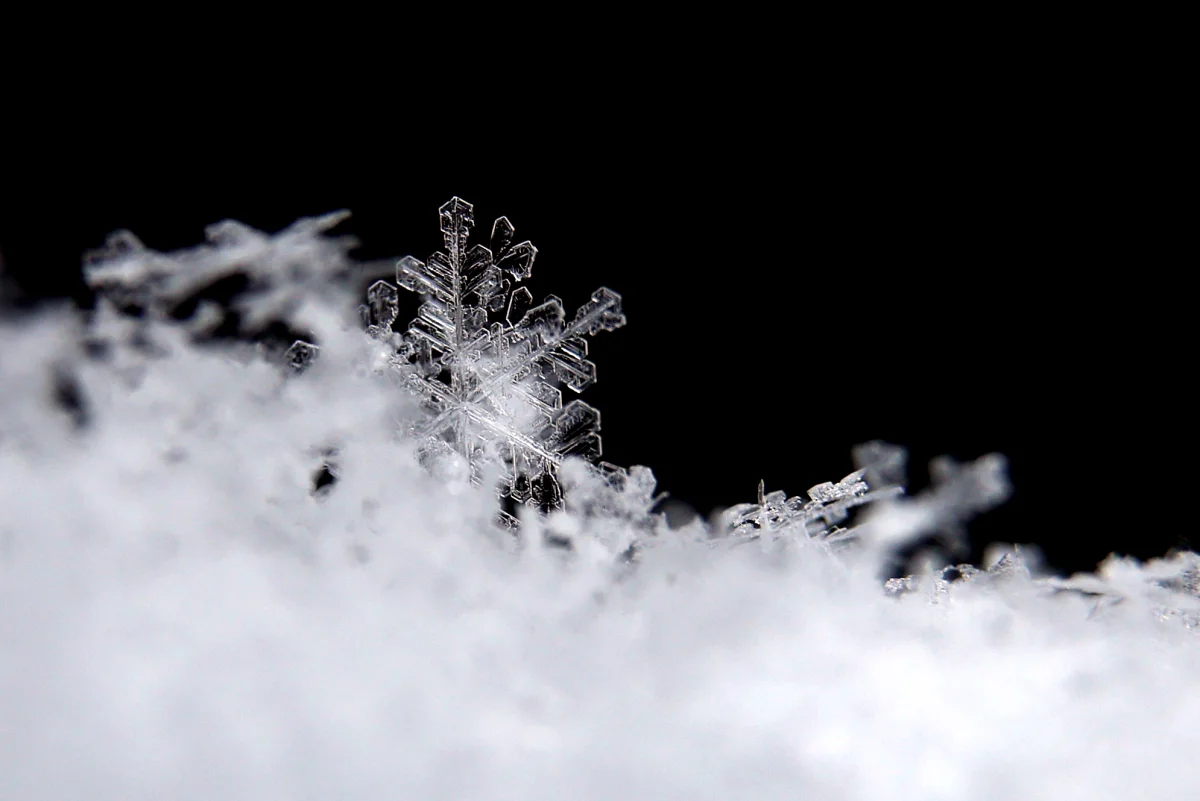
This is exactly where the six-fold symmetry comes from: every classic snowflake has six points or six facets, and that's not chance — it's a direct consequence of geometry at the molecular level.
Why Shape Depends on the Weather
As the seed falls through the cloud, new water molecules attach to it along the way. Exactly where the next molecule lands, and how fast the crystal grows, is determined by two variables: temperature and humidity of the surrounding air.
At around 28°F (–2°C), flat hexagonal plates form. At 23°F (–5°C), long ice needles grow. At 5°F (–15°C), you get the lacy, branching star-shaped dendrites that show up on holiday cards. At –22°F (–30°C), it's back to simple columns and plates.
This relationship between shape and temperature was first systematically mapped by Japanese physicist Ukichiro Nakaya in the 1930s, and his diagram remains the foundation of snowflake classification to this day.
Humidity determines complexity: more moisture means more molecules attaching, producing a more branched, intricate crystal. In dry air, simple shapes form; in humid air, ornate ones.
The Journey Down — and Why Every One Differs
A snowflake falls from cloud to ground over 10–40 minutes, traveling hundreds of meters or even kilometers along the way. During that time, it passes through countless layers of air with different temperatures and humidity levels. Each layer alters its growth pattern for a few seconds — and the crystal "records" that journey into its shape, the way a tree records its years in growth rings.
For two crystals to end up identical, they'd need to follow an absolutely identical path — through the same layers, at the same temperatures, with the same humidity, at the same speed.
But even two snowflakes falling side by side, a centimeter apart, pass through slightly different micro-conditions: one drifting a touch left in the airflow, the other a touch right. A fraction of a degree of difference, and the shape already diverges.
The Math: Why a Match Is Essentially Impossible
A typical snowflake contains roughly 10¹⁸ water molecules — a quintillion, a billion billions. Each of those molecules can theoretically occupy one of several positions within the crystal lattice.
The number of possible combinations is astronomical, exceeding the number of atoms in the observable universe.
Kenneth Libbrecht, a physics professor at Caltech who has spent over twenty years studying snowflakes, puts it this way: the odds of nature randomly producing two absolutely identical complex snowflakes are so vanishingly small that, across the entire history of snowfall on Earth, this has almost certainly never happened.
But Wait — Identical Snowflakes Were Actually Found
And here's where the story takes a turn. In 1988, Nancy Knight, a researcher at the US National Center for Atmospheric Research, was studying snow samples collected by aircraft at about 6,000 meters above Wisconsin. Among thousands of crystals, she found two that looked absolutely identical under a microscope — two thick hexagonal plates with no branching.
The discovery made headlines worldwide, but scientists took it in stride. Simple shapes — plates, columns, needles — genuinely can look indistinguishable under a microscope, since they have too few details to be individually unique. It's a bit like saying "two billiard balls are identical" — technically true, but the comparison you actually want is between patterns, not spheres.
The claim "no two are alike" refers specifically to complex star-shaped snowflakes — dendrites with dozens of branches and hundreds of micro-details. Among those, no match has ever been found.
Why a Snowflake Stays Symmetric — If Conditions Differ Across Its Arms
Here's another puzzle that stumped researchers for a while: how do a single snowflake's six arms "agree" to grow identically, given that they sit at different points in space? The answer is: they don't need to agree at all.
All six arms of a single crystal pass through the exact same air layers, because the snowflake is so small (typically 2–5 millimeters) that the difference in conditions between the tips of its arms is negligible. In effect, all six arms grow in an identical environment — hence the symmetry within one snowflake, and the differences between separate ones.
What This All Adds Up To
Next time a snowflake lands on your sleeve, you're holding a crystal that traced a unique path through the atmosphere — and recorded that journey in its shape. Simple plate-shaped snowflakes can look like twins.
But a complex dendrite with lacy branches is the product of so many variables that no one could replicate it, even on purpose. The claim "no two are alike" isn't folklore or poetic exaggeration — it's a direct consequence of physics and combinatorics, multiplied by the atmosphere's inherent chaos.