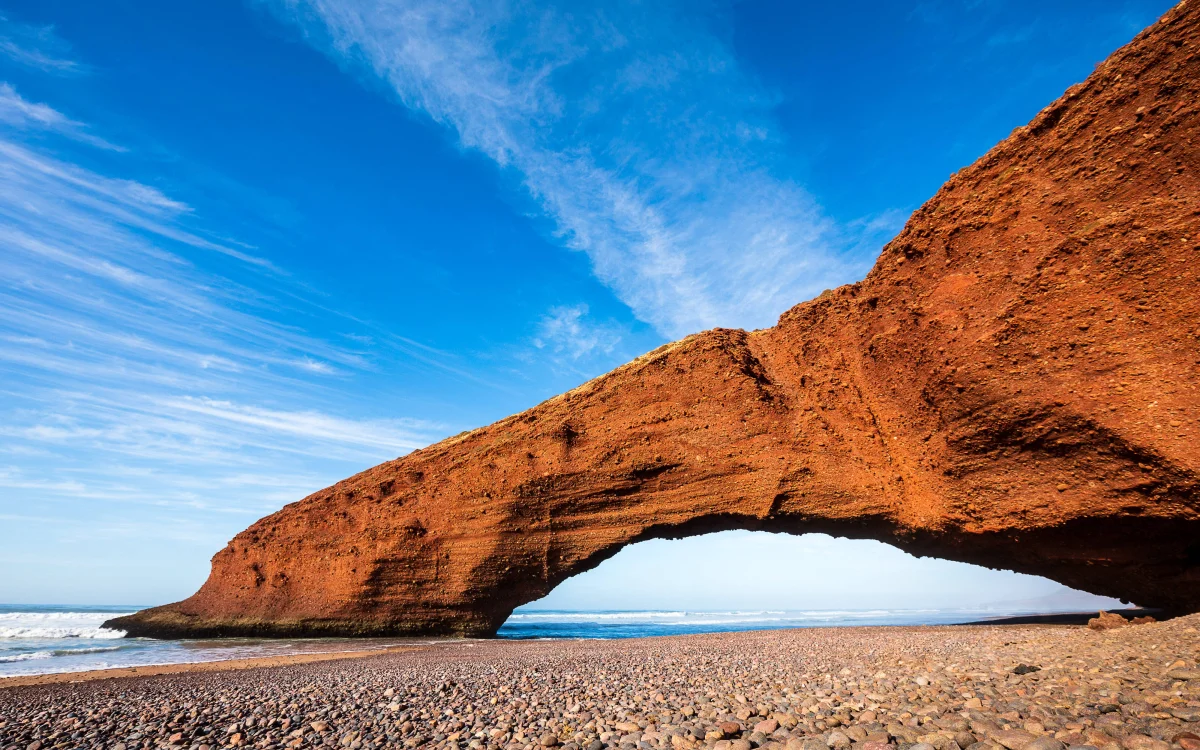
You're standing ankle-deep in the Atlantic, the sun is blazing at +30°C, and the water is bitingly cold — around eighteen degrees, no more. Nearby, surfers are catching two-meter waves and aren't cold at all. Welcome to Morocco — a country where "beach vacation" works entirely differently from what you're used to.
Morocco offers nearly 1,800 kilometers of coastline, two completely different bodies of water (the Atlantic Ocean and the Mediterranean Sea), the Sahara Desert at its back, and the Atlas Mountains through the middle. The climate shifts every hundred kilometers.
On one coast: wind and bracing water. On the other: calm and warm sea. Choose the wrong resort or the wrong month, and instead of swimming, you'll just get a tan. Let's break down when and where to fly so your trip matches your expectations.
Two Coasts, Two Personalities
Morocco is washed by the Atlantic Ocean to the west and the Mediterranean Sea to the north. Between them lies the Strait of Gibraltar, just 14 kilometers wide — but the difference in water temperature and coastal character is enormous.
The Atlantic is the country's main coastline, running from Tangier in the north to the Mauritanian border in the south. The major resorts sit here: Agadir, Essaouira, Casablanca. But the Atlantic off Morocco's shores is colder than you'd expect from Africa.
The reason is the Canary Current, which carries cool water south along the entire western coast. Even at the height of summer, water rarely warms above +21–22°C, and in Essaouira it can hold at +19°C while the air runs +28°C. Add near-constant waves — flat calm on the Atlantic is a rarity.
The Mediterranean forms a narrow strip in the north, from Tangier to the Algerian border. There are fewer resorts here (Tangier, Saidia, Tetouan, Martil), but the water runs noticeably warmer: +24–27°C in summer, with almost no waves. Around 80% of foreign tourists visiting Morocco for the beach choose the Mediterranean coast — and water temperature is the main reason.
When the Season Starts and Ends
The Atlantic coast: beach season runs from late June through early October. In May, the ocean is still +18–19°C — too cold for most. Peak season is August–September, when water finally reaches +21–23°C. Swimming is still possible in October, but by November the ocean cools, waves build, and the season closes.
The Mediterranean coast: the season is wider — early June through late September. Water warms faster: already +21–22°C in June, +26–27°C in August. September is velvet season: air at +27–29°C, sea at +24–25°C, and crowds have thinned out.
In short: Mediterranean swimming season starts a month earlier, and its peak water temperature runs 4–5 degrees warmer than the Atlantic's. For anyone prioritizing a warm sea, the choice is obvious.
Agadir: The Country's Main Beach Resort
Agadir is what most tourists picture when they hear "Morocco and the sea." The city sits in a bay on the Atlantic coast, surrounded by eucalyptus groves, and holds the reputation of the country's sunniest city: roughly 300 clear days a year.
The beach is a wide, 6-kilometer sandy strip with gentle entry. A promenade lined with restaurants, thalassotherapy centers, and hotels of every level — beach infrastructure here is more developed than anywhere else in Morocco. In winter, air holds around +20–22°C, and sunbathing works even in January — though few will want to swim at +16°C.
Summer air runs +27–30°C, ocean at +20–22°C. The heat is easy to bear thanks to the constant ocean breeze, which both cools the air and kicks up waves. For families with small children, that can be a downside — waves on the open Atlantic beach can be substantial.
Best months: August and September — the warmest water and minimum wind.
Essaouira: Wind, Surf, and Cool Water
Essaouira is a fortified city 175 km north of Agadir. Here, you don't sunbathe — you chase wind. Essaouira is called the "City of Wind" (Mogador, in Berber), and that's no exaggeration: a persistent Atlantic breeze blows nearly year-round, strengthening to force 6–7 in summer.
Water sits at +18–20°C even in August: the Canary Current passes especially close to shore here. For a classic beach vacation, Essaouira doesn't work.
But for windsurfing and kitesurfing, it's one of the best spots in the world. Plus, there's atmosphere: a UNESCO-listed medina, a harbor of blue boats, and Berber art galleries. People come here for the experience, not the tan.
Casablanca: A City, Not a Resort
Casablanca is Morocco's largest city, the country's economic center. Beaches exist (the city beach Ain Diab and the Corniche promenade), but they're urban-style: sand alongside concrete, with a road and restaurants nearby. Water runs +19–22°C in summer, with constant waves.
For a dedicated beach vacation, Casablanca isn't the choice. But as an entry point into the country, it's ideal: direct flights from Moscow (Royal Air Maroc, daily, roughly 6 hours) and from St. Petersburg (three times a week). From Casablanca to Agadir is an hour by plane or 4.5 hours by train; to Marrakesh, 2.5 hours by train.
Tangier: Between Two Worlds
Tangier sits at the junction of the Atlantic and the Mediterranean, at the entrance to the Strait of Gibraltar. Spain lies 14 kilometers across the water, and on a clear day, the European coast is visible to the naked eye.
Water here runs warmer than Agadir's but cooler than the pure Mediterranean coast: +22–24°C in August.
Beaches are sandy, long, with gentler waves than the open Atlantic. For a family vacation, Tangier is a reasonable compromise: the sea is warmer, and excursions into the medina are just a walk away.
Best months: July–September.
Saidia: Morocco's Warmest Water
If your main criterion is water temperature, the answer is Saidia. This Mediterranean coast resort, near the Algerian border, was built specifically for tourists and offers what the Atlantic can't: a calm, warm sea.
Water in August runs +26–27°C, with a 14-kilometer golden sand beach and almost no waves. The resort is young: hotels, a golf course, a yacht marina — everything relatively new and well-kept.
The downside is distance: Casablanca to Saidia is about 600 km, requiring a route through Fes or Oujda. There are no direct flights from Russia to Oujda. Infrastructure outside the resort zone is modest.
Best months: July and August — peak water temperature.
Month by Month: What to Expect
- May. On the Atlantic, still too early: water at +18–19°C, windy. On the Mediterranean, already worth trying: +19–20°C. Great time for sightseeing: Marrakesh, Fes, and the Sahara aren't scorching yet.
- June. Atlantic: +19–20°C, swimmable but bracing. Mediterranean: +21–22°C, comfortable. Coastal air runs +25–30°C.
- July. Beach season in full swing. Ocean at +20–21°C, Mediterranean at +24–25°C. Air runs +28–35°C. In Marrakesh and Fes, +38–43°C — excursions inland become an ordeal.
- August. Peak. Atlantic at +21–23°C (annual maximum), Mediterranean at +26–27°C. Coastal temperature: +28–32°C, tolerable. Inland: scorching, up to +45°C in Marrakesh.
- September. Velvet season. Ocean at +21–22°C (still warm), sea at +24–25°C. Air at +26–28°C. Fewer tourists, lower prices. Arguably the best month for combining beach and sightseeing.
- October. Mediterranean season ends: water at +21–22°C, rain possible. Atlantic: +20–21°C, still swimmable, but wind strengthens. Excellent for touring the country.
Visa and Flights: Getting There
Russians don't need a visa for Morocco — visa-free entry for up to 90 days. A passport valid for at least 6 months past your return date suffices. A stamp is issued at the border, and a migration card is filled out (usually distributed on the plane).
Direct flights from Moscow to Casablanca run daily (~6 hours); from St. Petersburg, three times a week. From Casablanca to beach resorts: domestic flights, trains, or buses.
UnionPay cards work in Morocco for withdrawals and payments. Currency: the Moroccan dirham (€1 ≈ 10.5–11 MAD). Exchange money at official currency exchanges or ATMs.
What to Keep in Mind
Waves on the Atlantic are no joke. Even in Agadir's bay, surf can be substantial, and on open coastal stretches it can be serious. Red flags on the beach mean a swimming ban, and ignoring them isn't wise — currents off the Moroccan coast run strong.
Wind in Essaouira and along the northern Atlantic blows nearly constantly. A beach umbrella is more decoration than protection. If you're not a surfer or thrill-seeker, choose enclosed bays or the Mediterranean coast.
Ramadan, the sacred month of Muslim fasting, shifts every year. During the day in this period, many cafés and restaurants close, and the pace of life slows. Tourists are affected only indirectly (hotels operate normally), but it's worth planning your trip around Ramadan's dates.
September is the optimal choice for anyone wanting both beach and sightseeing. The ocean is at peak warmth, city air is no longer scorching, prices drop after the August peak, and the visa-free format lets you stay for up to three months.
Morocco is one of the few destinations where Africa, Europe, and the Atlantic meet at a single point — and experiencing that requires nothing more than a six-hour direct flight.