Patagonia is one of those places you can't visit "whenever it's convenient." A short summer, wind strong enough to knock you off your feet, and mountains that start disappearing under snow as early as April leave travelers a narrow window — and you need to hit it precisely.
Scroll through photos of Torres del Paine or the Perito Moreno Glacier, and you'll want to book a flight immediately. Then you check a climate map and realize: for nine months of the year, this region is either buried in snow or battered by wind strong enough that you can only stand on a trail sideways.
The remaining three or four months are the actual season. Let's break down when it arrives, and why even within it, weather remains a genuine test.
Where It Is, and Why It's So Harsh
Patagonia is the southern tip of South America, split between Argentina and Chile. It stretches roughly from the 40th to the 55th parallel south — in the Northern Hemisphere, those latitudes correspond to Naples and Copenhagen.
Climate-wise, it's closer to Copenhagen: the surrounding ocean is open, and the Andes, despite their height, don't block the westerly winds that sweep unobstructed across the entire Atlantic.
The result is a cold summer, an icy winter, and wind year-round. Average temperature during the warmest month (January) in southern Patagonia is only 50–59°F (10–15°C), while winter (July) sits at 28–41°F (–2 to +5°C). And that's at ground level — in the mountains, it's 5–10 degrees colder.
The Southern Hemisphere: Everything Flipped
The first thing to remember: seasons in Patagonia run opposite to Russia's. Our winter is their summer, our summer is their winter.
- December–February — Patagonian summer.
- March–May — autumn.
- June–August — winter.
- September–November — spring.
Travel season is tied to the southern summer — November through March. The rest of the year, most trails, campgrounds, and transport links either close entirely or operate with restrictions.
November: The Season Opens — With Caveats
November marks Patagonian spring, and it sounds appealing: fewer tourists, lower prices, nature waking up after winter. But in practice, snow still lingers on the mountain passes in November, some trails in Torres del Paine remain closed, and nighttime temperatures drop to 23°F (–5°C). River crossings can be difficult due to meltwater.
For experienced travelers with good gear, November is an excellent choice: empty trails and clear air. For a first trip, it's risky.
December–February: High Season
These are the three months when Patagonia runs at full capacity. Every trekking route is open, campgrounds and refugios (mountain shelters) fill up, and buses and flights connect the towns. Daylight stretches 16–18 hours, which matters enormously for long treks.
Daytime temperatures run 54–68°F (12–20°C) on the plains and in valleys, and 41–50°F (5–10°C) in the mountains. Sounds mild — until you factor in the wind.
Wind is Patagonia's greatest enemy of comfort. Westerly winds blow nearly nonstop here, hitting maximum intensity in December–January: gusts of 37–62 mph are routine, not exceptional. On exposed stretches of trail, the wind can knock you off your feet, tear apart tents, and make photographing from a tripod physically impossible. January and February are the windiest months of the year.
March: The Best Month Few People Know About
Many experienced travelers consider March the best time for Patagonia, and there's good reason for that. Wind eases noticeably compared to January. Temperatures still hold at summer levels.
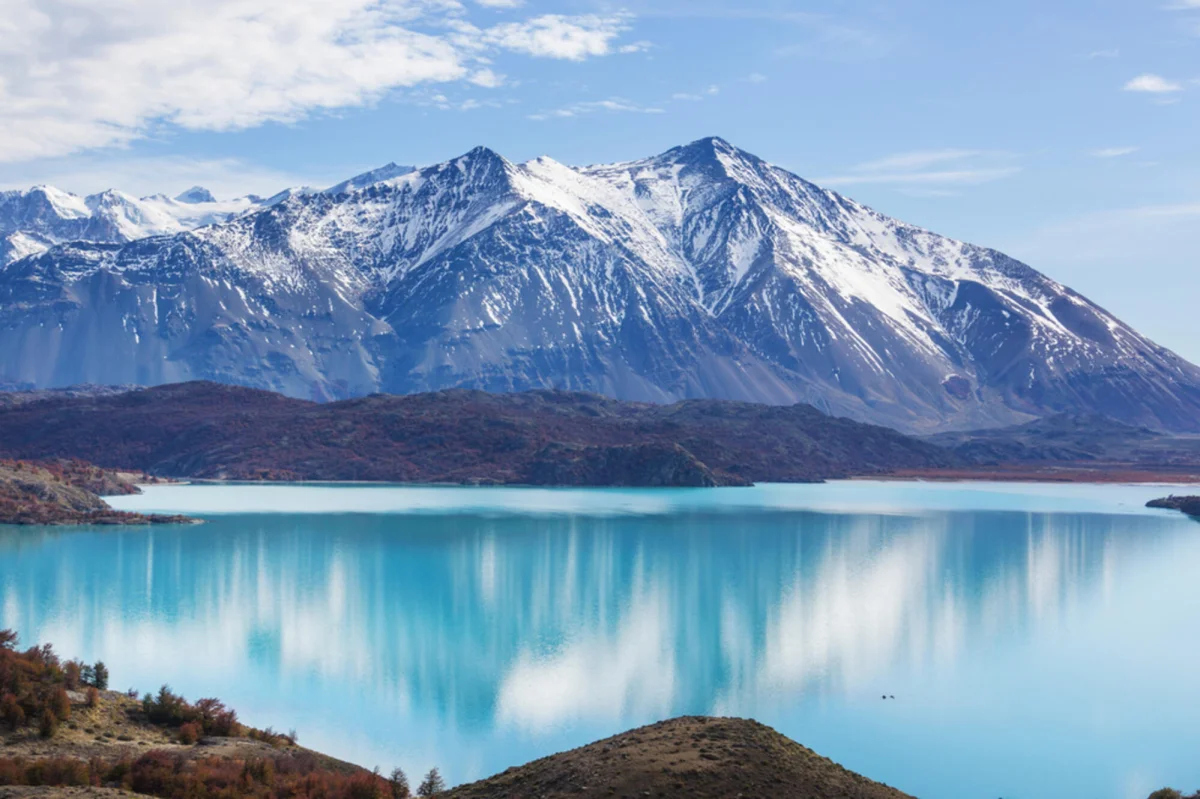
Tourist numbers drop, and the beech forests begin turning autumn colors — red and gold, creating exactly the contrast with turquoise lakes and glaciers that draws photographers here from around the world.
March has one downside: toward the end of the month, weather turns unpredictable and days shorten. Trails stay open, but it's worth building in backup days in case of bad weather.
April: The Season Closes Quickly
In April, Patagonia slides rapidly into winter. Snow returns to the mountain passes, temperatures fall, and campgrounds close. Many trails in Torres del Paine and El Chaltén are officially inaccessible from mid-April through October. Bus service thins out, and flights to smaller airports become less frequent.
The Perito Moreno Glacier is one of the few attractions accessible year-round: a paved road leads to it, and the viewing platforms operate even in winter.
What to Pack: Not a Situation Where You Can Cut Corners
Patagonia is a region where the weather can change several times in a single day. Sun and calm air in the morning, hurricane-force wind by afternoon, rain by evening, frost overnight. A local saying goes, "In Patagonia you can live through four seasons in one day" — and that's not a metaphor.
Clothing needs to be layered: a thermal base layer, fleece, a wind-blocking membrane shell, and waterproof pants. An ordinary city down jacket won't cut it — the wind cuts straight through it. High-ankle trekking boots are essential: trails are rocky, and wet stretches get slippery.
Sunscreen isn't optional — it's a necessity: the ozone layer over southern Patagonia is thinner than over most inhabited places on Earth, and UV radiation here is more aggressive than at the equator. You can get sunburned even on an overcast day.
Key Destinations and When to Go
- Torres del Paine (Chile) — a national park home to the iconic W trek. The full loop (the O trek) takes 8–10 days. Best time: December–March; book campgrounds and refugios several months ahead.
- El Chaltén (Argentina) — Patagonia's trekking capital, the base camp for routes to Mount Fitz Roy. Best time: November–March, with March suited to those wanting quieter trails and autumn color.
- Perito Moreno (Argentina) — a glacier visible in any month, though summer makes it easier to combine with the rest of an itinerary.
- Ushuaia (Argentina) — the southernmost city in the world, gateway to Antarctica. Cruises to the Antarctic Peninsula depart from here November through March.
Why the Window Is So Narrow
Five months — November through March — is the formal season. But strip out risky November and unpredictable late March, and the genuinely comfortable window narrows to three and a half months: early December through mid-March.
Within that window, there isn't a single day where good weather is guaranteed. Patagonia isn't a place people visit for comfort — they visit for scale, and the weather here is part of the experience, not an obstacle to it.