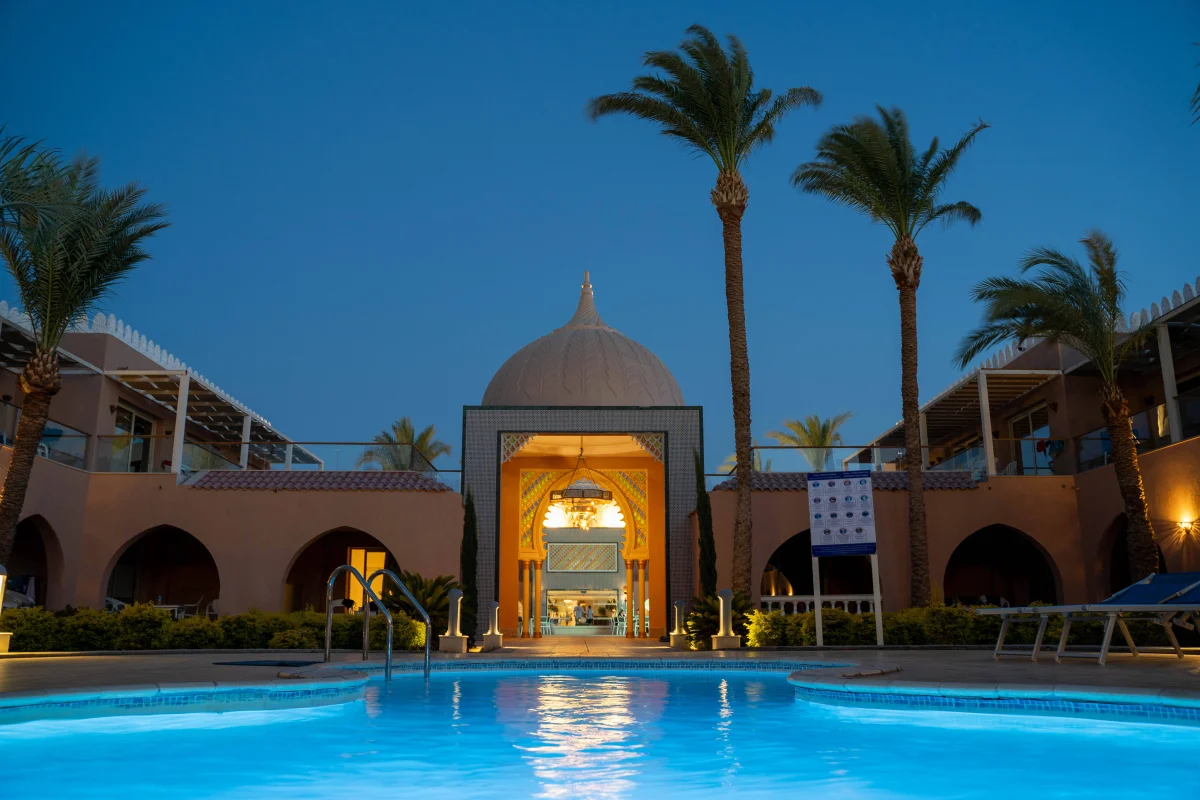
On the very first evening at an Egyptian hotel, a security guard politely but firmly asks you to get out of the pool. It's hot, the water looks inviting, you're in vacation mode — and you're being sent back to your room. Most tourists chalk this up to management being difficult, but there are genuinely concrete reasons behind the ban.
Every season, the same story repeats across chats and reviews: "wasn't allowed to swim after sunset, the guide explained it vaguely, we felt insulted." Some assume the hotel is just cutting corners on lifeguards; others suspect the water gets poisoned with chlorine overnight. The truth, as usual, is both more complicated and more mundane.
The Pool: It's Not About Rules — It's About Chemistry
The evening pool ban isn't one hotel's quirky policy — it's standard practice across Egypt. The reason is technical: once a pool closes for the night, disinfectant gets added to the water — typically concentrated chlorine-based treatments.
Egypt's climate creates ideal conditions for bacteria: air temperatures of 95–113°F (35–45°C), high humidity near the water, and dozens or hundreds of swimmers passing through each day.
Under these conditions, ordinary daytime chlorination isn't enough — pathogen concentration in the pool climbs by evening. So at night, hotels run shock treatment: dumping a dose of chemicals far exceeding daytime levels and leaving it to work until morning.
Swimming in that water is a direct path to skin irritation, burns to mucous membranes, and poisoning if accidentally swallowed. By morning, concentration returns to normal, and the pool is safe again.
The Sea: Living Dangers Invisible in the Dark
The ban on night swimming in the Red Sea is a separate matter, unrelated to chemistry. Here, it's about wildlife.
- Sea urchins
During the day, they stay at depth or hide in coral crevices. Once darkness falls, they migrate into the shallows — sometimes right up to the waterline. Stepping on one in the dark is easy to do: the spines drive deep into tissue, break off inside, and cause severe pain and inflammation. Removing the fragments yourself is nearly impossible.
- Stingrays
At night, they settle onto the sandy bottom near shore and bury themselves under a layer of sand. Stepping on one means taking a venomous barb to the foot. The wound is painful, heals slowly, and in severe cases risks infection.
- Stonefish
The most venomous fish in the world lives in the Red Sea. During the day, it's still possible to spot one — it camouflages itself as a rock on the seabed, but a careful look can pick it out. At night, there's no chance: the fish stays motionless, and its venom, delivered through a puncture, causes agonizing pain, swelling, and requires emergency medical care.
- Moray eels and lionfish
Lionfish are nocturnal hunters, actively feeding around reefs after dark. Their venomous spines cause sharp pain, nausea, and, in rare cases, anaphylactic shock upon accidental contact. Moray eels don't attack first, but if startled, they can bite — and their teeth are sharp and curve inward.
The Third Reason: No Lifeguards
This one is the simplest to understand and the hardest to argue with. After sunset, lifeguard stations on the beaches stop operating. A security guard patrolling hotel grounds physically can't respond quickly to someone drowning in dark water — especially if the pool or beach sits at the far end of the property.
Night swimming means no visibility, a slippery pool edge, alcohol after dinner, and not a single professional nearby. Egyptian hotels don't publish accident statistics, but the sheer fact that this ban exists universally suggests precedents have happened.
Why the Heat Amplifies All These Risks
It might seem unrelated to weather, but the connection is direct.
At daytime temperatures of 104°F and above, pool water warms to 86–91°F (30–33°C) — an environment where bacteria multiply far faster than at 77°F. That's exactly why shock chlorination happens every single evening, rather than once a week, as it might at a pool in a temperate climate.
In the sea, heat plays a role too: warmed shallow water attracts nocturnal creatures that stay at greater depth during the day. The warmer the water near shore, the higher your odds of encountering an urchin or a stingray after dark.
What to Do in the Evening Instead of the Pool
Egyptian hotels compensate for the nighttime ban quite deliberately: show programs, evening entertainment, restaurants, and bars stay open late precisely to keep guests from being tempted into the water. In Sharm el-Sheikh and Hurghada, the promenades and markets come alive after sunset — you can spend an evening there just as enjoyably as in the water.
If evening swimming is non-negotiable for you, it's worth checking at reception exactly what time the pool closes.
Some hotels don't shut the pool the moment the sun sets — they close it later, at 8 or 9 p.m., and swimming until then is both permitted and safe, since the chemicals haven't been added yet.
Is It Worth Breaking the Rule
Tourists break it regularly — climbing over the pool fence, wading into the sea "just up to the knees." There's technically no fine for this, but the person swimming bears the consequences themselves. A stonefish puncture to the foot isn't just a ruined evening — it's a trip to the hospital and possibly the end of your vacation. Chlorine burns to the eyes aren't exactly the souvenir you want to bring home either.
The ban wasn't invented to ruin your evening — it exists so that the next morning, you can step back into clean water, safely, in both the pool and the sea.