The UAE has seven emirates, but most Russian tourists only ever see one — Dubai. Meanwhile, the beaches here differ far more than you'd expect: from city strips of sand beneath skyscrapers to wild bays framed by mountains on the horizon.
The typical decision-making process looks like this: "going to the Emirates" simply means "going to Dubai." From there: Palm Jumeirah, the Burj Khalifa, a mall, a rooftop pool. The beach ends up as background scenery rather than the actual goal.
If the sea, sand, and swimming are genuinely the point, it's worth zooming out on the map. Let's break down how the emirates differ for beach travel, and which one fits your particular priorities.
Two Seas — The First Thing You Need to Know
The UAE is washed by two distinct bodies of water. Six emirates (Dubai, Abu Dhabi, Sharjah, Ajman, Umm Al Quwain, Ras Al Khaimah) face the Persian Gulf — warm, shallow, with a sandy bottom and calm water. The seventh, Fujairah, sits on the Gulf of Oman, which is effectively part of the Indian Ocean: cooler water, clearer, with a richer underwater world.
Water temperature in the Persian Gulf during season (November–April) runs 72–79°F (22–26°C), climbing to 93°F (34°C) in summer. The Gulf of Oman runs 2–3 degrees cooler year-round, with noticeably better underwater visibility.
Choosing between the two gulfs is the first decision — and everything else follows from it.
Dubai: The Best Infrastructure, But the Beach Isn't the Point
Dubai is a city built around commerce and entertainment, with the beach serving as a pleasant addition rather than the core experience. The best beach spots are Palm Jumeirah (private beaches at hotels, calm water within the "crescent"), JBR (a public beach lined with skyscrapers, lively, full of cafés and shops), and Bluewaters Island.
The advantages are obvious: everything's close by, the airport transfer takes half an hour, and the hotel selection is enormous. The downside for a beach-focused trip: most city hotels don't sit directly on the shore — they're across the road or further, requiring a shuttle to reach the beach.
Water within city limits runs less clear than further out. And critically, Dubai is loud: if quiet and sea are the priority, this isn't the destination.
Abu Dhabi: Saadiyat Island Has the Country's Best Sand
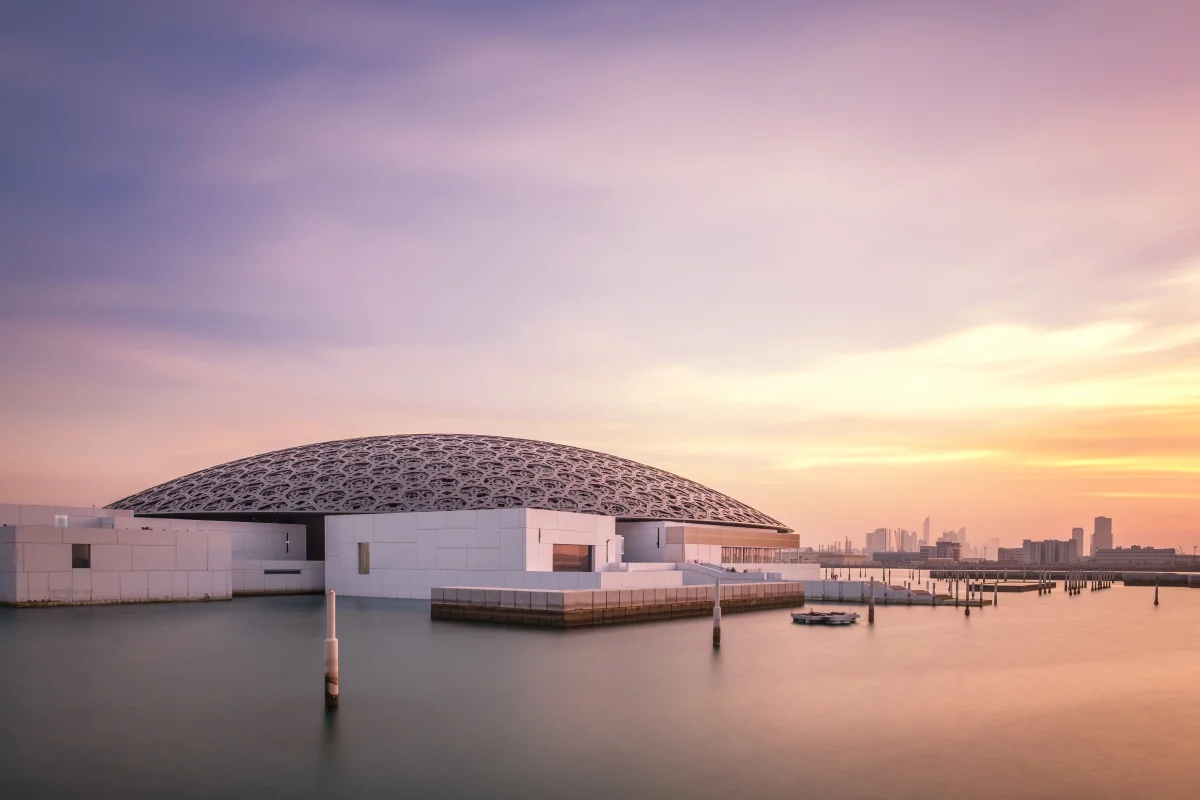
The UAE capital shows up less often in beach-focused roundups, and that's a shame. Saadiyat Island offers several kilometers of white sand with turquoise water, no skyscrapers on the horizon. The beach by the Louvre Abu Dhabi museum ranks among the most photogenic in the region.
Saadiyat is a protected nature zone: hawksbill turtles nest here, and development is restricted. There are fewer hotels than in Dubai, but each comes with its own private beach and the feel of a secluded resort rather than a metropolis. The drive from Abu Dhabi Airport takes about 30 minutes.
A second option is Yas Island, where beach time combines with theme parks (Ferrari World, Yas Waterworld) — a convenient pairing for families with kids.
Ras Al Khaimah: Mountains, Dunes, and All-Inclusive
The northernmost emirate — and arguably the most underrated for beach travel. Ras Al Khaimah offers a long coastline, reddish sand, the Hajar Mountains on the horizon, and desert with towering dunes at your back.
The key distinction from Dubai: this emirate has the largest concentration of all-inclusive hotels — a rarity in the UAE, where breakfast-only is the norm. Al Marjan Island, an artificial island, serves as the main resort district: several kilometers of beach, calm water, newly built resorts. From Dubai Airport, it's about 1.5 hours; from Ras Al Khaimah itself, 20 minutes.
A bonus: from Ras Al Khaimah, it's easy to visit the Jebel Jais zipline — the world's longest, stretched across a mountain gorge at 1,680 meters.
Fujairah: A Different Sea, a Different Rhythm
Fujairah is the only emirate on the eastern coast, and that makes it a fundamentally different story. Instead of the Persian Gulf, there's the Gulf of Oman: cooler, cleaner water, with a rocky bottom and coral reefs. Instead of flat desert behind the shore, there are the Hajar Mountains.
The best beach is Al Aqah: a long sandy stretch backed by rising cliffs. Nearby sits Shark Island, reachable by kayak — one of the best snorkeling spots in the UAE, home to reef fish, rays, and small sharks.
Fujairah suits travelers who prioritize the underwater world and mountain scenery over restaurants and nightlife. Infrastructure is more modest than Dubai's, but the quiet and nature are genuine. The transfer from Dubai Airport takes about 2 hours.
Sharjah: Budget-Friendly and Right Next to Dubai
Sharjah borders Dubai and has effectively merged with it — coastal hotels here sit just 20–30 minutes from Dubai's malls and beaches. Meanwhile, accommodation prices run noticeably lower.
The beaches — Al Corniche and Al Khan — are wide, well-maintained, with a gentle entry. A good option for families with kids: no nightclubs, but there's an aquarium, a science museum, and a peaceful waterfront.
An important detail: Sharjah is the only fully "dry" emirate — alcohol is banned everywhere, including hotels and restaurants. For some travelers, that's a plus; for others, a significant limitation.
Ajman: Minimal Tourists, Maximum Beach
The smallest emirate — just 259 square kilometers — sits wedged between Sharjah and Umm Al Quwain. Ajman offers a long sandy beach, a handful of good hotels, and almost no crowds. It draws travelers who want a beach without a packed excursion schedule, at prices below Dubai's.
Alcohol is permitted in Ajman (unlike neighboring Sharjah), and Dubai is about 40 minutes away by car. For a budget beach trip with the option of a day trip into Dubai, this is one of the best choices.
Which Season Suits Which Emirate
Beach season runs the same across all the emirates — October through April. In summer, the Persian Gulf turns into a hot bath (91–93°F), and air temperatures hit 113°F. Fujairah runs slightly cooler thanks to the Gulf of Oman and mountain breezes, but even there, summer is brutal.
Within the season, some nuances apply: November and March–April offer the best weather-to-price ratio. December–January mark peak prices and occupancy, especially in Dubai and Abu Dhabi. February is the sweet spot: warm, dry, with the New Year's rush already behind.
How to Choose: A Quick Cheat Sheet
Want it all at once — Dubai: city, beach, shopping, restaurants. The best sand and quiet — Abu Dhabi's Saadiyat Island. All-inclusive with mountains and dunes — Ras Al Khaimah. Snorkeling and underwater life — Fujairah.
Budget-friendly and close to Dubai — Sharjah (no alcohol) or Ajman (alcohol permitted). All the emirates sit within two hours of each other, so it's entirely possible to combine two destinations in one trip — a quiet emirate as your beach base, with a couple of days in Dubai for contrast.