If you are still racking your brains over how to make a flower bed with your own hands, and out of improvised materials at that, here are the main tips for designing a flower garden at the dacha. And even those gardeners and growers who believe that beds should be used rationally and planted exclusively with fruit and vegetable crops would do well to set up a flower garden.
Experienced flower growers assure that appetite comes with eating. Once you have made one flower bed, you will want to decorate the plot more and more – to your own delight and your neighbors’ envy. And then you will teach your friends, too, how to make a flower bed at the dacha.
What you can make a flower bed from: materials for design
How do you make a beautiful flower bed with your own hands? Amateur gardeners and designers assure that it is as easy as can be, and you can even make very beautiful flower beds decorated with improvised materials. Tires, stones, bricks, and wood are all suitable for this. Use plates, roof tiles, bottles – anything that comes to hand; it all depends only on your gardener’s imagination. Even if the first flower bed turns out to be a flop, you will already know your mistakes and understand from what and how you can make beautiful flower beds.
Flower beds from tires
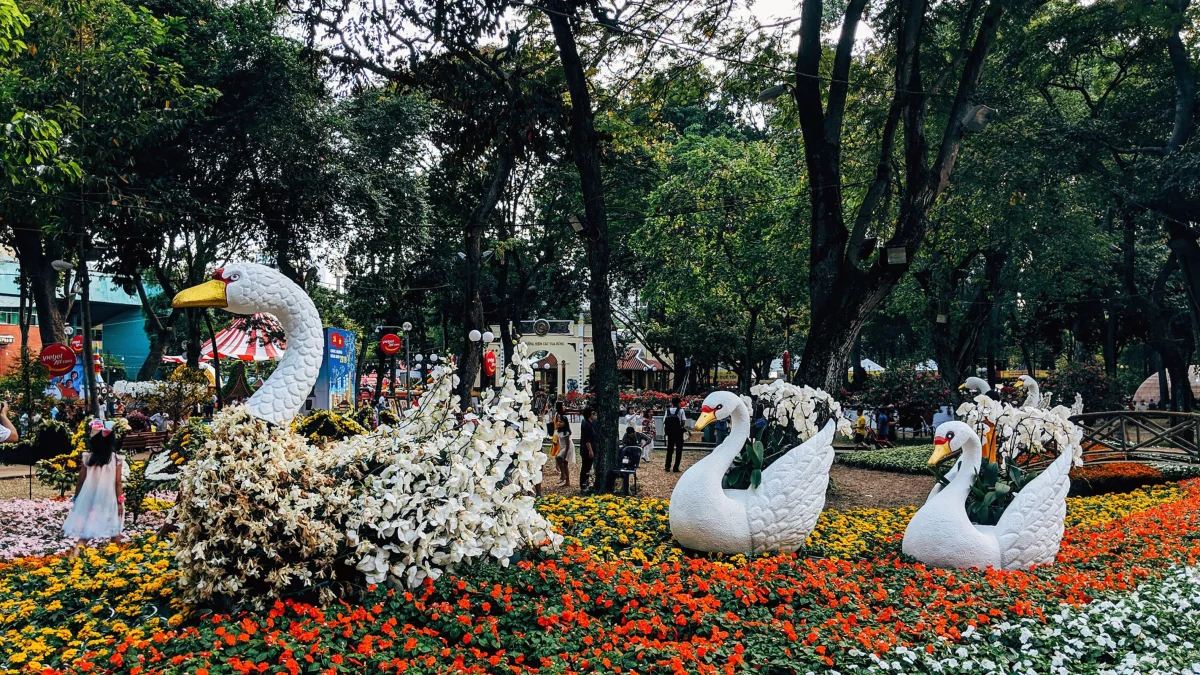
The «swans» and «burst» flowers made out of car tires that gardeners used to craft are now a thing of the distant past and evoke nothing but second-hand embarrassment. Even out of tires you can make designer «frames». Moreover, they tolerate temperature fluctuations well, and paint goes on them without any problems.
How do you make a flower bed out of tires? Use ready-made templates or rely on your own ingenuity. For example, here is one way to make a flower bed out of tires – suitable for beginners.
- For a rubber turtle, cut the tread into four parts, make cuts for the legs, and insert pieces of tread into them. It is better to fix them with staples.
- From another piece of rubber, make a little tail.
- A plastic bottle will work for the neck, and papier-mâché – for the head.
- The last step – paint the flower bed.

Photo: VPales/Legion-Media
Flower beds from stones
When creating a flower bed from stones, the main thing – is to switch on the mindset of a landscape designer. The flower bed should not overload the plot or look like the aftermath of a rockfall.
Choose a spot for it in the center of the lawn, next to the house or a pond. A flower bed of stones evens out the dacha’s irregularities and corrects an unfortunate view.
It is better to start building a flower bed from stones in spring and early summer – the settling of the drainage stone will take about two months, and you will be planting the plants in autumn.
Here are the main principles of how to make a flower bed from stones: first prepare the soil, then create a drainage layer, next place the large stones and lay in the planting mix, and only after that plant the flowers and decorate with small pebbles.

Photo: Gay Bumgarner/Legion-Media
Flower beds from brick
Brick will make a budget-friendly and tidy design for a flower bed at the dacha. This is an excellent option for gardeners who are still wondering what kind of flower beds they can make. Brick is suitable for flower beds of various shapes, supplemented with other materials, and lets you not worry about the condition of the flower bed – brick is long-lasting and suitable for raised flower beds.
If you have decided to make a flower bed precisely from this material, take a closer look at the types of brick. Ceramic brick with cells increases thermal insulation and affects the sensitivity of the plants – they may freeze or overheat. In frosts the water in the holes can turn into ice cubes and ruin the flowers.
Silicate brick with reduced moisture resistance is also not a choice. The best option – is solid brick, which is able to withstand both frosts and thaws.
Flower beds from wood
Wood – is an eco-friendly and versatile material, but not without drawbacks. To make a wooden flower bed, use boards, logs, beams, and stumps. The advantages of wooden flower beds are considered to be their service life, ease of working with them, and economic accessibility. Among the drawbacks – mold, rotting, and, as a consequence, the need for systematic treatment with antiseptics and protective impregnations. Even before you make a flower bed for flowers out of wood, treat the material with a special compound or paint it.
By the way, another plus – a wooden flower bed can be not only stationary but also mobile, and at your command it will decorate different parts of the dacha each time: move the flower garden from the gate to the house or to any other place at the dacha. And in the cold season the flower bed can even be brought into the house for the winter.

Photo: Wirestock on Freepik
Which flower bed to make: design options and tips on choosing the shape and location for a flower bed
To understand how to make a flower bed for flowers beautifully, turn to your own imagination. A flower bed – is like a frame for a photograph, which turns even a modest bouquet into a work of art. But to set up the framing on a whim – is the same as poking your finger at the sky.
Think through the creation of the flower bed down to the smallest detail. Start with a plan of the plot: where the flower bed will not get in the way but only decorate. Give thought also to the composition of the soil, the lay of the land, and the lighting. After all, different varieties of flowers need different conditions. If you decide to plant a moisture-loving plant in a place where water lingers only during watering, it will not bloom and will only spoil the look of the plot.
But if you plant the flowers in the right place, the flower beds will give the dacha owners joy every day.
Flower bed – a flower border
It is easier to make a flower bed with your own hands out of improvised materials in the form of a border. You can use almost anything:
- Firewood, brushwood, and construction waste will work: little boards, roof tiles, brick, leftover pipes.
- Even plastic or glass bottles will easily become a border flower bed.
- You can also lay out borders with old plates: if you select ones that are harmonious in color and size, such a flower bed will be in no way inferior to designer ones.
- Borders are also made from flower pots. But, they say, pot borders are not durable and after the first rain may become stained.
But you should not overdo it with border flower beds after all, for the main heroes – are the flowers, not the fencing.

Photo: user15285612 on Freepik
Island flower bed
An island flower bed – is like an oasis in the desert. So give some thought to how to make a flower bed correctly. An island flower bed is set up in the middle of a large space on the lawn. When making it, keep in mind that an island flower bed is viewed from all sides.
The area of such a flower bed can vary and depends on the free space on the plot. But according to the rules of landscape design, it should be much smaller than the section of lawn on which it will be displayed.
As for the flowers, you can plant both annual and perennial plants on an island flower bed. Island flower beds are usually not edged with any materials. The only exception is that you can sprinkle expanded clay or pebbles around the flowers. And you have to care for the flowers themselves and for the lawn around them – mow the grass regularly so that the island flower bed looks like a real oasis.

Photo: Wirestock on Freepik
Flower bed – a patterned arabesque
Translated from Arabic, arabesco means «Arabic». Europeans used this word to refer to complex Eastern ornaments that were originally executed on carpets, walls, and dishware. In landscape design, an arabesque – is a type of flower bed with clear borders: round, diamond-shaped, raised above the paths. Often the fencing is laid out from stone or a mini-fence.
The flowers are planted according to one’s own design or to a ready-made sketch – so that the palette forms an ornament. The main thing – is to select plants not only by color but also by flowering time, so that the plantings bloom and flourish at one and the same time, without «bald patches». Only then will the arabesque look like a cohesive composition. And one more thing: it is good to choose plants that suit each other in height, usually – rising from the edge toward the center.
Raised flower bed
A raised flower bed will make the plot three-dimensional and add volume. And from a practical point of view, it will help plants bloom even in conditions of waterlogged soil.
Raised flower beds can be small – in a ceramic container, a clay pot, or huge, with sides of brick, natural stone, or wooden beams. The height of a raised flower garden is 20 centimeters to a meter, while the length and width depend on your wishes and the conditions of the plot.
How do you make a flower bed? To begin with, you remove 20 centimeters of the top layer of soil. On the bottom you lay a sheet of geotextile fabric, and then pour in 10 centimeters of crushed stone, then sand, and water it. And right into the sand you lay stone blocks or tiles.
Flower bed – a rabatka
This is a symmetrical flower garden, or a long straight bed with flowers 50-100 centimeters wide and of unspecified length. A rabatka serves not only an aesthetic but also a practical role and divides up, for example, the paths on a plot or in a park. Unlike borders, a rabatka runs in a straight line and does not curve.
More often, flowering or ornamental-foliage plants are planted in such a flower bed. And usually with foliage of contrasting coloring. Inside the rabatka, flowers are planted both in straight lines and in zigzags or other shapes.

Photo: Gay Bumgarner/Legion-Media
Vertical flower bed
For those gardeners who do not yet know which flower beds are best to make and where to plant the flowers, gardeners advise paying attention to the vertical option – this includes arches, columns, little pyramids, planters, and mounds of plants. Distributing climbing greenery and berry shrubs over vertical surfaces is also considered a vertical flower bed.
Such decoration of the plot saves space, allows you to decorate even the walls of the house, and simplifies plant care, since in vertical flower beds there are neither weeds nor pests, which get into flower beds from the ground.
True, vertical flower beds require more care, for the soil in them dries out faster than in the ground and needs constant watering. And since the flower beds are not so large, they are not suitable for all types of flowers.