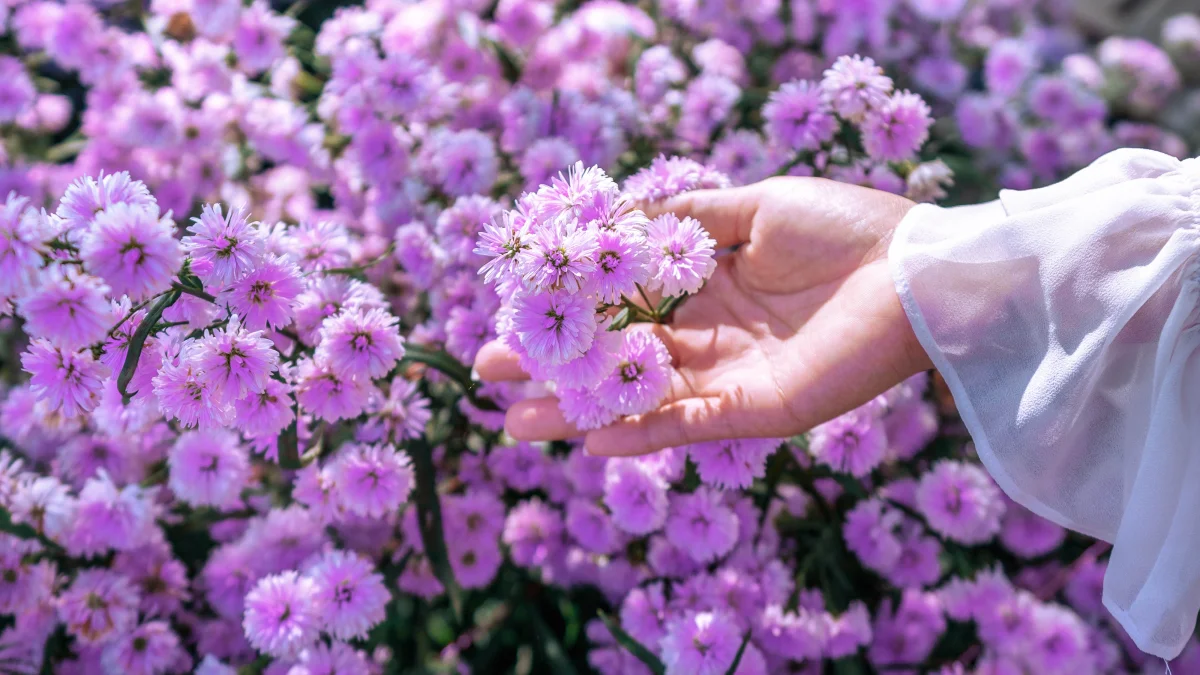
They can be light and soothing or dark, accent and bright, energetic. In any case, they are the perfect addition to any flower garden.
Of course, the most popular on the list will be lavender.
This is an incredibly hardy plant, which is, as a rule, perennial in climate zones 5 through 9. Its delicate purple flowers and soothing aroma – are not its only virtues.
Lavender is easy to care for. It grows abundantly and forgives occasional bouts of neglect. This plant appreciates full sun and well-drained soil for lush growth. You only need to water it when the soil feels dry. There is no particular need for fertilizer, since mixing in compost at the first planting should be enough.
But lavender – is far from the only beautiful purple flower.
Armenian grape hyacinth (mouse hyacinths)

Despite their name, «mouse hyacinths» are not actually related to hyacinths. They belong to the asparagus family! These little perennials grow in clusters and bloom in mid-spring. They love sunny spots and can spread quite quickly, both by seed and by underground shoots. But you can easily control their spread by growing them in containers.
On sale you can find grape hyacinths in blue, white, pink, and, of course, purple.
Purple passion (Gynura aurantiaca)

This plant with velvety leaves covered in purple hairs from Southeast Asia will certainly add a touch of flair to your garden. It is also kept as a houseplant. As long as you do not overwater it, Gynura should live a good two to three years.
A greater amount of sunlight will make the bright purple color of the leaves deeper, but direct light can also lead to wilting and scorching. To encourage growth, pinch the tips. Cut off the flowers when they have faded, as they can give off a strong and unpleasant smell.
Graptopetalum Amethystinum

This plant is called lavender pebbles. It really does look like pebbles - the plump oval leaves look very sweet and unusual. As with most succulents, it is relatively easy to care for, but it grows best in full sun – the more light you give it, the brighter its color will be.
Balloon flower

These airy flowers, or Platycodon grandiflorus, got their name because of their large, balloon-like buds. They open into stunning purple flowers.
You can grow balloon flowers indoors, in containers, and outdoors. They are easy to care for as long as they have rich, well-drained soil. Keep the flowers in full sun or partial shade, and soon you will have huge bouquets of purple flowers.
Hydrangea

Hydrangeas come in a wide variety of colors, but some varieties stand out with beautiful shades of purple – for example, Let's Dance, Rhythmic Blue, and Wee Bit Grumpy.
You can also experiment with the pH of the soil to get the color you want – acidic ground can make a hydrangea purple or blue. K
Care for a hydrangea in moderation, as it can become diseased with too much or too little care; it prefers moderate watering and sufficient shade.
Wandering Jew (Tradescantia zebrina)

Tradescantia zebrina has silvery leaves with stripes and a deep purple underside. It is hardy in climate zones 9 through 11, where it does not freeze in winter. Nevertheless, this tradescantia can also be kept indoors as a stunning houseplant year-round; it looks especially striking in hanging planters.
Purple heart (Tradescantia pallida)

Tradescantia pallida, a beautiful plant also called purple heart, has firm plum-colored leaves and stems with smaller light-purple flowers. Like its striped relative Tradescantia zebrina, this plant can grow anywhere indoors and outdoors in zones 9 through 11. For the most vivid color, keep the plant in full sun.
False shamrock (Oxalis triangularis)

Oxalis triangularis, also known as false shamrock, resembles purple butterflies. It can be grown outdoors in zones 6 through 11, planted indoors, or grown as an annual elsewhere.
The oxalis folds up its leaves at night and opens wide in the morning. This plant can go dormant every few years, so do not worry if the leaves look dead. Hold off on watering – when you see a leaf coming back to life, start watering again.