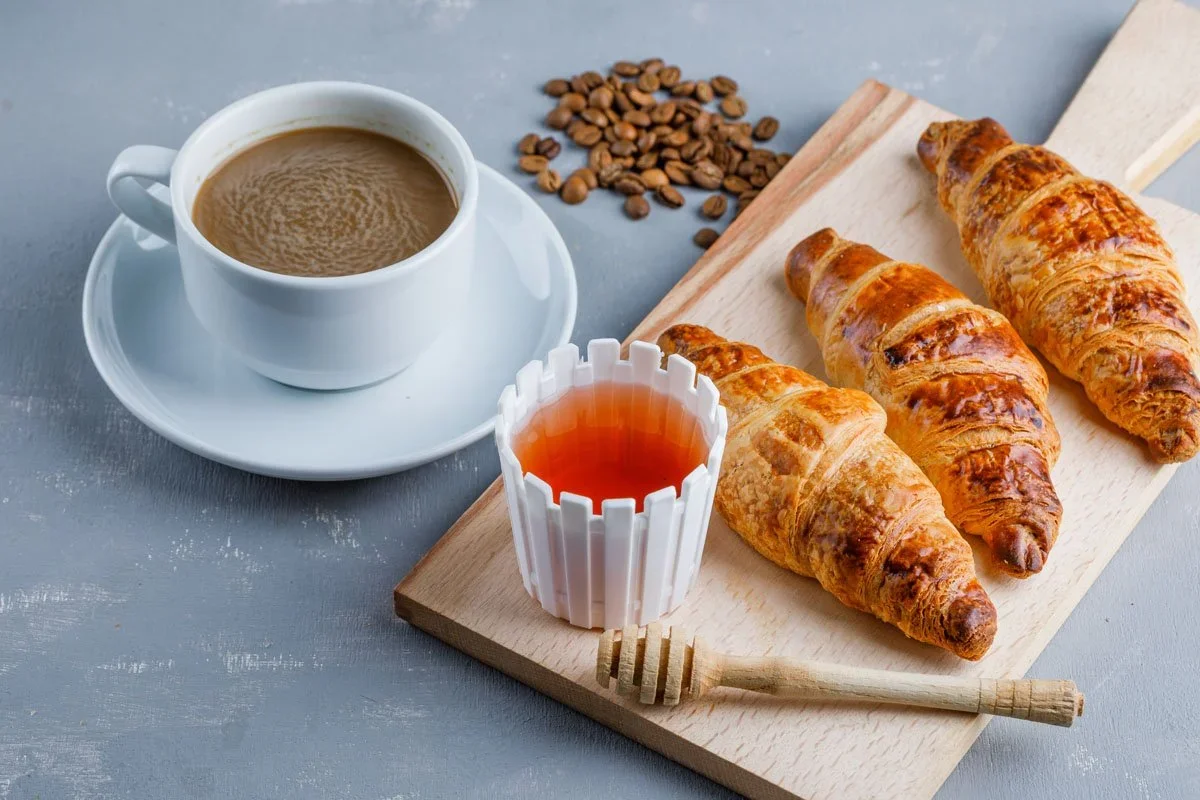
A golden, crispy crust, a tender creamy taste – this culinary image has long become familiar and pleasant to us. As has the cup of black, fragrant coffee that accompanies the appetizing crescent roll. And yet the story of the croissant's origin is shrouded in mysterious, unexpected discoveries and even heroic events.
Version 1
According to one version, the famous crescent roll symbolized the great victory of the Austrians over the Turks in 1683. And it was forged – or rather, kneaded – by Viennese bakers. On July 14 the warriors of the Ottoman Empire decided to storm the fortress of Vienna. Early in the morning thousands of sappers began mining the wall, but they were heard by the Viennese bakers, whose culinary workshops were located in cellars adjoining the walls. The bakers managed to warn the city's residents, thanks to which the Austrian army was able to gather all its forces to defeat the enemy. In honor of the famous victory, the Viennese bakers baked buns in the shape of crescents-rolls, resembling the prototypes of the future French croissants.
Discovery of the year: scientists have finally figured out why we love cats so much
Version 2
According to another legend, the croissant appeared thanks to a certain Yuri Kulchitsky, but also during the war between the Turks and the Austrians. Kulchitsky valiantly defended the city, for which he received three hundred captured Turkish sacks of mysterious beans, which on inspection turned out to be coffee beans. Soon the hero, having unlocked the secret of brewing, opened his own coffee house. And to whet interest in the new beverage (which people were extremely reluctant to try), he began adding sugar and milk to it. Then crescent-shaped baked goods appeared, which symbolized the victory over the Turks (it is precisely a crescent that is depicted on their flag).

Version 3
Scholars who study the history of cooking had their own opinion about the origin of croissants. They claimed that the croissant's predecessor was the kipferl bun. It was baked from yeast dough in the shape of a crescent. And in pagan times, bread of such a shape was considered an offering to Selene – the Greek goddess of the Moon.
Version 4
In 1770 Paris solemnly, with great pomp, welcomed the new queen of France – the Austrian Marie Antoinette. Madame Deficit, as the people would later call her for her ruinous passion for luxury, adored Viennese pastries. And the French court chefs were ready to bend over backwards to please the queen. Now not a single day went by without the famous rolls with coffee. But these culinary delicacies were already called croissants, finding a new and permanent homeland.
How to warm up in the frost: the 5 most common mistakes we make
And who else?
Many tried to popularize the baked rolls. For example, the Austrian artillery officer August Zang, weary of military affairs, opened a «Viennese Bakery» in Paris in 1838. His business went fairly well, but the rolls had not yet won wide fame at the time. Following the tradition of Austrian bakers, they were still baked from yeast dough.
A new turn in the culinary fate of croissants came during the reign of the last empress of France, the dazzling beauty Eugénie. She, contrary to court rules, was not in the least afraid of spoiling her royal figure with the «Viennese treats». And in a narrow aristocratic circle, over a cup of coffee with her friends, she devoured croissants with great relish. With the empress's blessing, they came to be regarded as a refined, exquisite delicacy. And they were now baked from puff pastry! This became the first step toward the appearance of the croissants familiar today.

Inspired by the queen's example, the baker and restaurateur Louis Ernest Ladurée did everything he could to make croissants the calling card of France. His recipe for making these buns was unanimously recognized as the classic one. Now the traditional crescent was baked on a base of margarine, and other buns – on butter, in the shape of straight twists.
Making a classic French croissant at home is very difficult! Bakeries use special ovens with ventilation, which allows the croissants to come out crispy and flaky. And the most difficult part of the recipe – is preparing the perfect puff pastry.
Recipe for a classic French croissant
For the dough you will need:
- 500 g of flour
- 50 g of sugar
- 20 g of fresh yeast
- 200 g of milk
- 1 egg
- 310 g of butter
- A pinch of salt.
We begin cooking:
- Sift the flour into a bowl and make a well in the middle. Dissolve the yeast in warm milk and carefully pour it into the well.
- Add to it the egg, 50 grams of butter, and the sugar with salt. Knead the dough.
- Then throw the finished dough forcefully onto a board sprinkled with flour. And we carry out this ordeal for 10 minutes. Thanks to such a strenuous workout, the dough will become elastic.
- Now the dough can be left to rest for half an hour under cling film in a warm place. As soon as the yeast takes effect and the dough increases in size, press it down with your palm (as if deflating it) and put it in the refrigerator for an hour.
- Place the softened butter – 250 grams between layers of cling film and begin rolling it out with a rolling pin to a thickness of 1.5 centimeters. Put the resulting sheet in the refrigerator.
- Take the chilled dough out of the refrigerator and roll it out to a thickness of 2 centimeters. The sheet will turn out huge! And it must be twice as long as the butter sheet! In width a bit larger, but not by much. Place the butter in the center, fold the dough over, and roll it out to 1 centimeter thick. The length should exceed the width by three times. Fold the lower end of the rolled-out sheet over two-thirds of the way, and the upper end over the remaining one-third. Press down the seam and fold our sheet in half. Smooth it with your hand and put it in the refrigerator for half an hour.
- In the next stage we roll the dough out even thinner – to 8 mm. Fold it in three and put it in the refrigerator for an hour.
- And now, at last, the time has come for twisting the croissants. We roll the dough out again to 8 mm and cut it with a sharp knife into triangles. At the base of the triangle we make a small cut (literally 1 cm) and tuck the upper corner inward. We lay the rolls on parchment spread on a baking sheet and let them rest and rise a little for half an hour.
- Brush them with beaten egg yolk and put them in an oven preheated to 180 degrees for 15 minutes.