The ticket's bought, the suitcase is packed, and you still don't know — Budva or Petrovac? The Bay of Kotor or the open coast? The answer doesn't come from online rankings — it depends on what you actually want from your trip.
Montenegro's coastline runs just 293 kilometers along the Adriatic, but it packs in so much variety that choosing the wrong resort can ruin your vacation before you even fly out. One town is about loud parties and promenades bustling until midnight. Another is about quiet coves where nothing but cicadas make a sound. A third is about mud baths and mineral springs.
And some travelers settle deep inside the Bay of Kotor, where instead of open sea there's mirror-still water between mountains. In short, "going to Montenegro" is too vague a plan. Specifics are needed.
First: About Visas — What Changes on November 1
Starting November 1, 2026, Montenegro introduces a visa regime for Russian citizens. Until that date, nothing changes: passport, a stamp at the border, up to 30 days visa-free. After it, a Category C visa will be required, granting stays of up to 90 days within a six-month period.
The decision was made by the country's government on July 23, 2026, and has already been published in Montenegro's official gazette. The reason is aligning visa policy with EU requirements — Montenegro expects to join the European Union by 2028. Belarus, China, Saudi Arabia, and Turkey join Russia under the new visa regime.
VFS Global visa centers already operate in eight Russian cities: Moscow, Pskov, Yekaterinburg, Voronezh, Novorossiysk, Petrozavodsk, Murmansk, and Arkhangelsk. Consular fee: €35 for adults, €17.50 for children under 14. Processing time: two to three weeks.
The practical takeaway is simple: if you want to visit Montenegro without visa hassle, plan your trip to enter the country by October 31 at the latest. September and the first half of October are an excellent window: the sea is still warm, tourist numbers have thinned, and no visa is needed.
Getting There: A Layover Is Unavoidable
There are currently no direct flights from Russia to Montenegro. The main routes go through Istanbul (Turkish Airlines, Pegasus) or Belgrade (Air Serbia). From Moscow to Tivat, expect 5 to 10 hours total travel time, layover included.
Air Serbia flies from Moscow to Belgrade, with a 40-minute hop to Tivat from there. The layover at Nikola Tesla Airport is compact — an hour and a half to two hours is enough. In summer 2026, a charter program via Kuwait (Jazeera Airways) is also running, along with flights connecting through Yerevan.
Round-trip tickets in high season run 45,000 to 70,000 rubles from Moscow, depending on route and dates. Book two to three months out.
Budva: For Those Who Want It All
Budva is Montenegro's main tourist hub and the coast's liveliest resort. An Old Town with narrow streets and a citadel, a long promenade lined with restaurants, nightclubs open until dawn — it's all here.
Budva's beaches are pebble and sand-pebble, extensive. Slovenska Plaža is the largest and busiest — in July–August, you need to claim a spot by 9 a.m. A set of two loungers and an umbrella runs €15–20 a day. Every beach has a free zone, but it's narrow.
Water in Budva warms to +24–26°C from July through September. Beach season runs June through October, though early June water is still bracing at around +21°C.
Who it suits: young people, groups, and anyone wanting to combine the beach with an active nightlife. Downsides: crowds at peak season, little greenery, hotels without expansive grounds.
Bečići and Rafailovići: Same Area, Calmer
Just a couple of kilometers from Budva, but the feel is entirely different. Bečići is a resort town built around hotels with their own beach access and well-maintained grounds. Bečići Beach is one of the country's best: fine pebble, clean water, gentle entry.
Rafailovići is even quieter. A tiny fishing village tucked between cliffs, with a cozy bay. Not dozens of restaurants — just five or six, but serving fish pulled from the sea that morning.
Who it suits: families with children, couples, and anyone wanting a good beach without Budva's noise. Budva is a 10-minute walk along the promenade for anyone wanting evening action.
Sveti Stefan: Postcard Montenegro
An island hotel connected to shore by a narrow causeway — the country's calling card. Sveti Stefan itself is closed grounds (formerly managed by Aman Resorts), and access to the island requires being a guest there. But the surrounding beaches are among the coast's most beautiful: pinkish pebbles, clear water, views of medieval walls.
Vacationing here costs more than nearby Bečići: it's a premium area, and restaurant and accommodation prices reflect that. But the tranquility and scenery are instantly recognizable to anyone who's ever googled Montenegro.
Who it suits: couples, lovers of beautiful views, and secluded getaways. Not the best choice if budget is tight.
Petrovac: Small and Cozy
Petrovac is a compact town 17 km south of Budva, tucked into a bay between two capes. No nightclubs here, but olive groves right behind the beach, a fortress on a cliff, and two small islands offshore — Sveta Nedjelja and Katič.
The beach in Petrovac itself is small and packed at the height of summer. The main drawback: with high tourist volume, the beach strip simply can't handle it. But nearby, within walking distance, sits Lučice Beach — more spacious, pine-shaded, fine pebble, gentle entry.
Who it suits: families with young children (quiet, compact, everything close by), older travelers, anyone preferring an unhurried pace. Best avoided in July–August — it gets tight.
Kotor and the Bay of Kotor: Not About the Beach, But the Atmosphere
The Bay of Kotor is the southernmost fjord in the world (strictly speaking, it's a bay, but visually — a genuine fjord). Mountains 1,500–1,700 meters high flank the water on both sides, medieval towns hug the shore, and at sunset, it all reflects in mirror-still water.
Kotor is a fortress city, a UNESCO site. Inside its walls, the Old Town is a maze of stone streets, squares, and churches. Climbing to St. John's Fortress (1,350 steps) is a must-do, but at +30°C in July–August, it's a serious ordeal. Go early in the morning.
Beaches within the bay lag behind the open coast: water is less transparent, and shorelines are often concrete or pebble. But the water warms faster — swimmable as early as June. For a proper beach vacation from Kotor, it's convenient to drive to the beaches of the Budva Riviera — 20–30 minutes by car.
Who it suits: those who care more about architecture and history than lying on a beach. Ideal for short trips and as a base for exploring the bay.
Tivat: Convenient, But Not a Beach Destination
Tivat is first and foremost the airport — most flights land here. The second thing that comes to mind is Porto Montenegro, a yacht marina with a promenade, boutiques, and restaurants. It looks impressive, but has little to do with traditional beach vacationing.
Beaches in Tivat itself are modest — pebble or concrete platforms, with water quality affected by the port's proximity. For swimming, head to neighboring villages: Donja Lastva, Lepetane, Stoliv.
But the town is calmer than Budva, prices are more moderate, and reaching any point on the coast by car takes about half an hour.
Who it suits: anyone renting a car and using Tivat as a transit base, plus fans of the yacht lifestyle. Not the best choice for pure beach vacationing.
Herceg Novi: A Green City on a Thousand Steps
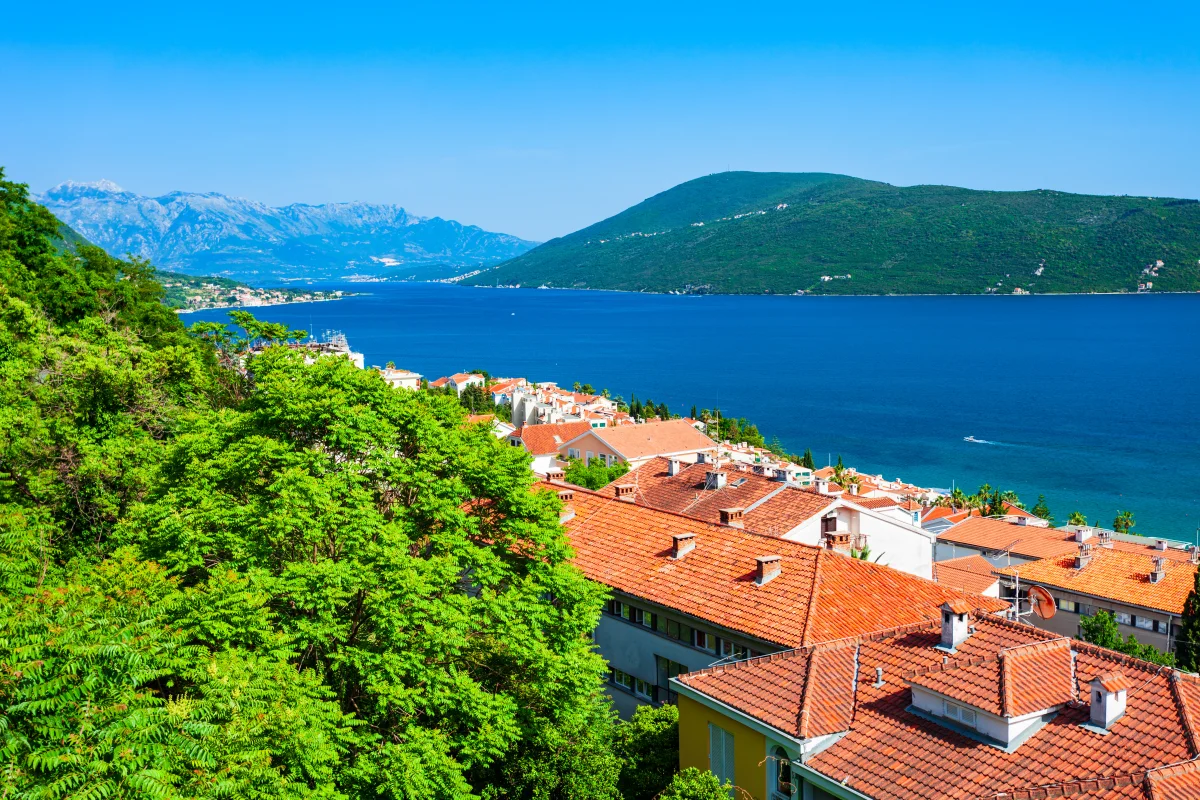
Herceg Novi sits at the entrance to the Bay of Kotor, opposite Tivat. The city is nicknamed "Montenegro's botanical garden": palm trees, mimosas, oleander, and agave grow throughout — so much greenery that +30°C heat here feels milder than in stony Budva.
The whole city is built on a slope. Heading to the sea means stairs. Climbing to your hotel means stairs. Going out for bread means stairs. Strollers and wheelchairs struggle here. Beaches are pebble or concrete platforms. Bay water warms earlier than the open coast, and waves are almost nonexistent.
A separate story is the village of Igalo on Herceg Novi's outskirts. A wellness center operates here with therapeutic mud and mineral springs. Mud treatments at Igalo are priced accessibly by European standards, and the spot draws steady demand.
Who it suits: those who value greenery and quiet, wanting to combine vacation with wellness. Families with young children — with the caveat of all those stairs.
Bar and Sutomore: Budget South
Bar is a port city, more about local life than tourism. Wide avenues, supermarkets, a market selling cheap fruit, but few hotels and modest tourist infrastructure. On the upside, Old Bar — ruins of a medieval city on a hill four kilometers from the coast — is an atmospheric spot for a walk.
Sutomore is the nearest resort town to Bar. The beach is sand-pebble, long, with a gentle entry. Accommodation prices are among the lowest on the coast. But infrastructure matches: fewer restaurants and shops, everything simpler.
Who it suits: budget travelers, and anyone seeking a quiet stay without pretensions to luxury.
Ulcinj: The Southernmost and Most Unusual
Ulcinj sits at Montenegro's very south, near the Albanian border. The character is different here — the majority population is Albanian, Albanian is heard on the streets, and mosques stand alongside churches. There's no tourist bustle, and no nightlife either.
The main treasure is Velika Plaža (Great Beach), a sandy strip 13 kilometers long. It's Montenegro's longest beach and one of the longest on the Adriatic. The sand is dark, of basaltic origin, and reputed to have healing properties.
Even further south lies Ada Bojana Island, surrounded by river and sea. Conditions here are excellent for kitesurfing and windsurfing: steady wind, shallow water, and no waves near shore. The spot draws water sports enthusiasts from across Europe.
Water in Ulcinj is the warmest on Montenegro's coast — up to +27°C in August. The season here lasts longer than in the north.
Who it suits: water sports enthusiasts, anyone drawn to an eastern character, and everyone seeking a long sandy beach without the crowds.
When to Go: The Month Matters
June — a gentle season start. Air at +25–28°C, water at +21–23°C — still cool for some. But tourist numbers are low, prices sit below peak, and nature is still green and fresh.
July–August — the peak. Air at +28–33°C, water at +24–27°C. Hot, crowded, prices at their maximum. Traveling with children — choose Bečići, Petrovac, or Herceg Novi, and save Budva and Kotor for evening excursions.
September — the golden window. Water holds at +23–25°C, the heat retreats, and the sea has fewer crowds. Prices start dropping, and there's still runway before the November 1 visa cutoff.
The first half of October — your last chance to swim without a visa. Water sits around +22–23°C, air at +20–24°C. Ulcinj and Bar run warmer than the Bay of Kotor. Evenings already turn cool, and some restaurants close, but beach vacationing remains possible.
Renting a Car: Necessary or Not?
If you're staying in Budva or Bečići and don't plan to venture beyond the resort, you can skip it. Everything is within walking distance, and buses run to Kotor and Petrovac.
But if you want to see the Bay of Kotor, visit Perast (a tiny town with two islands offshore), drive the switchbacks above Kotor Bay, or reach Ulcinj — a car is essential. Rental starts at €25–30 a day for a compact car, gas runs around €1.50 a liter. Roads are narrow and winding, but well-paved.
What to Consider Before Your Trip
- Cash. Russian bank cards don't work in Montenegro. Bring euros in cash. Major cities have ATMs, but withdrawing money on a Russian card won't work.
- Registration. Within 24 hours of entry, you must register with the police at your place of residence. If staying at a hotel or officially rented apartment, the owner does this for you. If renting privately, confirm in advance whether the host is prepared to issue the "white card" (registration document).
- Insurance. It's not formally checked at entry, but emergency care without a policy costs hundreds of euros. Getting insured takes ten minutes and a couple thousand rubles.
- The national currency is the euro. Montenegro isn't formally part of the Eurozone but has used the euro as its national currency since 2002. Coastal prices are comparable to Russia's Sochi, and the south (Bar, Sutomore, Ulcinj) runs noticeably lower.
Montenegro remains one of the most accessible European destinations for Russians for now. But the window is narrowing: after November 1, the familiar "passport and ticket — and you're on the Adriatic" format stops working. For anyone who's been putting off this trip, autumn 2026 is sending a clear signal — go now, or go with a visa.