Georgia is a country you can either taste in a week or turn into a road marathon. Tbilisi, ancient monasteries, the vineyards of Kakheti, the Georgian Military Highway, and the snow-capped peaks of the Caucasus — all of it is genuinely doable in seven days.
For a first trip, the optimal route looks like this: Tbilisi → Mtskheta → Kakheti → Stepantsminda → Tbilisi. About 500 kilometers of roads, three entirely different regions, and enough time to do more than just check boxes off a sightseeing list — time to sit down with khinkali, drink some wine, and understand why so many people keep coming back.
Where to Start: Tbilisi
Tbilisi is the essential first stop. Not because it holds the most attractions, but because the capital is where you'll most easily grasp the country's character.
Budget at least two days for the city. In one day, you can see the Old Town, Narikala Fortress, the sulfur baths, and Rustaveli Avenue — but it'll be a rushed overview. A second day lets you slow down: browse the flea market, sit in a café, wander Sololaki, and ride up Mtatsminda.
Old Tbilisi isn't an open-air museum. Carved 19th-century balconies stand beside Soviet apartment blocks, glass-fronted modern buildings, and half-ruined courtyards. Sometimes the most interesting thing isn't on the square — it's behind a door that looks like it hasn't opened in thirty years.
The main walk runs from Liberty Square through the Old Town to Narikala Fortress. Along the way: the sulfur baths in the Abanotubani district, a waterfall in Legvtakhevi Gorge, the Bridge of Peace, and the Kura River embankment.
In the evening, head back to the Shardeni or Sololaki area. Not for a tourist checklist — just to sit down, order khachapuri and khinkali, and leave the evening unscheduled.
Mtskheta: The Ancient Capital, Half an Hour From Tbilisi
Mtskheta often gets squeezed between other stops on the itinerary — and rightly so. It's only about 25 kilometers from Tbilisi, so an overnight stay isn't necessary.
The main attraction is Svetitskhoveli, one of Georgia's most important churches. Nearby stands Jvari Monastery atop a hill, offering the view of the Aragvi and Kura rivers merging — the exact shot that appears in nearly every guidebook about the country.
Three or four hours are enough for Mtskheta. Arrive in the morning, see Svetitskhoveli, climb up to Jvari, grab a coffee, and move on. Staying overnight only makes sense for those deliberately seeking quiet and a small town instead of evening Tbilisi.
Mtskheta fits naturally on the day you leave the capital toward the Caucasus or Kakheti.
Kakheti: Why Go to Wine Country
Kakheti is an entirely different Georgia. Less urban bustle, more vineyards, monasteries, and small towns — and every other turn reveals somewhere offering homemade wine to try.
From Tbilisi to Telavi is roughly 95 kilometers — about two hours by car, so the region is easily covered in a single day. But if you want to linger rather than just pass through the wineries, spend the night in Telavi or Sighnaghi.
Telavi is Kakheti's main town and a convenient base for exploring the region. Sighnaghi is a small hilltop town overlooking the Alazani Valley — considerably more touristy, but extremely photogenic.
Don't turn Kakheti into a speed wine tour: three tastings, five monasteries, and back to Tbilisi. Here, a different rhythm applies. Vineyards, a long lunch, a jug of wine on the table, and conversations that start with "where are you from?" and end two hours later.
If you only choose one thing, choose a wine tasting at a small family winery. Georgian winemaking spans thousands of years, and the traditional method of aging wine in qvevri — large clay vessels buried underground — has survived to this day.
The Georgian Military Highway: The Week's Most Beautiful Drive
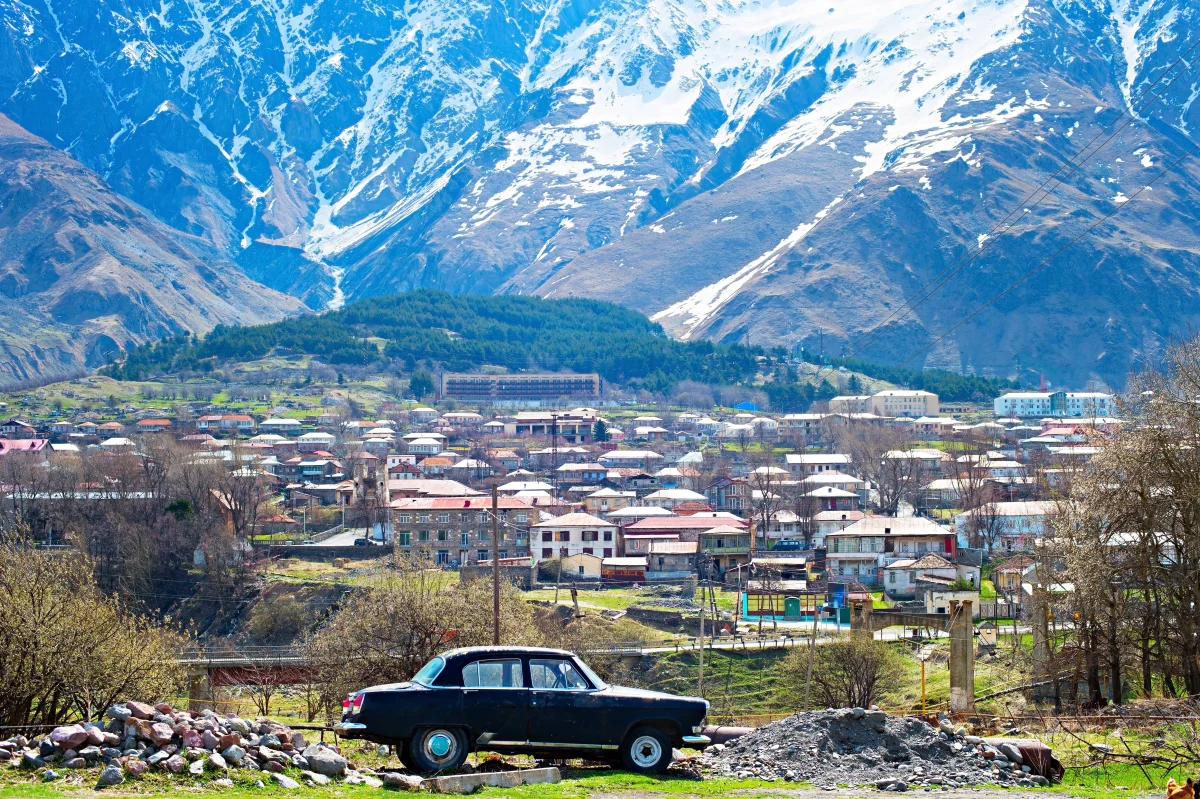
After Tbilisi and Kakheti, head north toward Stepantsminda. This is where the Georgia most people picture in photographs begins: mountain gorges, switchbacks, rivers, and the peaks of the Greater Caucasus.
The distance from Tbilisi to Stepantsminda is about 150 kilometers, but timing the trip by distance is pointless. Formally, the drive takes three to four hours, but in practice it easily stretches into an entire day.
The reason is simple: you'll want to stop constantly.
The first major stop is Mtskheta, if you haven't already visited. Then: the Zhinvali Reservoir, Ananuri Fortress, overlooks above the gorges, and the ski resort of Gudauri.
Don't try to drive the Georgian Military Highway without stopping. Do that, and you'll spend a few hours on a bus and miss the trip itself. Here, the road is part of the destination.
By evening: Stepantsminda, a small settlement at the foot of Mount Kazbek. Stay the night here rather than trying to return to Tbilisi the same day.
Kazbek and Gergeti: That Postcard View
The main reason to visit Stepantsminda is Mount Kazbek and the Gergeti Trinity Church. The church sits at roughly 2,170 meters, with the 5,054-meter Kazbek massif rising behind it.
You can reach Gergeti on foot or by car. The hike takes several hours, depending on weather and fitness level. By car — considerably faster.
But the real point isn't the church itself. It's standing at that altitude, clouds all around, an enormous mountain ahead, and tiny Stepantsminda far below. On a clear day, it's one of those moments in the trip where photos afterward never quite do it justice.
Budget a full day for Kazbek. Morning: Gergeti. Afternoon: a walk through the surrounding gorges. Evening: dinner in Stepantsminda.
And here's an important rule: don't build the entire day around getting a photo with Kazbek. The mountain can be shrouded in clouds. Mountain weather changes fast, and even in summer, a clear morning is no guarantee of a clear evening.
What to Do if the Weather Turns
Georgia isn't a country where bad weather automatically means a lost day.
If Kazbek is covered in clouds, skip the high mountains and switch to a backup plan: Ananuri Fortress, Gudauri, a gorge walk, or a return to Tbilisi.
In Tbilisi itself, a rainy day isn't a problem either. Sulfur baths, museums, wine bars, restaurants, and the old quarters can easily fill a whole day.
The biggest mistake of a week-long trip is scheduling every hour. One rainstorm, a closed road, or a border delay between regions, and the whole plan starts to fall apart. In Georgia, it's better to have two or three fixed points per day and leave the rest for improvisation.
Is Batumi Worth It?
If this is your first trip and you only have seven days, it's better not to include Batumi in the main route.
Not because the city isn't interesting. On the contrary: the sea, subtropical vegetation, modern architecture, an old town, and an entirely different climate make Batumi a destination in its own right.
The problem is distance. From Tbilisi to Batumi is about 370 kilometers. Adding two days there means cutting Kakheti or Kazbegi from the itinerary.
Batumi is better saved for a separate trip, or built into an itinerary of at least 9–10 days. In a single week, it's better to see mountain Georgia than spend a significant chunk of your vacation on the road.
The exception: if the sea matters more to you than the mountains. In that case, restructure the route as Tbilisi + Batumi, and save Kazbegi and Kakheti for next time.
Why You Shouldn't Try to See All of Georgia in a Week
On a map, Georgia looks small. But mountain roads are slow, and the distance between two points doesn't always reflect the actual travel time.
From Tbilisi, you can reach Kakheti relatively quickly. Kazbegi too. But trying to add Svaneti, Batumi, or Vardzia turns the vacation into a driving tour.
Svaneti especially deserves a trip of its own. Mestia, Ushguli, glaciers, and high-altitude villages need at least a few days — too precious to squeeze into a brief detour.
Georgia is a case where seeing less but feeling more is the right strategy. Three regions are enough for a week. Everything else remains a good reason to come back.
A Ready-Made Seven-Day Itinerary
If you'd rather not assemble the trip yourself from a dozen scattered points, here's the optimal breakdown.
- Day 1 — Tbilisi. Old Town, sulfur baths, Narikala, the Bridge of Peace, dinner with Georgian cuisine.
- Day 2 — Tbilisi. Sololaki, Rustaveli Avenue, Mtatsminda, markets, and an evening stroll through the center.
- Day 3 — Mtskheta + the Georgian Military Highway. Svetitskhoveli, Jvari, Ananuri, the Zhinvali Reservoir, Gudauri. Overnight in Stepantsminda.
- Day 4 — Kazbegi. Gergeti, mountain walks, the view of Kazbek. Overnight in Stepantsminda, or return to Tbilisi.
- Day 5 — Kakheti. Telavi, a winery, the Alazani Valley. Overnight in Kakheti.
- Day 6 — Kakheti + Sighnaghi. Monasteries, a tasting, a walk through Sighnaghi. Evening: Tbilisi.
- Day 7 — Tbilisi. A buffer day for bad weather, or a relaxed close to the trip: the market, cafés, shopping, and a final dinner.
If you'd rather not switch hotels constantly, an even simpler approach works: base yourself in Tbilisi and take day trips or drives out. But try to keep the overnight in Stepantsminda regardless — doing it as a same-day round trip means spending far too much time on the road.
Car or Guided Tours
For a first trip, a car gives you more freedom — especially in Kakheti and along the Georgian Military Highway, where you'll want to stop wherever the view catches you, not just at pre-planned points.
But renting a car purely for Tbilisi is a bad idea. In the Old Town, a car is more of a hindrance: narrow streets, parking, and heavy traffic.
The best approach is spending a few carless days in Tbilisi, then renting a vehicle for the regions — or booking individual trips with a driver.
If you're not confident driving mountain roads, the second option is often more comfortable. Switchbacks, oncoming traffic, and sudden cows on the road aren't the ideal combination for a first encounter with the Caucasus.
What to Try in a Week
Georgia isn't just khinkali and khachapuri, though you can't skip either.
In Tbilisi, try khinkali, ajapsandali, lobio, and grilled meat. In Kakheti, local wine and shoti bread. In the mountain regions, khinkali again — traditionally considered one of the symbols of the region's cuisine.
And don't order everything at once. Georgian portions are often sized for a group, and a feast can easily turn into a marathon.
When to Go
For a first trip, the best window is May–June or September–October.
In May, Georgia is green, Tbilisi is already warm, and hiking season opens in the mountains. July and August are hotter: daytime temperatures in Tbilisi can climb above +30°C, though the highlands become especially appealing.
September is one of the most comfortable months: warm, Kakheti's vineyards enter harvest season, and tourist flow gradually thins. October is even richer in color: golden autumn in the mountains, grapes, and cool evenings.
Winter trips are possible too, but the mountain portion depends heavily on weather and road conditions. Kazbegi under snow is stunning, but planning a "new location every day" itinerary during this period isn't advisable.
Which Route to Choose
- Want to feel Georgia for the first time — Tbilisi + Mtskheta + Kakheti + Kazbegi. The best balance of city, history, food, wine, and mountains.
- Want more nature — cut one day of Tbilisi and add a full day in Kazbegi.
- Want wine and gastronomy — leave two nights in Kakheti.
- Want the sea — swap Kazbegi for Batumi, but don't try to add everything at once.
- Want to see genuinely high mountains — plan a separate trip to Svaneti rather than squeezing it into seven days.
Above all: don't turn your first Georgia into a checklist of sights. This is a country that resists the "saw the church, photographed the mountain, moved on" format.
Leave time for a long lunch, a conversation with your guesthouse host, a spontaneous stop at an overlook, and a glass of wine nobody planned for. You won't see all of Georgia in a week — and that's fine. But you'll get to see the Georgia that makes you want to come back.