Your passport expired, there's no time for a visa, and vacation starts in two weeks. Sound familiar? September is the rare moment when that's not a problem — it's an advantage: the best Russian destinations perform better in early autumn than in summer.
Vacationing in Russia in September isn't a compromise for those with "nowhere else to go" — it's a deliberate choice with its own advantages. Airfare drops 20–30% after summer season ends, hotels stop inflating rates, kids head back to school, and resorts settle into calm.
Black Sea water has warmed to its peak all summer and holds that heat until mid-October. Mountains turn yellow and crimson. And along the Caspian, at Baikal, and on Kamchatka, what locals call the best time of year begins. Choose based on your mood.
Sochi and Krasnodar Krai: Classic Velvet Season
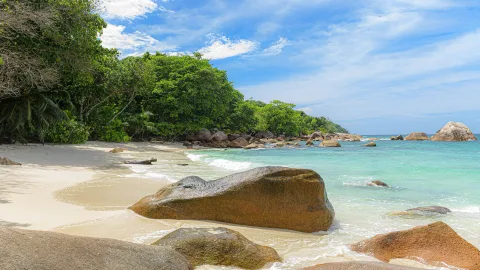
If your goal is swimming in a warm sea, the Black Sea coast of Krasnodar Krai works almost perfectly in September. Water: +23–25°C in early month, +21–23°C by month's end. Air: +25–28°C during the day, without July's swelter and mugginess. UV is gentler, tans develop more evenly, and sunburns happen less often.
Sochi in September is a different city.
Summer crowds have thinned, the promenade no longer resembles an anthill, and restaurants have open tables. The sea has cleared — water is more transparent than in August, when thousands of swimmers packed in simultaneously. Markets fill with figs, grapes, pomegranates, and persimmons — the real fruit season, absent during summer, has arrived.
For those wanting to combine beach and mountains — Krasnaya Polyana. No snow yet, lifts are running, and September is the best time for mountain walks: trails are dry, air transparent, and the Caucasus range's peaks are visible as if within arm's reach.
The route to the waterfalls in Dzhegosh Gorge is one excursion that fully justifies the day spent.
Gelendzhik and Anapa are simpler and cheaper than Sochi. Water is roughly the same, beaches roomier, and accommodation in September runs one and a half to two times cheaper than August's. In Anapa, mullet season begins toward month's end — local fishermen head to the promenade with rods, and fresh fish can be bought right on the shore.
Crimea: Grapes, Wine, and Empty Palaces
Crimea in September brings +24–27°C air, +22–24°C water, and the sense that the peninsula has finally exhaled after the summer onslaught. The southern coast — Yalta, Alushta, Miskhor, Gurzuf — is shielded by mountains from northern winds, and warmth lasts longest here. In Miskhor, one of the coast's warmest spots, swimming season stretches into mid-October.
But the main reason to visit Crimea specifically in September is wine season.
In late August and early September, grape harvest takes place, and wineries hold open-door days, tastings, and production tours. Massandra, Inkerman, Zolotaya Balka, and young private estates in the Sevastopol area all operate at full capacity right now.
Tours through the palaces and parks of the southern coast — Livadia, Vorontsov, Massandra — run without lines in September. In summer, cars queue to reach Swallow's Nest; in September, you can drive up calmly, photograph the castle without a crowd behind you, and move on.
Dagestan: Mountains, a Canyon, and the Caspian
Dagestan has transformed from an exotic destination into one of Russia's most sought-after routes over recent years. And September is the optimal month to visit.
Summer heat in the foothills (reaching +35–40°C in July–August) retreats, temperature drops to +25–28°C, and the Caspian Sea in Kaspiysk and Izberbash holds at +23–24°C.
The Sulak Canyon — Europe's deepest at 1,920 meters — looks like a filtered photograph in September: turquoise water, ochre cliffs, transparent air. Summer brings dozens of tour buses; September is quieter, though booking a canyon boat ride in advance is still wise.
Derbent — one of the world's oldest cities, home to the Naryn-Kala citadel (6th century) and the narrow lanes of its magals. In September, you can walk them for hours without risking heatstroke. The market offers fresh dried apricots, pomegranates, chestnuts, and mountain honey.
A separate pleasure is the mountain villages: Gunib, Chokh, Gamsutl (the abandoned "Dagestani Machu Picchu"). Roads are switchbacks, not for the faint of heart, but the views justify it. Car rental starts at 2,500 rubles a day, and seeing real Dagestan without one is difficult.
Kaliningrad: Amber and Empty Beaches
Kaliningrad Oblast reveals a less obvious side of itself in September. Swimming in the Baltic is possible only in the first ten days of the month (water at +17–19°C), and even then, mostly for the hardy.
For walks, sightseeing, and "atmospheric" vacationing, it's an ideal time.
Svetlogorsk — a resort town with pre-war villas, pine forest, and a seaside promenade. In September, it's quiet, smelling of pine and wet sand, with evenings cool enough to want a hot chocolate at a café.
Zelenogradsk — more casual: a long beach, a cat-themed architecture (the city is officially "the city of cats"), wooden promenades. Early September still allows sunbathing; by month's end, people walk in jackets and hunt for amber on shore. After autumn storms, waves wash pieces onto the sand, and finds aren't rare.
The Curonian Spit — a national park, a narrow strip of land between the lagoon and the sea. Sand dunes, the "Dancing Forest," an ornithological station. In September, autumn bird migration passes through the spit — a spectacle birdwatchers travel here from across the country for.
Gorny Altai: Golden Larches
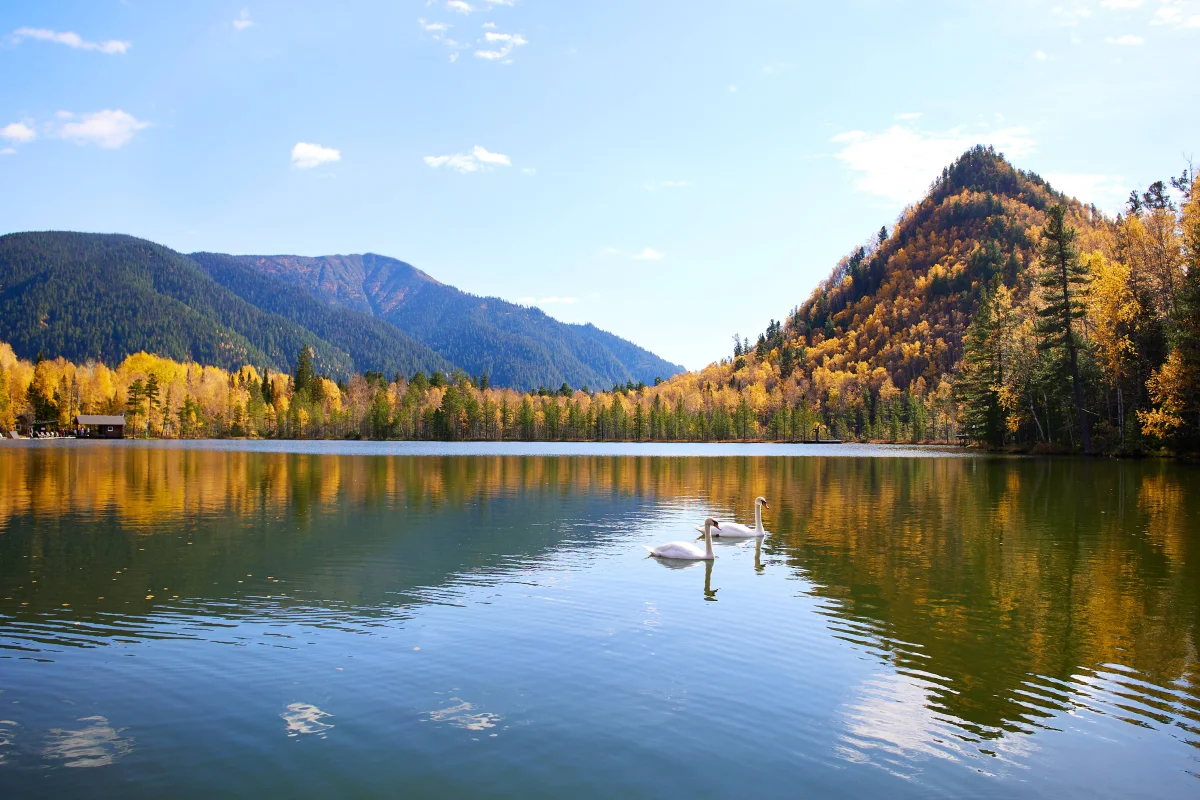
Altai in September is one of Russian autumn's biggest highlights. The larches covering the mountain slopes turn yellow, transforming valleys into a golden sea. Weather: +12–18°C during the day, with frost possible at night, but daytime stays dry, sunny, and clear.
The Chuya Highway — one of the world's most beautiful roads (per National Geographic). Driving it in September is 700 kilometers of shifting landscapes: from birch groves near Biysk to the steppes of Kosh-Agach, crossing the Seminsky and Chike-Taman passes. Every turn brings a new picture.
Lake Teletskoye — early September can still deliver warm days (+15–18°C), and waterfalls run full after summer rains. By month's end, it turns cold and tourist infrastructure winds down — but that's exactly when the lake gets a silence impossible to find in July.
Chemal — the most accessible entry point for a first-time Altai visit. The confluence of the Chemal and Katun rivers, the suspension bridge, Patmos Island. September makes for comfortable, unhurried walking without summer's rush. And early autumn is pine nut season: cones ripen right around September, and markets sell them by the sackful.
Baikal: Clear and Empty
Baikal in September suits those who value silence. Tourist flow drops, lodges empty out, and the lake takes on the transparency it's famous for worldwide: visibility down to 40 meters. Water temperature: +10–14°C (swimming only for polar plunge enthusiasts), air: +10–16°C.
Listvyanka — the village nearest Irkutsk on the shore — remains accessible in September: ferries run, the nerpa (seal) show operates, and restaurants serve Baikal omul.
Olkhon Island — the sacred site of Cape Burkhan (Shaman Rock) is wrapped in golden steppe and blue sky in early autumn. By late September, the Olkhon ferry crossing may close due to storms — check the schedule.
A separate story is the Circum-Baikal Railway (CBR). An old line running along the lake's southern shore: tunnels, bridges, viaducts, cliffs dropping into the water. In September, an excursion train runs from Irkutsk, and golden taiga outside the window is the best argument for coming here in autumn specifically.
Kamchatka: Volcanoes Without the Lines
Kamchatka is expensive and remote — but those who make it there call it the country's best destination. September is the last month of active season and, in many people's view, the most beautiful: tundra turns crimson and orange, volcanoes get their first dusting of snow, and bears come to the rivers to fish for silver salmon.
Temperature: +10–14°C, changeable — sun can turn to rain within the hour. But it's precisely in September that the odds of seeing volcanoes cloud-free rise — summer more often shrouds them.
Hot springs operate year-round, and soaking in a thermal pool at +38°C against a backdrop of snow-dusted hills is a sensation unmatched anywhere else. A helicopter excursion to the Valley of the Geysers starts at 45,000 rubles per person, but there's no alternative way to reach it.
Flights from Moscow to Petropavlovsk-Kamchatsky start at 25,000 rubles one-way with early booking. Flight time: 8.5 hours; time difference: +9 hours.
Caucasus Mineral Waters: Treatment Plus Golden Autumn
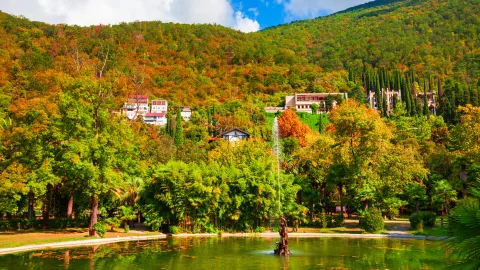
Kislovodsk, Pyatigorsk, Yessentuki, Zheleznovodsk — four cities offering a rare September combination: warm weather (+18–23°C), mineral springs, terrenkur walking trails, and parks drenched in autumn colors.
Kislovodsk National Park — one of Europe's largest urban parks (966 hectares). In September, deciduous trees start turning yellow, trails are dry, air transparent — ideal conditions for long walks.
Terrenkur (medicinal walking along marked routes of varying difficulty) is what draws people here: the load is measured, elevation gain gentle, and the views — on clear days — reach Elbrus.
In Pyatigorsk, outdoor thermal-water pools still operate in September. Climbing Mount Mashuk (by cable car or on foot) is a must-do program: from the top, the entire Caucasus range is visible, and on clear days, both peaks of Elbrus.
What to Consider When Planning
- Tickets
Domestic flights get cheaper in September, but popular destinations (Sochi, Kaliningrad, Kamchatka) are best booked a month to a month and a half out. Trains are an alternative: Moscow to Sochi takes 24 hours, to Kislovodsk, 26 — but with views and no baggage restrictions.
- Accommodation
September prices run 20–40% below peak, but the first week of the month (while kids are still trickling back to school) can see high demand. The second half of September is the best-value window.
- Weather
September is transitional, and by month's end, everywhere except the Black Sea coast turns noticeably colder. Baikal and Altai may see nighttime frost; Kamchatka, prolonged rain. Layered clothing, a waterproof jacket, and a backup plan for bad weather are standard kit.
September in Russia is the month when nature is at its most generous: sea still warm in the south, mountains already gold in Altai and the Caucasus, first snow on Kamchatka's volcanoes, and Baikal at its clearest. No international passport needed for any of it — just a ticket and a free week.