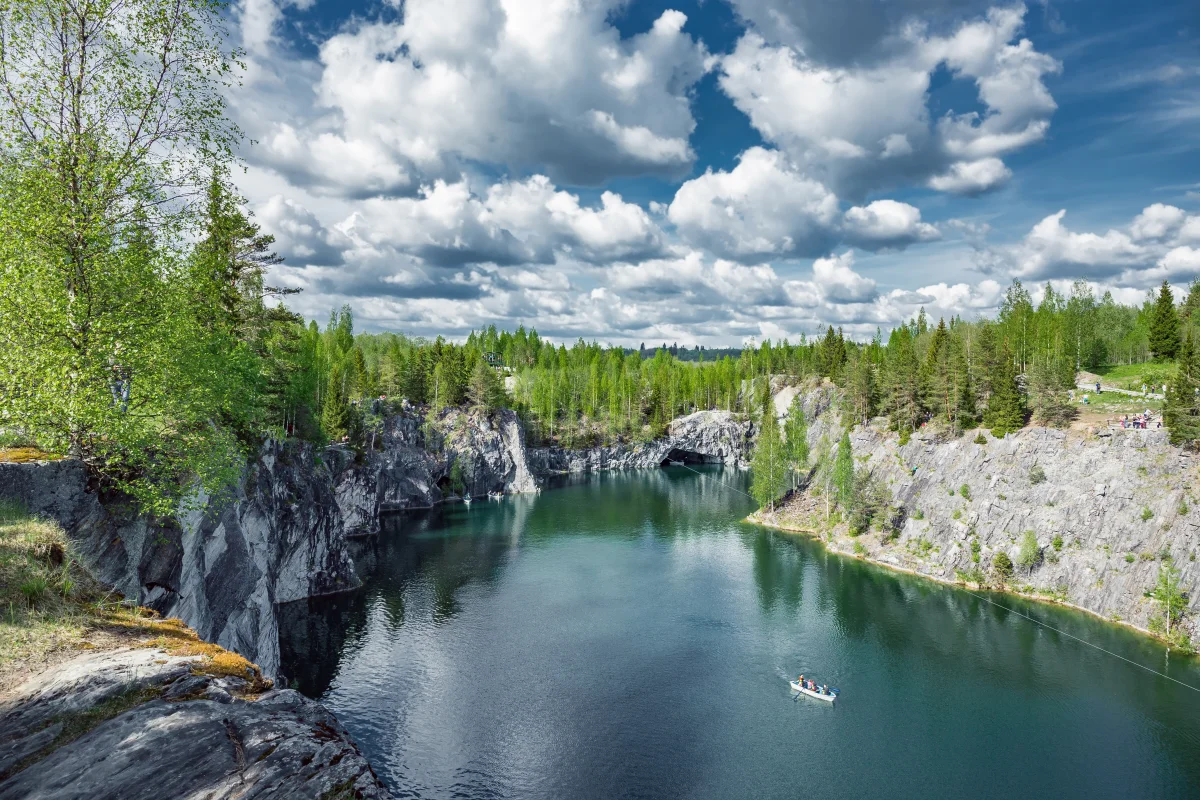
Karelia has 27,000 lakes, but the swimming season on most of them fits into four or five weeks. Average water temperature in July is around +20°C, and by local standards that qualifies as "warm." But if you know which lakes heat up best, you can swim for pleasure — not just to win a bet.
Karelia isn't a beach destination in the conventional sense. People come here for rocky shores, white nights, waterfalls, and Kizhi. But in summer — especially in hot years — Karelian lakes become a legitimate alternative to overcrowded southern beaches. Just with their own set of rules.
When Swimming Season Starts in Karelia
Ice on Karelian lakes breaks up in late April through May, but the water remains frigid long after. In June, most bodies of water sit at +10–16°C. Only polar plunge enthusiasts swim at those temperatures.
Comfortable swimming begins in mid-July, when shallow lakes warm to +20°C and above. The peak falls in late July through the first half of August: +20–24°C in smaller lakes, +18–20°C in larger ones.
By the second half of August, the water starts cooling. By September it's +14–16°C, and swimming becomes an exercise in hardening. The total window: four to six weeks, depending on how generous the summer is with sunshine.
Why Some Lakes Are Warmer Than Others
A simple rule applies in Karelia: the smaller and shallower the lake, the warmer the water. Ladoga and Onego are massive and deep — warming them during a short summer is a physical impossibility. But small forest lakes with sandy bottoms and depths of two or three meters heat up fast and release their warmth slowly.
The second factor is wind exposure. A lake nestled in a forested basin, sheltered by trees, retains its warm surface layer. An open lake on higher ground gets blown across, and wind mixes warm and cold water together.
The third is bottom color. A dark, peaty bottom absorbs sunlight and transfers heat to the water. A light, sandy bottom reflects it.
Paradoxically, "brown" forest lakes are often warmer than "crystal clear" ones — even though it looks like it should be the other way around.
Where the Water Warms Up Best
- Syamozero
One of the warmest lakes in Karelia — in July–August, water in the shallow bays reaches +22–24°C. Sandy beaches, gentle entry, clear water. Located in southern Karelia, 70 km from Petrozavodsk. Lakeside lodges and campgrounds on the shore. For families with children — one of the best options.
- Lake Lososinnoye
20 km from Petrozavodsk. Small, shallow, heats up well — to +22–24°C at the height of summer. Sandy stretches of shore, easy access by car. Popular with locals — can get busy on weekends.
- Vagvozero
A compact lake with a sandy shore. Warms quickly, reaching +22°C by mid-July. Quiet, uncrowded — suits anyone seeking solitude.
- Konchozero
An elongated lake 50 km from Petrozavodsk. Water warms to +20–22°C. Nearby stands Russia's first spa resort, Martsialnye Vody, founded by Peter the Great.
- Urozero
One of the most transparent lakes in Karelia — visibility up to 10 meters. Warms to +20–22°C. The bottom is sand and stone, the water has a bluish tint. The sensation is like swimming in a Swiss alpine lake.
- Koionsaari Island (Ladoga)
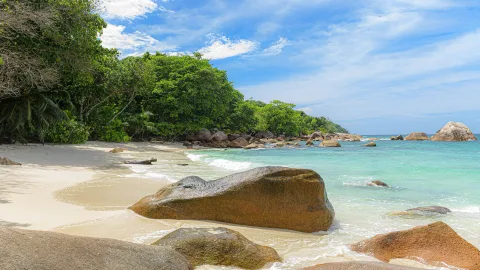
Ladoga as a whole is cold — +14–17°C even at the height of summer. But the sandy shoal at Koionsaari warms to +20–22°C thanks to the shallows. White sand, turquoise water, pine trees — images you wouldn't believe come from Karelia.
Onego and Ladoga: Great but Cold
Europe's two largest lakes are Karelia's headline attractions, but not its best for swimming.
- Lake Onego
Average depth: 30 meters; maximum: 127. In the open part, even in August — +16–18°C. But the city beach "Peski" in Petrozavodsk is the exception: a shallow bay with a sandy bottom warms to +20–22°C. It's the main swimming beach of the Karelian capital — with infrastructure, lifeguards, and a pier.
- Lake Ladoga
Even bigger and colder: average depth of 50 meters, and in the central part during summer — +8–12°C. Near the shores — +14–18°C, and only in the shallow skerries and inlets does the water reach +20°C. Ladoga is a lake for kayaking, fishing, and contemplation — not for beach vacations.
What Tourists From the South Don't Expect
- Mosquitoes and Black Flies
The supreme test of a Karelian summer. In June–July near the water, clouds of biting insects descend. Repellent, head nets, and covered clothing aren't precautions — they're a necessity. Things ease up by August, but the insects don't fully retreat until September.
- Ticks
Karelia is on the endemic list for tick-borne encephalitis. It's best to get vaccinated in advance, and while outdoors, check yourself every couple of hours.
- Weather Swings
+22°C and sunshine in the morning, +14°C and rain by noon, clear again by evening. Karelian weather changes faster than your mood, and warm layers are essential even in July. Keep a jacket and rain gear in the car at all times.
- Wild Beaches
The vast majority of Karelian beaches are unequipped. No lifeguards, no changing cabins, no cafés. The bottom is unsurveyed, depth is unpredictable. It's part of Karelia's charm — and part of the risk.
Which Month to Choose
Want to swim — late July or the first half of August. Water is at its peak, mosquitoes are already thinning out, days are long. Choose small lakes in southern Karelia — Syamozero, Lososinnoye, Urozero.
Want nature without the biting — second half of August or early September. Swimming is an acquired taste, but mosquitoes are nearly gone, forests are turning their first gold, and mushrooms and berries are everywhere.
Want white nights — June. The water is cold, but a night that never falls is a spectacle worth enduring +15°C in a lake for.
And the most important thing: don't go to Karelia expecting a "beach vacation" in the Black Sea sense. Here, swimming is part of the adventure, not its purpose.
Diving into a transparent lake after a lakeside sauna, swimming out to a rocky islet, drying off on sun-warmed stones with a view of the pine forest — that's a different format entirely. And it's worth every minute spent in water whose temperature is best described as "bracing, but bearable."