The Paris Catacombs, France
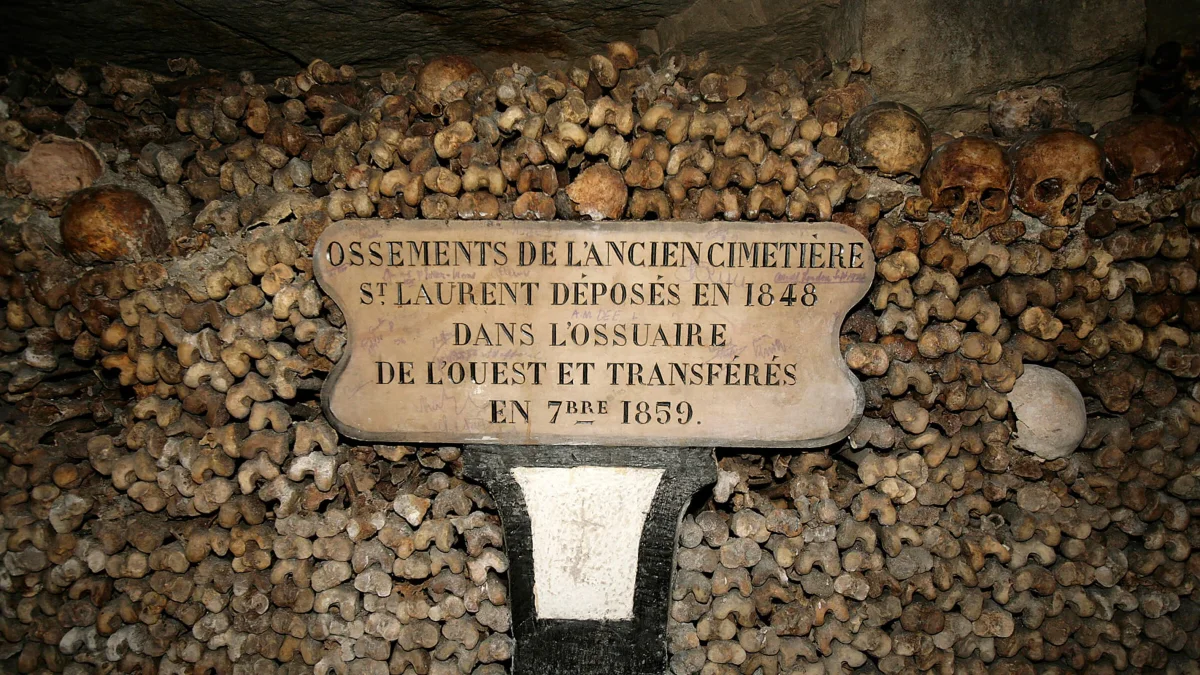
Beneath the heart of France – Paris – lies one of the strangest and most frightening underground cemeteries in the country. The many kilometers of tunnels, part of which remains unexplored to this day and is a mystery, have literally encircled the capital. Serious problems facing the city forced the construction of such labyrinths.
The year 1780 is considered the starting point. The famous Cemetery of the Innocents, where all the dead of Paris and its environs were buried, neighbored the central market. Dirt, garbage, and waste were often dumped right onto the graves. And one day, in the basements of houses tightly adjoining the Cemetery of the Innocents, the walls collapsed. Foul-smelling sludge poured into people's dwellings, and along with it the dead tumbled out. The threat of an epidemic forced the authorities to use the quarries beneath Paris as catacombs, widening and deepening them in order to set up an enormous cemetery here later. From morning till evening the residents of the city carted the remains of the dead to the new burial place. And it seemed that this horrifying, grim procession would never end.
Over the course of almost a quarter of a century, more than six million dead Frenchmen found peace in the catacombs. Many of them lie in special burial chambers – ossuaries. Here the great people of France's past found their final resting place: François Rabelais, Charles Perrault, the physicist Blaise Pascal, Robespierre, Danton, Marat.
Today the Paris Catacombs – are a favorite place for tourists from all corners of the world. They stand in long lines just to catch a glimpse of, for example, the Barrel. That is the name of a composition of the bones of the dead, framed with skulls. Incidentally, business life is in full swing in the underground cemetery of Paris. Beginning in the 19th century, enterprising French farmers have been growing entire plantations of champignon mushrooms in the abandoned tunnels.
Poveglia Island, Italy

Poveglia Island, occupying an area of about a hundred hectares, seems to be stuck in the sea like an enormous boulder. The deserted patch of land with the surviving remnants of former life concealed a deep sadness and sorrow. And only a little later do other feelings come: fear and horror. When at night the tolling of bells sounds – and in the pitch darkness the voices of people calling for help can be heard. According to the Italians, – these are the souls of the dead, lamenting their fate.
Here, on the Island of Plague in the second half of the 16th century, a tragedy occurred whose scale is still unknown to this day. It is precisely from that moment that Poveglia is called the «Gates of Hell,» the «Refuge of Lost Souls.» Prosperous Venice, facing the threat of an invasion of bubonic plague that was devastating the cities of Europe, made a radical decision – all the sick were brought to Poveglia Island. Among their number were even healthy people suspected of having the plague. And in blazing fires they burned alive together with the corpses of the dead. The terrible fame stripped Poveglia Island of its former prosperity. It quickly emptied, and no one wanted to settle in this cursed place.
In 1922 an asylum for elderly mentally ill patients was opened on Poveglia Island. However, this event opened yet another grim page in its history. The head physician, in the name of science, as he believed, conducted insane, cruel experiments on people within the walls of the psychiatric hospital. For example, with the help of a hand drill, a chisel, and a hammer and without anesthesia, the doctor performed lobotomies on patients.
In 2015 a glimmer of hope appeared that the cursed island would at last turn into a corner of civilized tourism. The Italian businessman Luigi Brugnaro won an auction for 513,000 euros and became the owner of Poveglia for 99 years. He became eager to outfit the island with modern hotels and to improve it for future guests. Alas, Brugnaro was soon elected mayor of Venice, and the project to transform the Island of Plague into a cherished retreat remained only on paper.
The Scarecrow Village of Nagoro, Japan

The Japanese village of Nagoro, tucked away in the valleys of the small island of Shikoku, was no different from others. Young people strove to get to the cities, while the old people were left to live out their days. The village quickly emptied, and only a few dozen people would serve as a reminder of its former past. But soon the artist Ayano Tsukimi returned to her native land, to her aged father.
According to her, the idea of recreating the village out of cloth dolls came unexpectedly. The constant invasions of birds onto the vegetable garden prompted her to make a kakashi – a scarecrow – out of rags and straw. To her surprise, Ayano found in the scarecrow an amusing resemblance to her father. This pushed her toward the idea of reviving the village in the images of friends and neighbors.
From afar it seems that in the field dozens of peasants are working tirelessly. And at the bus stops slightly weary people are waiting for the bus. In reality, – these are frozen scenes from human life. And the role of the people is played by cloth dolls. The village of Nagoro not infrequently terrifies drivers. They are very afraid of the kakashi standing along the road, mistaking them at first glance for ordinary people.
The Chapel of Bones, Portugal
.jpg)
The Chapel of Bones in Évora – is one of the most frightening landmarks of Portugal. It was built in the 16th century by Franciscan monks during a plague epidemic. So many people were dying that there was not enough room in the cemetery. And then the monks found a way out of the situation that had arisen. To some extent it can even be called sophisticated and barbaric. From all the burials they gathered the bones and skulls of the dead and treated them with slaked lime. As a result, the human remains stood out for their whiteness. The broken skulls and bones, in crushed form, went into the cement mortar. The composition conceived by the monks had a mystical, philosophical character. The walls and columns of the chapel, lined with skulls, were meant to vividly demonstrate the vanity of human existence.
The City of the Dead, North Ossetia
.jpg)
Dargavs – the City of the Dead lies on a picturesque hill and is strewn all over with crypts. There is not even a hint here that human life once flowed in this place. The road to the Ossetian necropolis is always shrouded in fog, and there is always a sense of some anxiety in the air. At the end of the path, on hilly terrain, are located 97 crypts. Their walls are built of strong hewn stones. With the help of a special mortar consisting of lime, milk, sour cream, and bird eggs, these structures were built, it seems, to last for centuries.
The favorable microclimate in the crypts and the natural ventilation made it possible to preserve even the clothing on the dead. We note that most of them lie in coffins shaped like a boat. The Ossetian necropolis has recently attracted the interest of many tourists. Each of them so wants to visit the City of the Dead in order to immerse themselves in its secrets and mysteries.
The Ecological Top Ten: The Dirtiest and the Cleanest Cities on the Planet