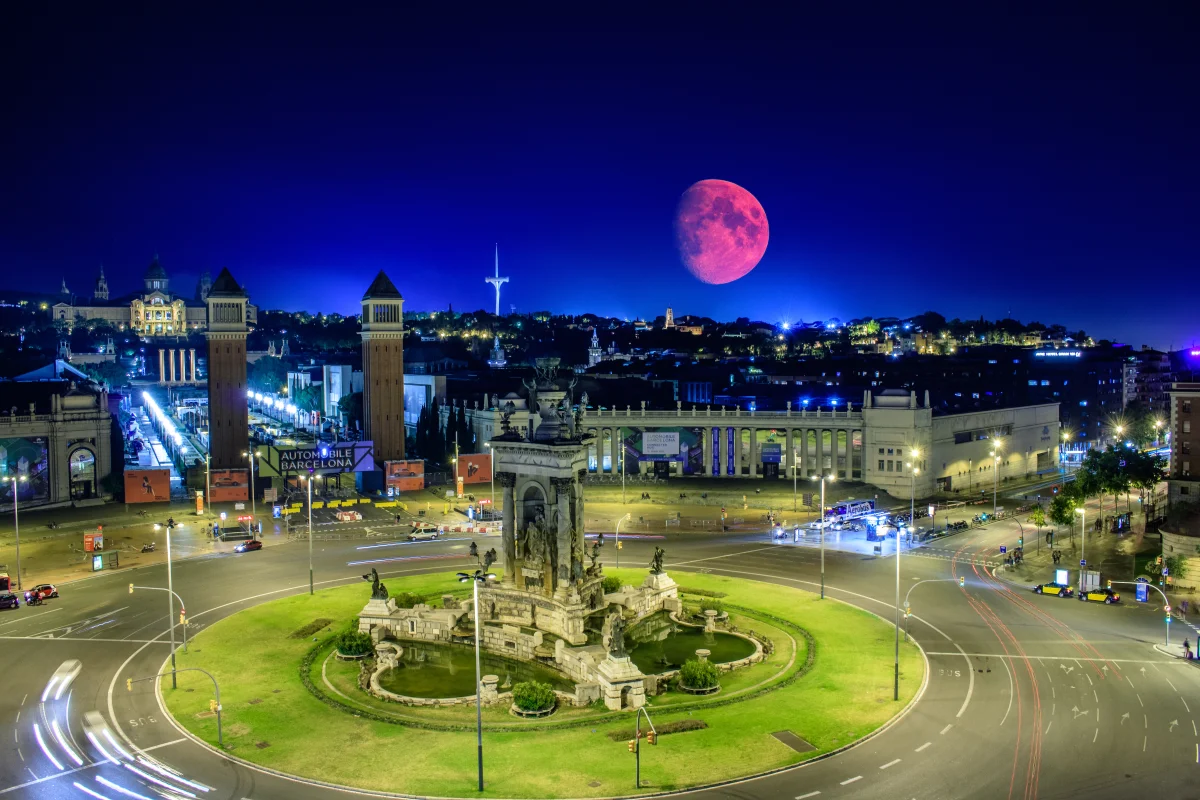
On March 3, 2026, the Moon turned copper-red for 59 minutes — the only total lunar eclipse of the year. The next "Blood Moon" won't arrive until December 31, 2028, but the phenomenon itself has nothing to do with blood or mysticism — only with the physics of light.
The name sounds ominous, and for millennia people genuinely took a red Moon as a bad omen. Medieval chronicles linked its appearance to wars, plagues, and divine wrath.
In reality, a "Blood Moon" is a total lunar eclipse — one of the most beautiful and entirely harmless astronomical events, visible to the naked eye.
Why the Moon Turns Red
During a total lunar eclipse, the Earth positions itself between the Sun and the Moon, casting its shadow onto the satellite. Direct sunlight can't reach the Moon — so logically, it should simply go dark. Instead, it turns red.
The reason is Earth's atmosphere. Sunlight passing tangentially along the planet's edge refracts through the atmosphere like through a giant lens. White light is made up of waves of different lengths: blue and green waves are short, red waves are long. The short waves scatter in the atmosphere (which is why the daytime sky is blue), while the long red waves pass all the way through and reach the lunar surface.
In essence, a Blood Moon is illuminated by every sunrise and sunset on Earth simultaneously. The red light refracting through the atmosphere along the planet's entire terminator converges on the lunar disk — and paints it.
Why the Shade Is Different Every Time
Not all Blood Moons are equally red. The hue ranges from bright orange to dark brown, nearly black. It depends on the state of Earth's atmosphere at the moment of the eclipse.
If the atmosphere is loaded with dust or volcanic ash, the Moon appears dark and dim because even the red rays scatter off the particles. After major eruptions — Pinatubo in 1991, Tonga in 2022 — eclipses produced a nearly black disk. In a clean atmosphere, the Moon turns bright, coppery orange.
To rate eclipse brightness, astronomers use the Danjon scale — from 0 (Moon nearly invisible) to 4 (bright, copper-orange, with a bluish fringe along the edge). The March 2026 eclipse scored around 3–3.5 — vivid and spectacular.
How a Lunar Eclipse Differs From a Solar One
Confusing the two is one of the most common mistakes. The difference is fundamental.
In a solar eclipse, the Moon passes between the Earth and the Sun, blocking the solar disk. It's only visible from a narrow strip roughly 200 kilometers wide, and totality lasts just a few minutes. Looking at it without protective eyewear means instant retinal burns.
In a lunar eclipse, the Earth passes between the Sun and the Moon. It's visible from half the planet at once — everywhere the Moon is above the horizon. Totality can last up to 107 minutes. You can watch safely with the naked eye; binoculars or a telescope reveal more detail but aren't necessary.
Why a Blood Moon Doesn't Happen Every Month
A full Moon occurs every 29.5 days, but an eclipse doesn't follow every time. The Moon's orbit is tilted 5 degrees relative to Earth's orbital plane, and during most full Moons the satellite passes slightly above or below Earth's shadow, missing it entirely.
An eclipse only occurs when a full Moon coincides with the Moon crossing an orbital node — a point where the lunar and terrestrial orbital planes intersect. This happens two or three times a year, but not every one of those eclipses is total. Full lunar eclipses occur on average once every year and a half.
The Eclipses of 2026
There are two lunar eclipses in 2026.
March 3 — total. The Moon entered Earth's shadow for 59 minutes, taking on its characteristic red hue. It was not visible from European Russia — the Moon was below the horizon at the time. Observers in the Russian Far East, East Asia, Australia, and the Americas had front-row seats.
August 28 — partial. The Moon will enter Earth's shadow by 93%, but totality won't occur — the disk won't be fully immersed. However, it will be visible from European Russia, making up for the missed March event.
When Is the Next Blood Moon for Russia?
The next total lunar eclipse observable from Moscow, St. Petersburg, and central Russia falls on December 31, 2028. A New Year's Eve Blood Moon sounds like a movie plot, but it's a genuine astronomical forecast.