Turquoise surface, blue clay, patterns on the bottom that shift right before your eyes. Right next to it: a sign reading "No Swimming." And someone is already taking off their shoes: "What's dangerous about it, the water's warm!" A minute later — a splash, a cloud of murky sediment, a ruined view, and startled tourists all around. That's the mild version of the story. It can get much worse.
Geyser lakes, thermal springs, and hot vents show up in dozens of places around the world — from Kamchatka to Yellowstone, from Iceland to New Zealand. Many of them are stunning: vivid colors, clear water, steam curling above the surface. But beauty is a terrible indicator of safety.
The water in these basins can be acidic, alkaline, toxic, boiling — or all of the above at once. The ban on swimming isn't bureaucratic overcaution; it's a direct consequence of physics and chemistry that's worth understanding before you decide to "just dip in."
Temperature: From a Warm Bath to Boiling Water
The first and most obvious danger is temperature. Geyser lakes and thermal springs are fed by water heated deep underground by volcanic activity. On the surface, that water can feel comfortably warm (77–95°F / 25–35°C) — or it can be lethally hot.
In Yellowstone National Park (USA), some hot springs reach temperatures of up to 199°F (93°C) — nearly the boiling point at the park's elevation. In Abyss Pool, temperatures exceed 140°F (60°C) at depths of more than 15 meters.
In 2016, 23-year-old Colin Scott slipped and fell into one of Yellowstone's boiling springs. By the time rescuers arrived the next day, his body had dissolved in the acidic water. Since 1870, at least 22 people have died in the park's thermal pools.
In Kamchatka, water temperatures in the Valley of Geysers range from 140°F to 208°F (60–98°C). The area can only be approached along equipped boardwalks — even a single misstep off the path can cause severe burns. The ground around the geysers is saturated with hot water, and a crust that looks solid can collapse underfoot.
The insidious part is that temperature isn't always visible. A lake can look calm and harmless — no steam, no bubbling. But water at 122°F (50°C) doesn't boil or steam on a warm day — it simply destroys tissue on contact. A third-degree burn can happen in seconds.
Chemical Composition: Acid, Alkali, and Heavy Metals
Temperature isn't the only enemy. Many geyser lakes have an extreme chemical composition that makes the water toxic regardless of temperature.
Sulfuric Acid
Volcanic activity releases sulfur dioxide, which dissolves in water and forms sulfuric acid. In some thermal lakes, the pH drops to 1–2 — a level of acidity comparable to car battery fluid. Such water can corrode skin, clothing, and shoes within minutes.
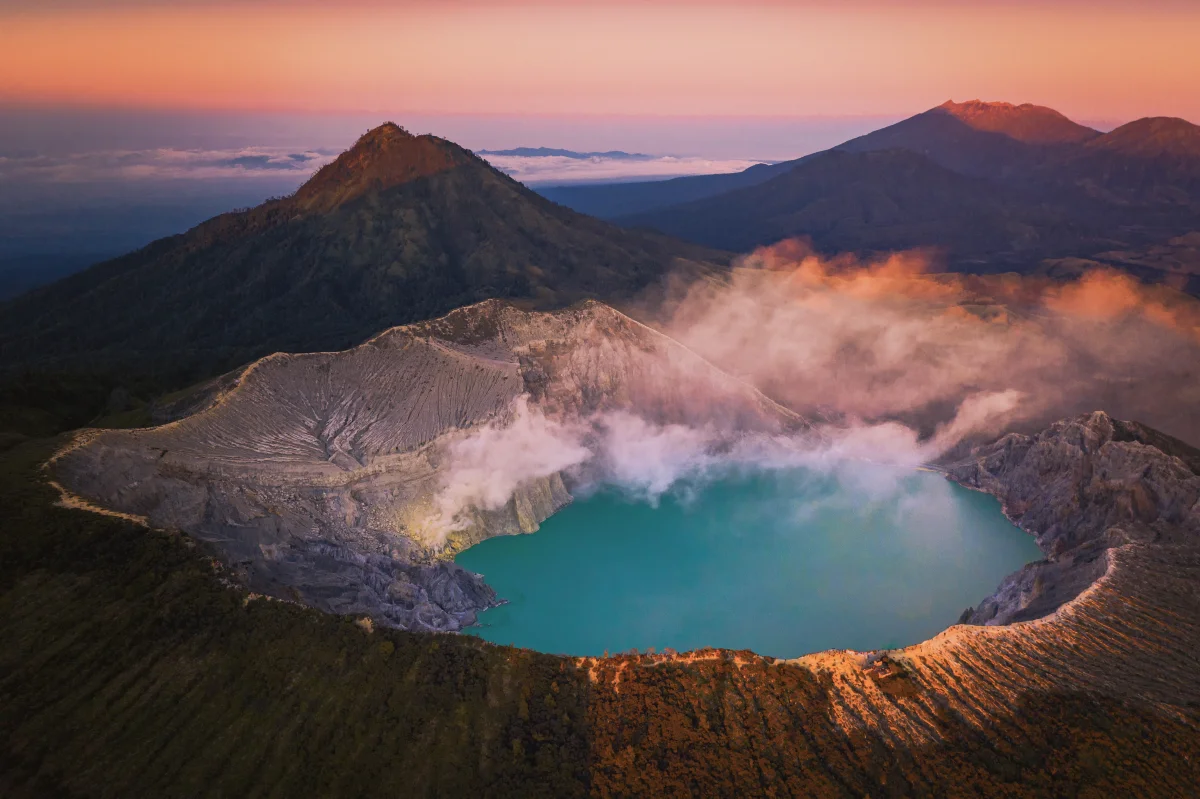
Kawah Ijen on the island of Java, Indonesia, is one of the most acidic bodies of water on the planet: a turquoise lake with a pH of around 0.5. It looks magical, but standing on the shore requires a respirator.
Alkalinity
The opposite extreme is alkaline lakes with a pH above 10–11. Lake Natron in Tanzania, famous for its red-pink surface, contains such a high concentration of soda and alkali that animals that fall in become calcified — literally turned to stone. Water temperatures reach up to 140°F (60°C), with a pH above 10.5.
Arsenic, Mercury, Fluoride
As thermal water passes through volcanic rock, it leaches out heavy metals. In Yellowstone, the water contains arsenic, mercury, and fluoride at concentrations far exceeding safe limits. Even scooping up that water in a bottle to drink is dangerous.
In 2026, a tourist at Yellowstone was filmed drinking water directly from a thermal spring off a wooden boardwalk — the video sparked widespread outrage: beyond chemical burns to the mucous membranes, such water can cause severe poisoning.
Gases: The Invisible Threat
Volcanically active zones release not just hot water but also gases: hydrogen sulfide, carbon dioxide, sulfur dioxide, methane. Some are lethal even in small concentrations.
Hydrogen sulfide (H₂S) — a gas with the characteristic smell of rotten eggs. At low concentrations it's unpleasant but harmless. Above 100 ppm, it causes loss of smell (the person stops noticing the odor), dizziness, and loss of consciousness.
At 500 ppm and above, it can cause death within minutes. Near geyser fields and acidic lakes, hydrogen sulfide concentrations can exceed safe limits by tens of times.
Carbon dioxide (CO₂) — heavier than air, it pools in low-lying areas, depressions, and around lakes. It has no smell or color. In 1986, Lake Nyos in Cameroon released an enormous cloud of CO₂ that rolled down the mountainside and killed more than 1,700 people in surrounding villages. People suffocated in their sleep.
In geothermally active zones, gases can be released unpredictably — a gust of wind, a shift in pressure, a tremor underground. That's another reason stepping off the designated path toward the edge of a thermal spring is a bad idea.
The Fragile Crust: Ground That Deceives
Around geyser fields, the soil is often covered by a mineral crust — a thin layer of deposits formed by evaporating thermal water. This crust looks like solid ground: dry, pale, sometimes even with vegetation growing on it. But underneath is hot sludge, mud, or boiling water.
In Yellowstone, several people have fallen through the crust and suffered severe burns after stepping "just a couple of steps" off the equipped trail. In some places, the mineral layer is only a few centimeters thick — it can hold the weight of a small stone, but not a person.
In Kamchatka, around fumaroles (vents releasing hot gas), the crust can be even thinner. Experienced guides know the safe routes, but tourists who decide to "get a little closer" on their own risk falling through into ground at 176–212°F (80–100°C).
The Geyser Lake in Altai: A Different Story
Not every geyser lake is deadly. Geyser Lake near the village of Aktash in the Altai Mountains is a small body of water (30 meters / about 100 feet across) with turquoise water and patterns of blue clay on its bottom. The water temperature is around 50°F (10°C), the chemical composition is harmless, and the depth is only about 2 meters. You won't get burned or poisoned here.
Swimming is banned nonetheless — but for a different reason. Thermal springs on the lakebed stir up clay and sand, creating the very patterns that draw thousands of tourists here. The moment one person jumps in, sediment rises, the patterns disappear, and the water stays murky for hours or even days.
The lake is a fragile ecosystem, and every swim causes it measurable damage. In May 2025, a tourist who jumped into Geyser Lake for a video sparked widespread outrage among visitors and online.
Here, the ban isn't about bodily safety — it's about preserving the site. Yet people break it just as casually.
Why Vivid Color Is a Warning Sign
The most photogenic geyser lakes — turquoise, emerald, yellow, orange — owe their color not to beauty but to chemistry and biology.
Turquoise and blue come from light scattering off particles of silica (quartz dust) suspended in the hot water. The finer the particles, the brighter the blue tint — the same effect that makes the sky blue.
Yellow, orange, and red come from colonies of thermophilic bacteria and archaea that thrive at temperatures between 140°F and 194°F (60–90°C).
The famous Grand Prismatic Spring in Yellowstone — the largest hot spring in the US — owes its rainbow halo to these microorganisms. The center of the spring is blue (too hot even for bacteria, at 189°F / 87°C), while the edges glow orange and red (bacterial mats thriving at 140–158°F / 60–70°C).
Green often signals the presence of sulfur or specific algae. Milky white indicates suspended mineral particles.
A vivid color is a marker of extreme conditions. If an ordinary lake is green, that's algae. If a geyser lake is green, it could be sulfur. The difference is between harmless and lethal.
Where Russia's Dangerous Thermal Waters Are Found
- Kamchatka is the main region — home to the Valley of Geysers, the caldera of the Uzon volcano, and the Paratunka and Mutnovka thermal springs. Temperatures range from a comfortable 100°F (38°C) in Paratunka's equipped bathhouses to 208°F (98°C) in the geysers themselves. The acidic lakes in the Uzon caldera have a pH below 2 — swimming in them is essentially diving into vinegar.
- The Kuril Islands — the Golovnin volcano on Kunashir Island has Boiling Lake, with water temperatures up to 176°F (80°C) and hydrogen sulfide and carbon dioxide bubbling up from the bottom.
- Altai — Geyser Lake near Aktash (chemically safe, but off-limits for a different reason) and the hot springs in the Dzhumaly River valley.
Equipped thermal spas — such as Paratunka in Kamchatka, Geduko in Kabardino-Balkaria, and the springs of the Tyumen region — are a different matter: there, the water is cooled, treated, and safe for bathing. Even so, they come with time limits: no more than 15–20 minutes per session, with breaks in between.
What to Remember
A geyser lake is not a swimming pool. Water shimmering in every shade of turquoise can be acidic, laced with heavy metals, or hot enough to cook protein in seconds. The ground around it can give way underfoot. The air can carry a gas that kills without smell or warning.
The "No Swimming" signs, fences, and wooden boardwalks in thermal zones aren't excessive caution, and they're not there to ruin your photo. They mark the line between a spectacle and an accident. On one side: an incredible shot. On the other: a burn, poisoning, or a story that gets told without you in it.
Look — yes. Photograph — yes. Touch, taste, jump in — no. The beauty of geothermal zones doesn't require contact. It requires distance.