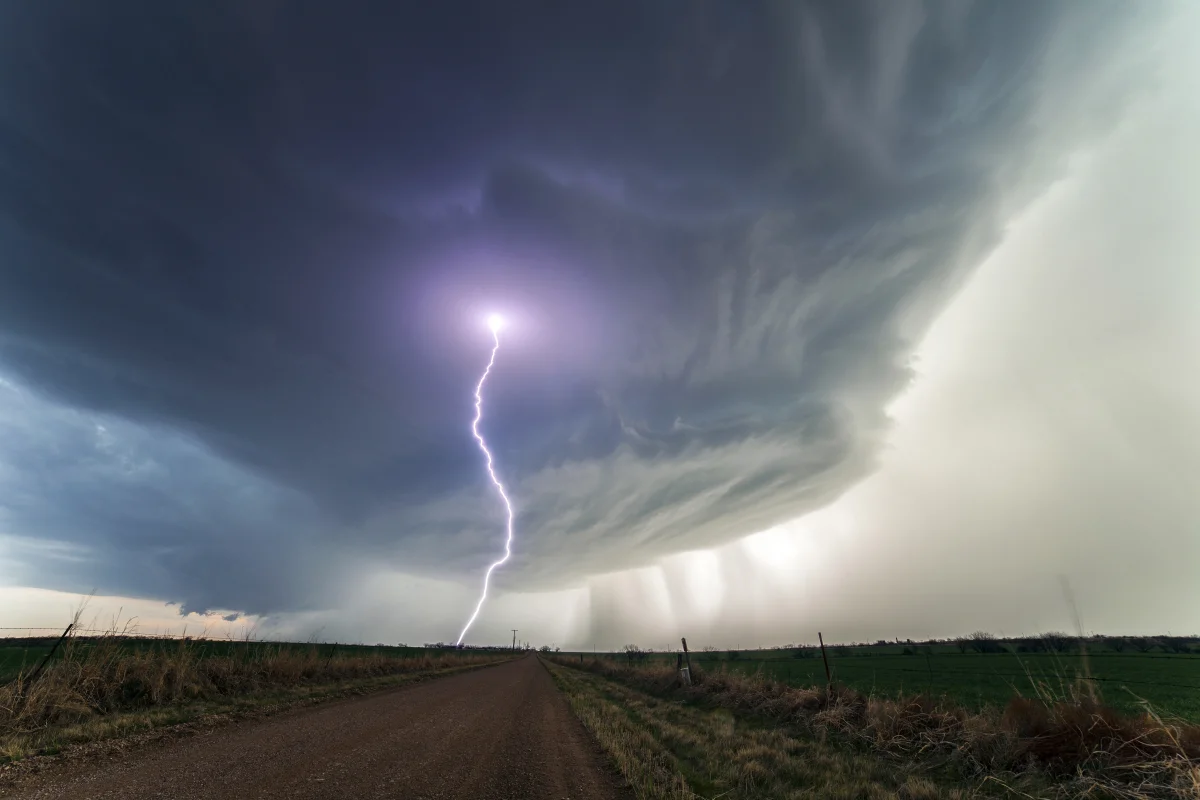
The storm's approaching, thunder's already audible, but the rain hasn't started yet — and it feels like there's time for one more lap. That's exactly the moment a body of water turns into the most dangerous spot on open terrain.
"Lightning strikes trees and tall objects, and water is flat, lower than the shore, it won't get hit there" — this logic still shows up on forums today. It sounds convincing, and it's fatally wrong. Lightning strikes water regularly, and the physics of what happens afterward turns swimming during a storm from a risky activity into one of the most dangerous things you can do.
Why a Swimmer's Head Is a Perfect Target
Lightning seeks the shortest path between a cloud and the ground, striking the highest point in an area. On shore, that point is a tree, a pole, a building. But out on open water, nothing stands taller than a swimmer's head — it juts above the flat surface like the only prominent feature around. To a discharge, that's a ready-made lightning rod.
Even someone standing chest-deep near shore still has their head and shoulders rising above the surface.
At a distance of several dozen meters from shore, with no trees or structures around, a swimmer can end up being the tallest point within the radius — and lightning will pick them.
What Happens When Lightning Hits Water
This is where the real danger begins. Lightning is an electrical discharge carrying up to 200,000 amps of current, with a channel temperature reaching 30,000°C. When it strikes water, the energy doesn't travel straight down into the depths — it spreads across the surface in every direction, gradually weakening with distance.
Fresh water contains dissolved salts and minerals that make it a decent electrical conductor. Current from a lightning strike spreads across a body of water for dozens of meters — and with a powerful discharge, up to a hundred meters or more. Anyone within that radius takes a hit — not a direct one, but enough to stop a heart.
Why a Direct Hit Isn't Necessary
This is exactly what makes water uniquely dangerous during a storm. On land, lightning strikes a specific object — a tree, a person, a pole. Someone standing ten meters away is relatively safe (though even there, step-voltage risk exists).
In water, it's different: current spreads across the entire surface, and a person 50–80 meters from the strike point can receive an electric shock strong enough to cause loss of consciousness.
Firuz Ashurov, a resuscitation physician at Moscow's Zhadkevich City Clinical Hospital, notes that people often die not from the electrical shock itself, but from losing consciousness in the water and drowning. Even when a discharge doesn't kill outright, it causes convulsions and temporary muscle paralysis — and in water, losing control of your body means drowning.
Why Salt Water Is More Dangerous Than Fresh Water
Seawater conducts electricity roughly 80 times better than fresh water, thanks to a much higher concentration of dissolved sodium and chlorine ions. That means current from a lightning strike in the sea travels further, striking over a wider area.
But there's a nuance: precisely because seawater is a superior conductor, current "prefers" to travel through it rather than through a human body (the body is a worse conductor than salt water).
In fresh water, the opposite happens — a swimmer's body becomes a better conductor than the surrounding water, so current tends to route through it. In practice, fatalities occur in both salt and fresh water, though the mechanism of injury differs slightly.
How Quickly a Storm Turns Dangerous
Yevgeny Tishkovets, lead specialist at the Phobos weather center, points to a rule that applies both on shore and in the water: count the seconds between the flash and the thunder. Three seconds equals one kilometer of distance to the storm.
If the interval drops below 30 seconds (meaning the storm is within 10 kilometers), get out of the water immediately.
But this rule has a trap: lightning can strike as far as 15–16 kilometers from a storm cloud — well beyond the rain zone. Thunder may not even be audible at that distance. The first strike can hit a body of water still sitting under a clear sky — a phenomenon English-language meteorology calls a "bolt from the blue."
The Shore Isn't Safe Either
Getting out of the water is the first step, not the last. On an open beach, a person remains vulnerable: wet skin conducts electricity better than dry skin, and metal objects (beach chairs, umbrellas, railings) attract a discharge.
After leaving the water, you should:
- Move away from the shoreline — don't linger at the water's edge.
- Never shelter under a lone tree — it will attract lightning.
- Stay clear of metal structures — masts, fences, lampposts.
- If possible, take shelter in a building or a car — a car's closed metal body acts as a Faraday cage, routing the current around the people inside.
If no shelter is available, crouch down with your feet together and wrap your arms around your knees. Never lie flat on the ground — the more surface area of your body touches wet ground, the higher the risk from step voltage.
Boats, Motorboats, and SUPs
A separate risk category is people on the water in boats. On a boat or a stand-up paddleboard, a person stands even higher above the water than a swimmer does, drawing lightning even more strongly. Falling into the water after a strike takes a second, while getting back to shore during a storm, disoriented, is a task not everyone can manage.
When a storm approaches, the only correct move is to paddle to shore immediately.
If shore is far away, lower the mast or paddle (removing the tallest object), sit as low as possible, and wait out the storm. On a motorboat, run at full speed toward the nearest shelter.
When It's Safe to Go Back In
The "30/30 rule" recommended by meteorologists: leave the water if less than 30 seconds separate the flash from the thunder, and don't return until at least 30 minutes have passed since the last rumble. Half an hour can feel excessive, but lightning can still strike after rain has stopped — a storm cloud moves away more slowly than it appears from the ground.
Patience here isn't overcaution — it's the only strategy that actually works. A body of water during a storm isn't a place where "probably nothing will happen." It's a place where physics works against you: a conductive medium, no shelter, a head as the highest point around. Thirty minutes of waiting on shore is a small price to pay to make it back into the water alive.