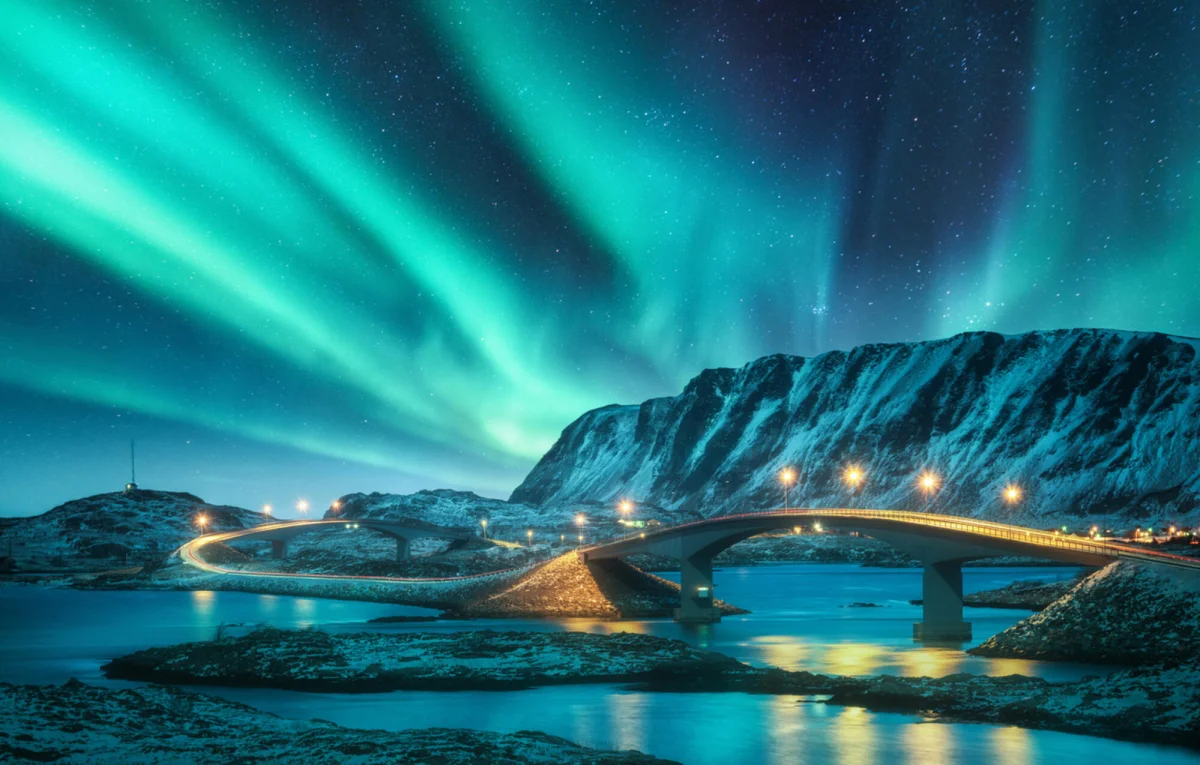
The northern lights occur year-round — it's just that in summer, you can't see them. Catching the glow requires three things to align: solar activity, a dark night, and clear sky. Each of these runs on its own calendar.
"When does the northern lights happen" is one of the most common search queries between September and March. The answer seems simple: winter, up north. But that "winter" conceals a set of variables — some tied to astronomy, others to weather, and others to the sun's eleven-year cycle, whose peak happens to fall right around 2025–2026. Let's break down when to go, and why there's reason to hurry.
Why the Aurora Doesn't Appear in Summer
More precisely, it does happen — you just can't see it. The northern lights result from charged solar wind particles colliding with atmospheric molecules at altitudes of 80–300 kilometers. These collisions happen constantly, regardless of season. But the glow is faint — visible only against a dark sky.
In summer, high latitudes get white nights and the polar day.
In Murmansk, the sun doesn't set below the horizon from May 22 to July 22, and twilight nights stretch on through the end of August. No darkness means no visible aurora, even if the atmosphere is genuinely glowing green at 100 kilometers up.
The Season: September Through March
The observation window opens once nights turn sufficiently dark and long. At the latitude of Murmansk or Tromsø, that runs from mid-September to late March — roughly half a year. At the latitude of St. Petersburg or Arkhangelsk, the season stretches a bit wider — from early September to April, since white nights there are shorter.
Within that window, the odds aren't uniform. Analysis of 95 years of aurora observation records shows two distinct activity peaks — around the autumn equinox (September–October) and the spring equinox (February–March).
This is the so-called Russell–McPherron effect: around the equinoxes, Earth's magnetic field sits in its most vulnerable position relative to the solar wind, allowing charged particles to penetrate the atmosphere more easily.
The Best Months Aren't December
Many people plan aurora trips for December–January, reasoning: longest nights, best odds. The logic makes sense, but it's incomplete. December nights genuinely are the longest, but cloud cover in this period also runs high — and the aurora is only visible under clear sky. On the Kola Peninsula, December and January rank among the cloudiest months.
Taking every factor into account — geomagnetic activity, length of darkness, and odds of clear sky — late February through March and October through early November are considered optimal.
February–March is especially strong: the equinox activity peak coincides with cold, often clear weather, and darkness is still sufficient.
Why 2025–2026 Is the Best Window in a Decade
Solar activity runs in cycles of roughly 11 years. We're currently in Solar Cycle 25, and its maximum, according to NOAA and NASA, hit in 2024–2025 — activity turned out noticeably stronger than initial forecasts predicted. In 2026, the sun still sits near that peak, though it's gradually starting to wind down.
In practice, this means the 2025/2026 season brings brighter, more frequent auroras, visible further south than usual. In May 2024, a powerful geomagnetic storm pushed the aurora as far south as Krasnodar and Rostov-on-Don — an event that only repeats once every 20 years. After 2026, activity will decline, and the next comparable window won't arrive until the mid-2030s.
Where to Watch in Russia
Murmansk and the Kola Peninsula are the most accessible option: direct flights from Moscow and St. Petersburg, developed tourism infrastructure, and dozens of aurora tours. It's important to get outside city limits — urban light pollution washes out faint auroras.
The villages of Teriberka, Lovozero, and Vidyaevo are popular spots with minimal light interference.
Arkhangelsk Oblast sits further south than Murmansk, but the aurora is still regularly visible. The Malye Korely open-air museum of wooden architecture, 50 km from Arkhangelsk, is one of the best spots: dark skies with a photogenic backdrop of old wooden churches.
The Komi Republic (Vorkuta, Pechora) offers minimal light pollution and high odds October through March, though it's harder to reach. Yamal (Salekhard, Nadym) sits above the Arctic Circle, with plenty of clear, freezing nights in winter and frequent, bright auroras.
What Time of Night to Head Out
The aurora can flare up at any point during dark hours, but statistically, activity peaks between 9 p.m. and 1–2 a.m. local time — this is when geomagnetic disturbance within the auroral oval reaches its maximum.
It's worth waiting in advance: eyes need 15–20 minutes to adapt to darkness. Checking your phone and then looking up means you might simply miss a faint aurora.
A smartphone camera, incidentally, "sees" the aurora better than the naked eye: it accumulates light over a several-second exposure and renders colors brighter than they appear to a human observer.
Three Conditions for a Single Night
Seeing the aurora requires all three of the following to align simultaneously:
- Solar activity. A solar flare or coronal mass ejection 1–3 days before your observation. Track this via the Kp-index: at Kp 3–4, the aurora is visible at Murmansk's latitude; at Kp 5–6, it reaches St. Petersburg's latitude; at Kp 7+, it can reach as far as Moscow.
- Dark sky. No urban light pollution and, ideally, no bright moon. Dates around a new moon are ideal.
- Clear sky. Clouds block the aurora entirely. Weather is the most unpredictable of the three factors, and the main reason aurora trips sometimes come up empty.
What to Bring and What to Prepare For
Watching the aurora means standing in the cold, in the dark, sometimes for hours. Dress like you're going ice fishing: thermal base layer, fleece, a down jacket, warm pants, a hat, mittens (not gloves — fingers get colder faster in gloves), thick-soled boots. A thermos of hot tea isn't a luxury — it's a necessity.
For photos, a recent-generation smartphone works fine — night mode handles it well. A tripod or a stable surface (a railing, a car roof) improves results. And most importantly: patience. The aurora might flare up five minutes after you step outside, or make you wait three hours. Or not show up at all. But when the sky finally lights up, you'll understand the wait was worth it.