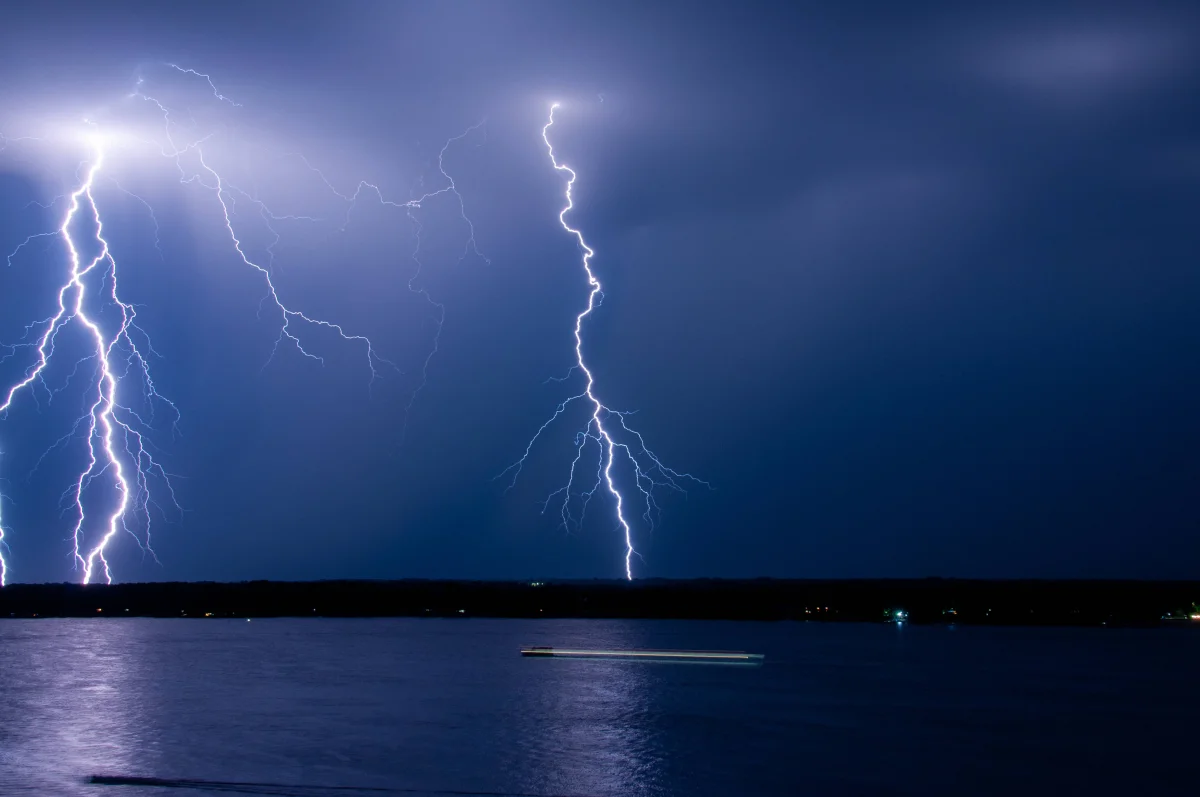
In the summer of 2025, three people — including a child — were killed by a lightning strike on a beach in Tula Oblast. All of them were near the water. The lightning didn't hit them directly — it struck the water nearby, and that was enough.
Every summer, the same mistake repeats: people see a storm approaching and think, "just five more minutes, I'll make it." Or they hear thunder in the distance and decide the danger has passed them by. These decisions cost lives.
According to global statistics, roughly three thousand people die from lightning strikes each year, and a significant share of those tragedies happen near water.
What Happens to Water When Lightning Hits
Lightning is an electrical discharge carrying voltage from tens of millions to a billion volts and current up to 200,000 amperes. When a discharge like that hits water, the current instantly spreads across the surface in every direction.
Water is a good conductor of electricity — far better than air, soil, or dry pavement. The current travels along the surface layer of the body of water and weakens gradually with distance.
But "gradually" is the key word: according to specialists, the lethal danger zone around the strike point extends up to 100 meters. At a distance of two kilometers, the current can still cause muscle seizures and cardiac arrest.
"Even if lightning strikes the water nearby rather than a person directly, the current spreads rapidly across the surface. That's enough to stop the heart, halt breathing, cause loss of consciousness, and lead to drowning," warns anesthesiologist and critical care physician Firuz Ashurov.
Why a Person in Water Is Especially Vulnerable
On land, when lightning hits the ground nearby, the current passes through your legs — the potential difference between two points of contact is relatively small. In water, everything changes: the human body is submerged in a conductive medium, and the current passes through the entire body — through the heart, the brain, the diaphragm.
There's a second reason: a swimmer's head and shoulders protrude above the water's surface. On the flat expanse of a lake or river, a person becomes the highest point — and lightning, as we know, strikes elevated objects. Even a boat or an inflatable raft increases the risk.
The third factor is secondary drowning. Even if the current doesn't kill instantly, it triggers muscle seizures and loss of consciousness. A person who blacks out in water drowns in a matter of seconds.
How Quickly a Storm Can Reach You
One of the most dangerous illusions is "the storm is far away, I have time." A thunderstorm cell moves at 40–60 km/h. In 15 minutes, it covers 10–15 kilometers. Thunder is audible from 15–20 kilometers away. This means: if you can hear thunder, the next bolt could strike your body of water.
A simple way to estimate distance to the storm: count the seconds between the lightning flash and the clap of thunder. Every three seconds equals one kilometer. If the gap between flash and thunder is under 30 seconds, the storm is within 10 kilometers, and being in the water or on the shore is already dangerous.
What to Do if a Storm Catches You Near Water
- Get out of the water immediately. Not "swim to the buoy first," not "finish one more lap" — get out now.
- Move at least 100 meters from the shoreline. The water's edge is one of the most likely strike points. Wet sand conducts current.
- Don't shelter under isolated trees. They attract lightning. Safer options: a low-lying area, a ditch, or a cluster of short trees.
- Crouch down if there's no shelter — make yourself as low as possible, but don't lie flat: full body contact with wet ground increases the area of exposure.
- Set aside metal objects — fishing rods, umbrellas, trekking poles. Carbon fiber rods conduct electricity just as well as metal ones.
- Don't return to the water for at least 30 minutes after the last lightning flash — the storm can come back.
If Lightning Strikes Nearby and Someone Is Hurt
A lightning strike victim can and should be touched — there's no residual current in their body, and they pose no danger to others. First: call emergency services at 112. Second: check for consciousness, breathing, and pulse.
If the person is unconscious and not breathing, begin CPR immediately: 30 chest compressions, 2 rescue breaths. Continue until paramedics arrive. In severe electrical injury, you're working against a clock measured in minutes, and on-site resuscitation is often the only chance.
Important: move the victim 30–50 meters from the strike site. Lightning is capable of hitting the same spot twice.
Why People Keep Swimming in Thunderstorms
The reason isn't ignorance — it's psychology. A person sees clouds but decides "it'll pass." Hears thunder but figures "that's far off." Already soaked from rain and thinks, "What difference does it make — I'm wet anyway." Every one of these decisions is potentially fatal.
A thunderstorm cannot be predicted down to the meter. But getting out of the water at the first sign of one — that you can always do. And it's the only thing that is guaranteed to save your life.