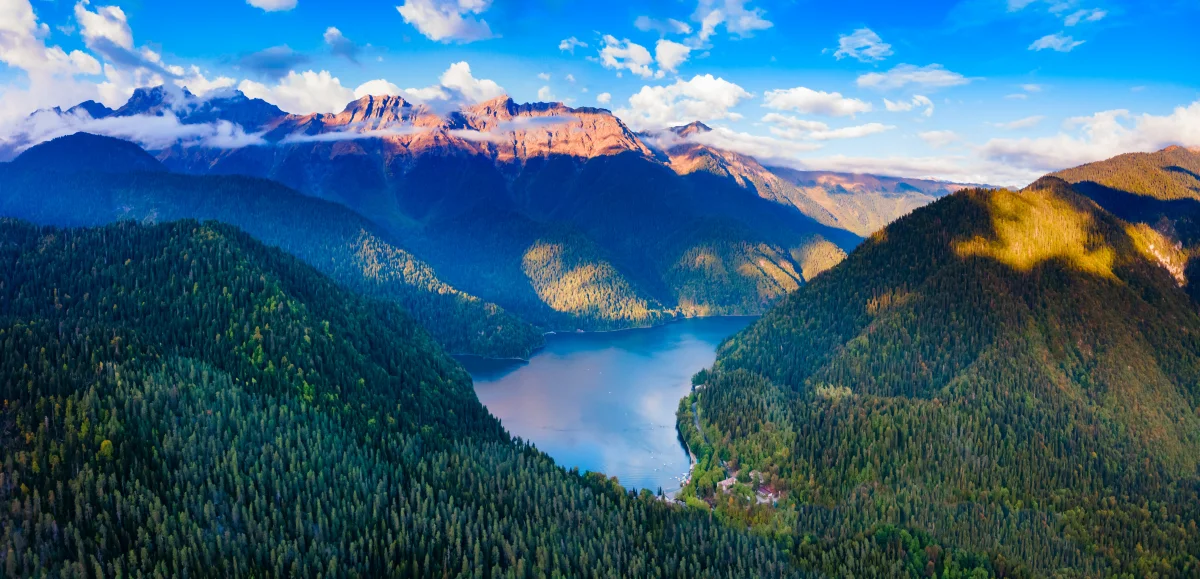
In the July heat, Ritsa's turquoise surface looks like the perfect invitation for a swim. But local guides unanimously advise against it — and it has nothing to do with superstition.
Tourists seeing Ritsa for the first time tend to react the same way: kick off their shoes and take a step toward the water. It's clear, vivid, almost glowing from within — hard to resist. But behind that beautiful surface lies a body of water with a complicated history and physics that lead to tragedies here every single year.
Where This Lake Actually Came From
Ritsa isn't a natural basin that filled with water over millions of years — it's the result of a relatively recent catastrophe. Roughly 250–300 years ago, a powerful earthquake struck this part of the Western Caucasus, triggering a landslide off Mount Pshegishkhva. A massive chunk of rock crashed into the gorge and blocked the river's course, and the lake formed where the flooded valley once was.
An important detail: at the moment of the landslide, a forest stood on the floor of what would become the lakebed. The trunks of firs and spruces remained standing underwater for a time before gradually collapsing to the bottom — and they've stayed there ever since, stacked in several layers, tangled among silt and the gaps between fallen logs.
Why the Water Stays Cold Even at the Height of Summer
The lake is fed by mountain rivers — chiefly the Lashipse — which carry glacial and snowmelt water down from elevations above 900 meters. Even in July's heat, only a thin surface layer near the shore warms up, reaching 63–68°F (17–20°C) in the shallowest spots. Just a short distance down, the temperature drops sharply and holds around 50°F (10°C) nearly year-round.
Ecologist Roman Dbar explains that Ritsa's origins give it an extremely complex lakebed terrain: gaps between the trunks of fallen trees and a layer of silt deposits make it nearly impossible to locate a person who can't get themselves out of trouble.
What Cold Water Does to the Body
That sharp temperature contrast is exactly what turns an ordinary swim into a potentially fatal one. According to Dbar, sudden immersion in such cold water can trigger cardiac arrest or respiratory failure, and a person who loses consciousness can drown within seconds.
This isn't an abstract risk: like most mountain lakes, Ritsa also carries a second danger — strong underwater currents at points where rivers flow in, capable of pulling under even a confident swimmer.
The Official Ban and Protected Status
Swimming in Ritsa is officially prohibited — Abkhazia's Emergency Ministry and Ministry of Tourism regularly remind visitors of this. The reason isn't only tourist safety; it's also the territory's protected status: the lake sits within the boundaries of Ritsa Relict National Park, home to rare and vulnerable fish and other wildlife.
There's a cultural dimension too: for many Abkhazians, mountain lakes and rivers are sacred sites, and swimming in them is seen as disrespectful of tradition. Even locals who grew up alongside Ritsa don't go into its water.
What to Do Instead of Swimming
Rather than diving into the cold water, the lake offers other ways to experience it:
- A catamaran ride — rental stands operate all summer right on the shore.
- Viewpoints along the road to the lake, including newer overlooks above the Bzyb Gorge.
- A walk to the Blue Lake along the route to Ritsa — the same principle applies there: the water never warms above 50°F, though there's little temptation to swim in it anyway, given how frigid it looks even at a glance.
What to Remember Before Your Trip
Ritsa looks stunning from the water and from the shore — but the shore is where it's meant to be admired. The cold temperature at depth has nothing to do with how warm the day feels up top — the gap between pleasant sunshine on the surface and ice-cold water just a couple of meters down can exceed twenty degrees Celsius.
If the goal is to cool off after a hot walk, it makes more sense to wait for the sea — the Black Sea coast of Abkhazia is only about an hour and a half by car from Ritsa.