In the Yakutian village of Oymyakon, –49°F counts as practically a warm spell, and kids walk to school at temperatures that would freeze all activity to a halt anywhere in central Russia.
Picture stepping outside in the morning to a thermometer reading –62°F. In most Russian regions, that would trigger a state of emergency. In the Oymyakon Valley, it's just another Tuesday.
Kids get ready for school, drivers warm up their cars in the garage, and housewives head out for water — not from a tap, but from a hole cut in the ice, because cold-water pipes simply can't survive here. This isn't a novelty or a travel blogger's exaggeration — it's an ordinary winter at the Northern Hemisphere's Pole of Cold.
Where the Coldest Inhabited Place on the Planet Actually Is
For nearly a century, two Yakutian settlements — the village of Oymyakon and the town of Verkhoyansk — have officially competed for the title of "Pole of Cold."
In 1892, Verkhoyansk recorded a temperature of –90°F (–67.8°C). In 1933, at the weather station in Oymyakon, located two kilometers from the village of Tomtor, meteorologist V. I. Popov logged –89.9°F (–67.7°C) — a record that remains the official minimum for an inhabited settlement in the Northern Hemisphere.
There's also an unofficial record: in 1926, geologist Sergei Obruchev measured –96.2°F (–71.2°C) here during an expedition — a figure now engraved on a memorial stele in the village center.
The cause of such extreme cold isn't simply latitude. Oymyakon and Verkhoyansk sit in basins surrounded by mountain ranges. Every winter, a stable, slow-moving anticyclone settles over all of Eastern Siberia: nearly cloudless skies, almost no wind.
Under these conditions, the ground rapidly sheds heat during the long polar night, while cold, heavy air flows down off the surrounding mountains and settles into the basin like water pooling at the bottom of a pit. With nowhere for that air to escape, temperatures keep dropping with every windless day.
How Cold It Actually Gets
The average January temperature in the Oymyakon Valley holds around –58°F (–50°C) — not a peak reading, but the monthly norm. Snowfall, meanwhile, stays light: cover rarely exceeds 20 centimeters, since the anticyclone brings dry weather.
Spring arrives late — stable above-freezing temperatures don't set in until after mid-May — while full winter conditions already return by late September.
Locals treat their records calmly, even with a certain pride. Tamara Vasilyeva, a local historian, member of the Russian Geographical Society, and owner of a guesthouse in Oymyakon, notes that over her years running the business, tourists from dozens of countries have traveled here specifically because they first heard the village's name in school geography lessons, as a synonym for extreme cold.
As for the ongoing debate over exactly where the true Pole of Cold sits, she says locals long ago considered the question settled in their favor.
How People Dress — and Why It's More Than Just a Warm Coat
An ordinary down jacket and city winter boots simply don't work in Oymyakon — the soles turn to stone within minutes in that cold. Only items proven over generations get the job done:
- Unty — fur boots made from reindeer or dog hide, warm enough to stand on snow for hours without freezing.
- Felt valenki boots, the second most popular footwear for both schoolchildren and adults.
- Multiple layers of natural materials — wool base layers, a sweater, and a padded or fur-lined coverall on top.
- Double-layered wool mittens and a hat with long ear flaps tied under the chin.
Zippers on synthetic fabric simply won't open in this cold, which is why locals prefer backpacks and bags made from dense woven fabric instead. And gloves should never come off for long, under any circumstances — bare skin can start developing frostbite within a single minute.
A School Closure Day Isn't –4°F — It's –62°F
In most of Russia, schools cancel classes at –13 to –22°F (–25 to –30°C). In the Oymyakon district, the scale runs entirely differently: younger students are excused from school at –62°F (–52°C), while older students keep attending until temperatures reach –67 to –72°F (–55 to –58°C).
It's not purely a matter of toughness — at these temperatures, the risk of school buses breaking down en route rises sharply, and waiting at a bus stop becomes genuinely dangerous.
Why Cars Here Run by Their Own Rules
Cars in the Oymyakon Valley run with double-paned windows — without that extra layer, an ordinary heater can't keep the cabin warm, and a passenger sitting by the window risks frostbite on half their face. At night, cars are always parked in heated garages — otherwise, starting the engine the next morning becomes nearly impossible.
When driving through severe cold is unavoidable, fuel consumption nearly doubles, and tires deform so badly that a car, once stopped, shakes as if driving on a broken road afterward.
Local drivers keep a full set of spare parts in the trunk in case of a breakdown en route — along the roads here, you can still spot the charred remains of cars that drivers burned to stay warm while waiting for help.
Daily Life: Water, Food, and the Sounds of the Pole of Cold
Some homes have central water supply, but only hot water actually flows from the tap — cold water in the pipes would freeze instantly. Many families still use outdoor, unheated toilets, visited briefly and quickly by necessity.
Because of permafrost and a short growing season, there's almost no local agriculture, so the diet centers on meat and fish — fresh vegetables and fruit have long been a genuine luxury.
Yet Oymyakon isn't some remote taiga outpost cut off from the world: the village has a school, a kindergarten, a hospital, internet, and cell service. And the cold here is something you can literally hear: below –58°F, every exhale comes with a faint hissing sound — the air is cold enough to crystallize instantly.
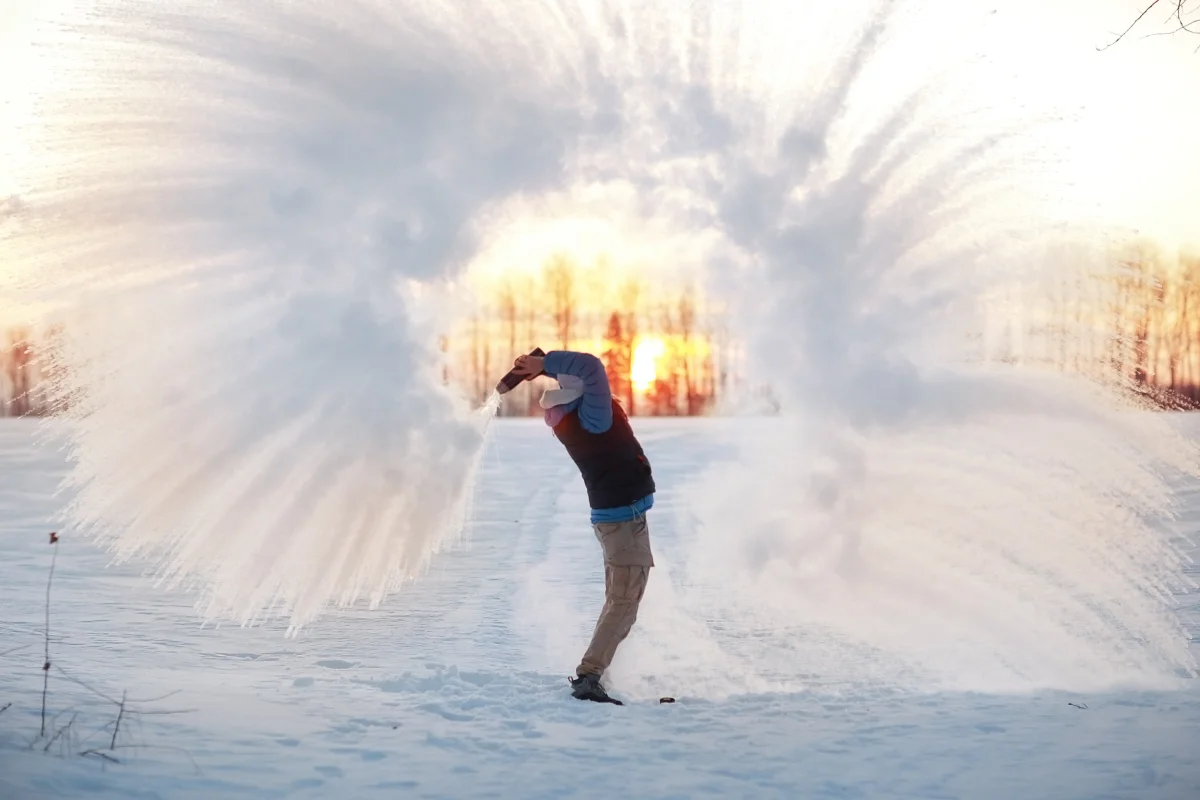
Boiling water thrown from a mug in this cold never reaches the ground — it turns into a cloud of ice dust with a distinctive crackling sound, a phenomenon locals call the "Yakutian salute."
Is It Worth Visiting, and What to Know
For a genuine shot at extreme cold, the best time to visit Oymyakon is December through February, when the odds of catching –49 to –67°F are highest. Essentials include unty or valenki boots, layered wool and fur clothing, a fabric backpack instead of a synthetic one, and a spare pair of mittens — a wet pair becomes useless fast in this cold.
It's best not to stand still outdoors for long, and never step out of a warm space on an empty stomach — the body needs fuel to generate heat under these conditions.
The easiest way to reach the village is through Yakutsk — the two are more than 900 kilometers apart, and the summer airport in Tomtor only accepts flights during the warm season; in winter, the only route in runs along the Kolyma Highway.
Anyone hoping to see the Pole of Cold in person, rather than just on a map, should build in extra time for the trip: roads in this kind of cold are unpredictable, and contact with the outside world here still depends on the weather more than on technology.