Baya weaver

This family of birds got its name for its ability to weave intricate nests of various sizes and shapes. Baya weavers choose the branches of thorny trees or palms over water, and then weave little houses out of blades of grass around them. The nests of these birds are no larger than a soccer ball, and in shape they resemble an elongated gourd. Interestingly, the weavers more often build their nests on the eastern side of the tree, to protect their dwellings from heavy rains.
Anna’s hummingbird

Anna’s hummingbird — is a tiny hummingbird, and so the dimensions of its nest are also small. The nest is no more than 10 centimeters in diameter and resembles in shape a small coffee cup without a handle. To build it, the hummingbird uses mainly plant fibers and feathers, which it binds together with spider silk. The nest is located at a low height: in a tree or in a bush — and to keep it inconspicuous it is usually covered with moss.
Rufous hornero

This bird builds an amazing nest that resembles an old-fashioned bread-baking oven with an intricate system of passages inside. It is precisely for this that the rufous hornero got its name. Horneros build their nests in pairs and use moist clay for construction. They choose in advance a spot on the ground from which they will haul their «materials» and pluck out all the grass that gets in the way.
After the rainy season ends, the birds haul the softened clay piece by piece and lay it onto a tree, shaping it into the form of an oven. As soon as the clay dries — the rufous horneros move inside the nest.
Gila woodpecker

This amazing variety of woodpecker lives in the deserts. There, unlike in the forest, there are no trees, so Gila woodpeckers hollow out their cavities right inside cacti! Building the home takes several months. The work has to start long before the nesting season, so that the cavity has time to dry out. Moreover, for the birds the cacti become not only a home but also a source of food. Gila woodpeckers, in turn, help the plants by eating pests.
Crested treeswifts
The thickness of these birds’ nest walls is comparable to the thickness of parchment. The home is attached to the side of a horizontal tree branch and resembles a little cup in shape, into which only a single egg fits! The swifts build their nest out of leaves, feathers, and bits of bark glued together with saliva. It is no wonder that the fragility of the nest does not allow the swift to sit on it to incubate the egg. So the bird sits on a twig next to it and covers the nest with its belly, keeping the future chick warm.
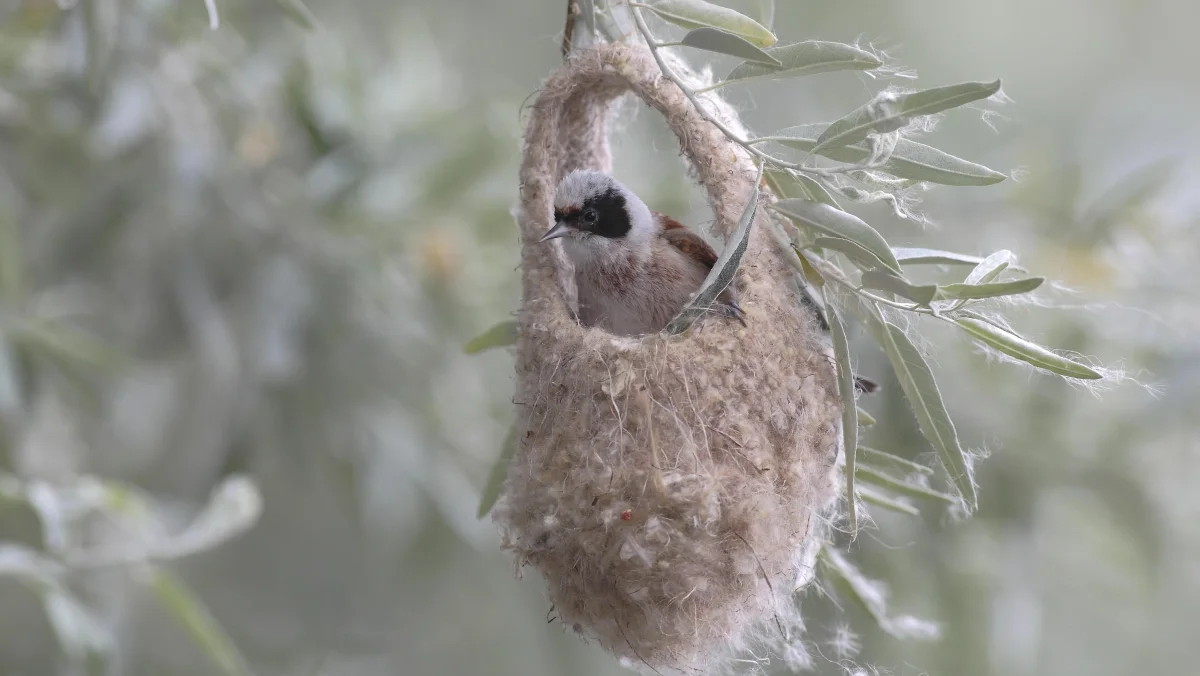
Penduline tit

The construction of a penduline tit’s nest takes about three weeks. The male begins building the nest by weaving a ring, which is attached to the fork of two branches. Then the bird begins to build up the walls. While constructing the dwelling, the male also attracts a female with his singing, and she helps him fit out the bottom of the future nest. Interestingly, for construction the penduline tits use bits of twigs, dry grass, and also animal hair, most often that of sheep or camels. As a result, from the outside the dwelling looks like a soft woolen cocoon.
Bowerbirds
The bowerbird also got its name because of its unusual nest-building technique. The male spends half a year on building the dwelling. The nest is located on the ground and is made of dry blades of grass. In shape it really does resemble a hut, as if built by human hands. The birds decorate it with pebbles, flowers, and bright berries. It is precisely for this reason that the first Europeans who appeared in the forests of Guinea thought that the bowers were actually built by local children.