Russia is washed by 13 seas, and the temperature range between them spans like different planets. The Black Sea in August: +27°C — a warm bath. The East Siberian Sea on the very same day: +2°C, and that's considered a summer high.
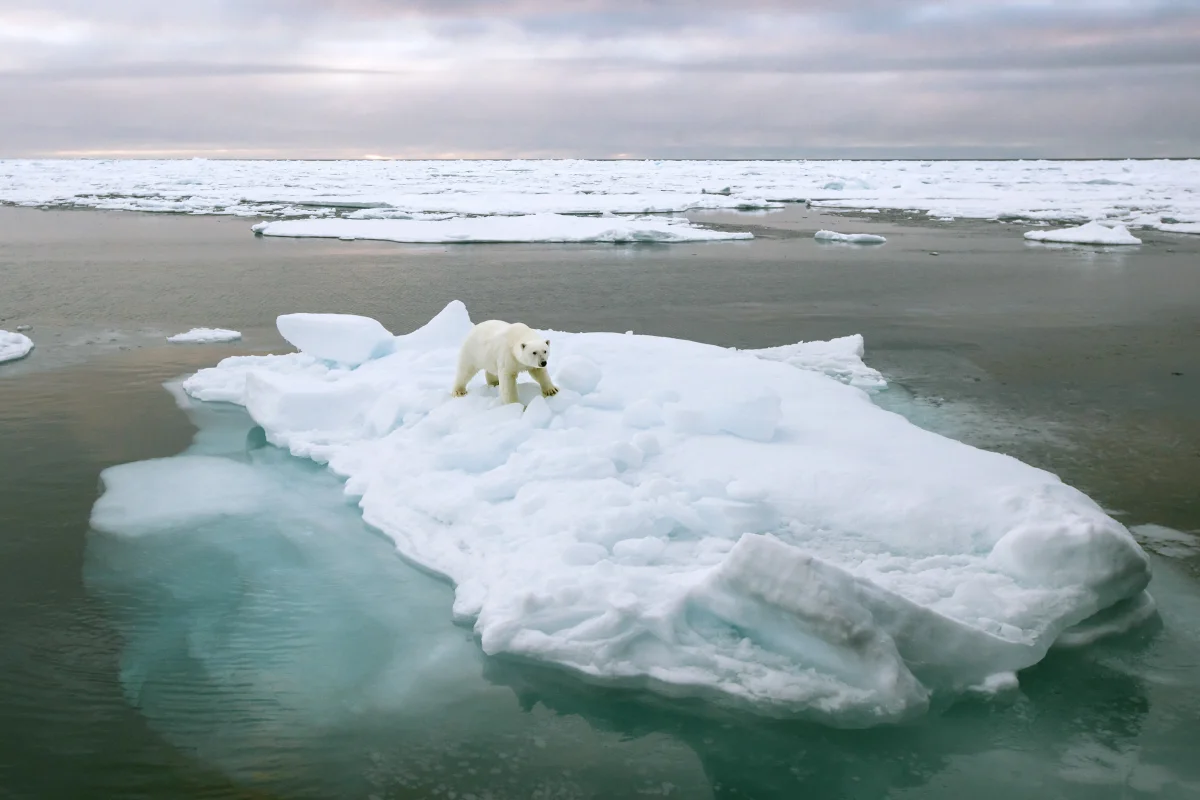
The East Siberian Sea is the absolute cold record-holder among Russian seas. It's ice-covered 9–10 months of the year, and in its northern reaches, the ice never melts at all. Even at the height of polar summer, water temperature never exceeds +5°C in the open sea, reaching up to +7°C near river mouths. Swimming in it is physically impossible — an unprotected person would lose consciousness within minutes.
Why the East Siberian Sea Specifically
The sea lies between the New Siberian Islands and Wrangel Island, off the coasts of Yakutia and Chukotka. Its area is roughly 913,000 square kilometers, with an average depth of just 54 meters. You'd think such shallow water would warm up quickly.
But the opposite mechanism is at play: a thin layer of water cools just as fast as it warms, and the sun at these latitudes stays low and weak even during polar day.
Three factors keep the temperature at the very bottom of the scale.
The first is latitude. The sea sits between the 70th and 76th parallels — deep within the Arctic Circle. Even in June, the sun sits low, warming the surface with glancing rays, and most of that energy gets reflected away.
The second is ice. Multi-year pack ice covers the sea's northern part continuously. It reflects sunlight back into the atmosphere and prevents the water from absorbing heat. A closed loop: ice blocks the sun — water doesn't warm — ice doesn't melt.
The third is rivers. The Indigirka, Kolyma, and Alazeya flow into the sea from the south, but they carry cold water — fed by permafrost thaw and snowmelt.
River runoff desalinates the coastal waters (salinity drops to 5–10‰ against the usual 30‰), and fresh water freezes at a higher temperature than salt water. The result: ice forms earlier along the shore and lasts longer.
What Summer Looks Like on the East Siberian Sea
The word "summer" requires quotation marks here. Polar day runs from May through July — the sun doesn't set for days at a time — but air temperature rarely exceeds +5–8°C. Fog, low cloud cover, and wind off the ice fields create the sensation of late autumn.
In July–August, the coastal strip in the south sheds its ice — the only window for navigating the Northern Sea Route. Coastal water warms to +2–5°C, reaching +7°C near river mouths. Out in the open sea: a steady –1.8°C, the same as winter.
At the region's one major port, Pevek — Russia's northernmost city — summer means being able to receive ships. Navigation lasts 2–3 months, and every day counts: supplies, fuel, and construction materials must be delivered before the sea freezes over again.
Ranking Russia's Coldest Seas
The East Siberian Sea leads, but it's not the country's only icy sea. Russia is washed by six seas of the Arctic Ocean, and all of them are cold — the differences lie in the nuances.
The Laptev Sea — the closest competitor. Winter: the same –1.8°C, but in summer, bays and inlets warm to +8–10°C — noticeably warmer than the East Siberian Sea. The reason: deeper bays and the influence of major rivers (the Lena, the Khatanga) carrying relatively warm water.
The Kara Sea — between Novaya Zemlya and Severnaya Zemlya. Winter: –1.8°C; summer: up to +6°C in the open part. One of the most ice-covered seas on the planet: even in August, a significant portion of the water remains frozen over.
The Chukchi Sea — east of the East Siberian Sea, closer to Alaska. Winter: –1.8°C, but summer brings up to +10–12°C near the shore. The warm Alaska Current gives the southern part a noticeable boost.
The Barents Sea — the only Russian Arctic sea that doesn't freeze completely. The Gulf Stream (or more precisely, its extension, the Norwegian Current) keeps the southwestern part at +3–5°C even in winter. Summer brings up to +7–9°C. By Arctic standards, that's practically warm.
The White Sea — the "warmest" of the Arctic seas. Bays (Dvina and Onega inlets) warm to +15–16°C in summer, and shallow coves reach up to +18–20°C. People actually swim here — briefly, and with a characteristic shriek.
Pacific Seas: Cold in a Different Way
Russia's two Pacific seas — the Sea of Okhotsk and the Bering Sea — are colder than the Black Sea, but significantly warmer than the Arctic ones.
The Sea of Okhotsk freezes over across 60–80% of its area in winter. In summer, the southern part warms to +12–15°C, the northern part to +5–8°C. The warm Tsushima Current gives the south a boost, but the bulk of the water stays cold. Unsuitable for swimming, but the fishing is world-class: salmon spawn here, along with crab, cod, and halibut.
The Bering Sea shows similar figures: –1.5°C in the north during winter, up to +9–10°C in the south during summer. In summer, gray and humpback whales arrive — a temperature that suits them just fine.
The Sea of Japan: The Far East's Warm Surprise
Against the backdrop of Arctic seas, the Sea of Japan looks like a resort. In summer near Vladivostok: +20–24°C, reaching +26°C in the southern bays. In winter: +1–2°C in the north, +10–12°C in the south.
It's the only Russian Pacific sea where a full-fledged beach season is possible — brief, but real, running from mid-July through late August.
From –2°C to +28°C: The Scale of Russia's Seas
Ranking Russia's seas by summer water temperature:
- East Siberian Sea — up to +5°C
- Kara Sea — up to +6°C
- Laptev Sea — up to +10°C
- Chukchi Sea — up to +12°C
- Bering Sea — up to +10°C
- Sea of Okhotsk — up to +15°C
- Barents Sea — up to +9°C
- White Sea — up to +16°C
- Baltic Sea — up to +22°C
- Sea of Japan — up to +24°C
- Caspian Sea — up to +27°C
- Black Sea — up to +28°C
- Sea of Azov — up to +28°C
The range is 30 degrees. Within a single country, one sea has water warmer than the Mediterranean, and another has water colder than Antarctica in spring. No other nation on Earth has a range this vast.
What's Happening to Russia's Cold Seas Right Now
Russia's Arctic seas are warming faster than any other body of water on the planet. Summer ice coverage in the East Siberian and Chukchi seas has shrunk by tens of percent over the past 40 years. The Northern Sea Route, once operational for two months a year, is now open three to four months — and that window keeps growing.
For navigation and resource extraction, that's a plus. For the ecosystem, it's a warning sign. Polar bears are losing the ice platforms they hunt from, walruses are losing haul-out grounds, and cold-loving fish species are losing their habitat. The East Siberian Sea remains Russia's coldest — but with every passing decade, that title holds less and less firmly.