In southeastern Altai, there's a village where houses have flat roofs — simply because there's no point building a pitched one. Snow is a rarity here, rain is an event people discuss for weeks, and over the course of an entire year, less water falls from the sky than Moscow gets in a single rainy October.
Kosh-Agach and the Chuya Steppe: Records for Dryness
Russia's driest place is the Chuya Steppe in the Kosh-Agach district of the Altai Republic. Average annual precipitation here is just 80–150 mm. For comparison: Moscow gets around 700 mm a year, St. Petersburg roughly 660 mm. That means the Altai steppe receives 5 to 8 times less moisture than either capital.
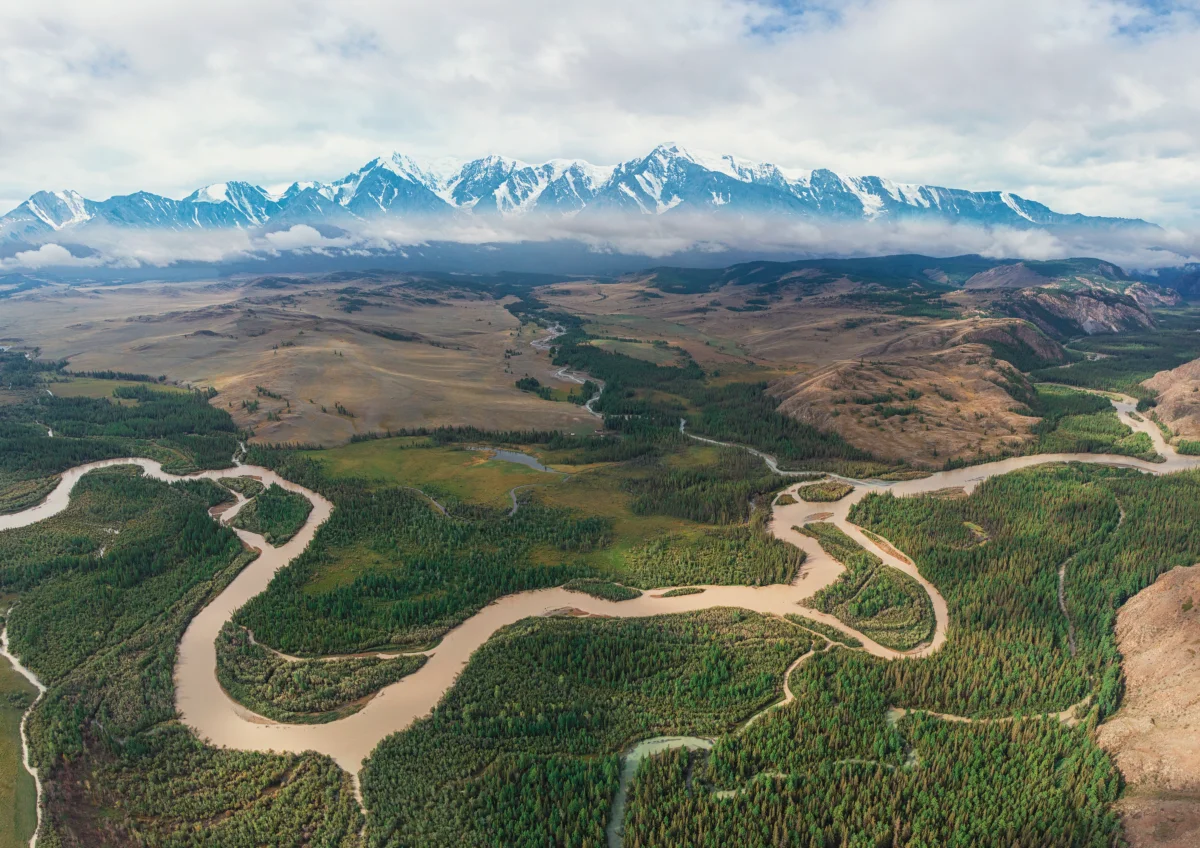
The district center, the village of Kosh-Agach, has a population of roughly 4,500. It sits in the middle of a high-altitude basin at 1,760 meters above sea level, surrounded by mountain ranges topped with eternal snow. The Mongolian border is just a stone's throw away — 50 km along the Chuya Highway.
Why It's So Dry Here
The mechanism is simple: mountains block the moisture. The Chuya Steppe is pinned between the Kurai Range to the north, the North and South Chuya ranges to the west, the Chikhachev Range to the east, and the Sailyugem Range to the south. Moist air masses from the Atlantic and Central Asia deposit their precipitation on the western slopes of these mountains, and only "wrung-out" air reaches the basin.
The result is a classic rain shadow. What little precipitation does fall arrives mostly in summer: June through August accounts for roughly two-thirds of the already meager annual total. In winter, snowfall is so scarce that houses are built with flat roofs — there's nothing to shed.
Tellingly, in 1992, the Kosh-Agach district was included on the list of territories equated to the Far North — despite being geographically southern Siberia. That's how harsh conditions are here.
Not Just Dry, But Extreme
The Chuya Steppe is a place of climatic extremes. Average January temperature drops to –32°C, and the all-time low was recorded at –62°C. In summer, the thermometer can hit +31°C. The spread between the absolute minimum and maximum is nearly 90 degrees — comparable to records set in Yakutia.
The frost-free period lasts just 50–65 days a year. Beneath the surface lies permafrost, 15 to 90 meters thick — in a steppe at the same latitude as Prague. Average annual temperature here is –6.7°C.
At the same time, the Chuya Steppe gets more sunshine than most Russian resorts — up to 300 clear days a year. That's exactly why, in 2014, Kosh-Agach launched Siberia's first solar power plant, with a capacity of 5 MW. It was opened with the president in attendance.
What About European Russia?
Turning to the country's European territory, the dryness record belongs to the Caspian Lowlands — the vast plain surrounding the northern shore of the Caspian Sea.
In the southeastern part of the lowland, around Astrakhan and Kalmykia, annual precipitation totals just 150–200 mm.
Among major cities, Astrakhan is considered the driest in European Russia: the southern districts of the region receive 180 to 200 mm a year. Summers here are hot, with temperatures up to +35–40°C, dry hot winds, and dust storms. In August, entire stretches can pass without a single day of recorded precipitation.
Other arid cities:
- Elista (Kalmykia) — around 257 mm of precipitation a year. The warm period lasts nearly nine months, and the surrounding steppe burns out by midsummer.
- Znamensk (Astrakhan Oblast) — approximately 249 mm a year. Summer heat comes with dry hot winds, and evaporation exceeds precipitation by several times.
- Yakutsk — 238 mm a year. Surprisingly, despite being in Siberia, it gets less rainfall than the arid southern steppes. Cold air simply can't hold much moisture.
What It Looks Like in Practice
Travelers who make it to the Chuya Steppe along the Chuya Highway often describe feeling like they've landed on a different planet. A yellow-ochre plain stretches 70 km long and up to 40 km wide. Trees are practically nonexistent. In spring and early summer, dust storms sweep across the steppe, and weather can shift within minutes: dry wind blowing one moment, then a brief, ferocious downpour — followed again by not a single cloud.
Vegetation is semi-desert: wormwood, fescue grass, scattered caragana shrubs. But wildlife is richer than you'd expect: the Kosh-Agach district is home to snow leopards, argali (mountain sheep), Pallas's cats, and roughly 30 species listed in the Red Book.
Why Go There, and When
The Chuya Steppe isn't a resort, but thousands of travelers make the trip to the end of the Chuya Highway every year. Worth visiting for several reasons:
- Petroglyphs and burial mounds. The surrounding area holds dozens of archaeological sites from the Pazyryk culture (5th–3rd centuries BCE). This is exactly where, in 1993, the famous "Princess of Ukok" was found — a 2,500-year-old mummy.
- Aktru Glaciers — suitable for trekking even in summer, about 100 km from Kosh-Agach.
- The night sky. Low humidity and near-total absence of light pollution make the Chuya Steppe one of the best spots for astrophotography in Russia.
The best time to visit is September and early October. Dust storms have died down by then, daytime temperatures hold around +10 to +15°C, sunshine is consistent, and the steppe's autumn colors are especially vivid. Summer works too, but expect sharp daily temperature swings — from +25°C during the day to 0–+5°C at night.
Essentials: warm clothing (even summer nights get cold), sunglasses and sunscreen (UV at 1,800 meters is no joke), a water supply (nothing to buy along the way), and a full tank of gas — gas stations are rare in these parts. If you plan to head beyond Kosh-Agach toward the border, arrange a border-zone permit in advance, in Gorno-Altaysk or Aktash.