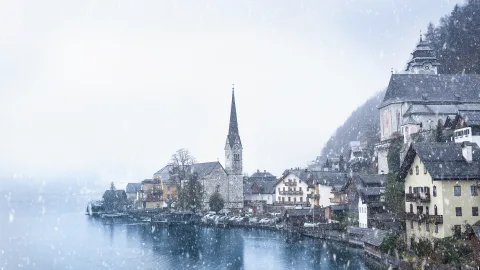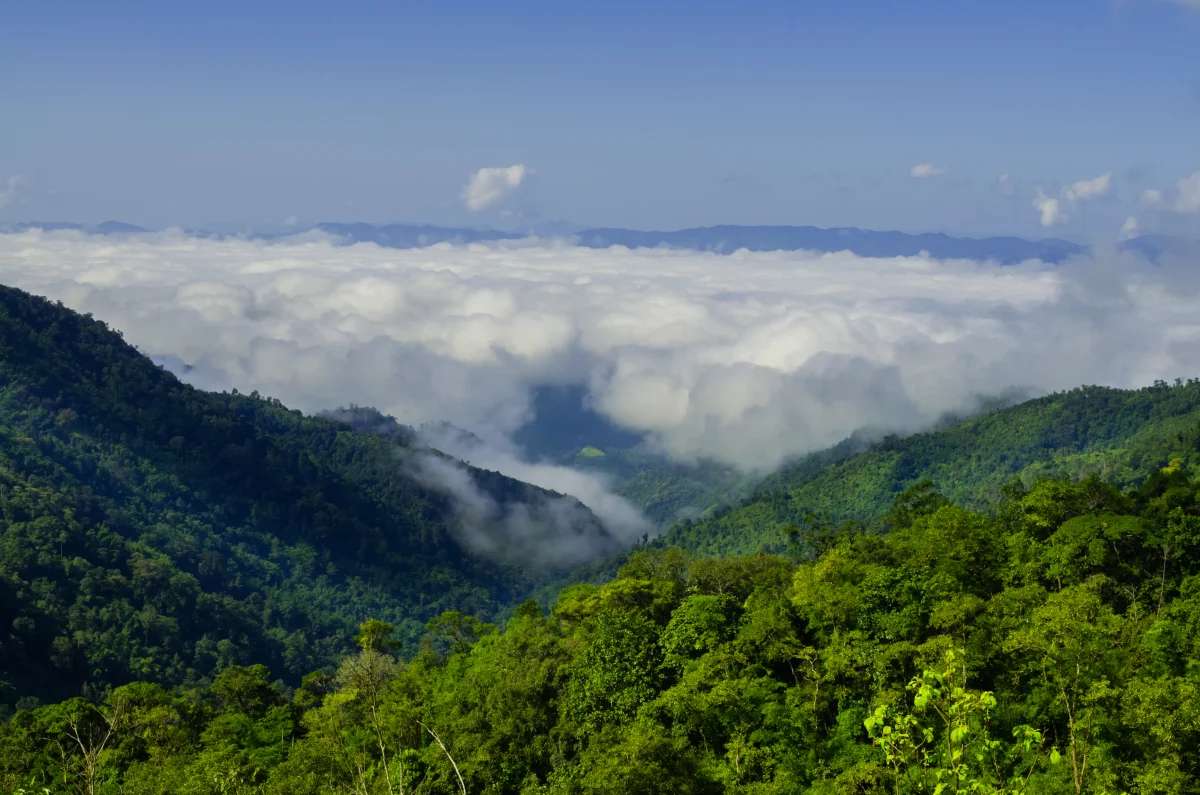
Picture a forest where the trees drown in snow, and in summer the sun only shows up until noon — then the clouds roll in, right on schedule, and the rain starts. Every day. This spot gets four times more precipitation than Moscow and twice as much as London. And it's just ten kilometers from Krasnaya Polyana.
When people say "the wettest place in Russia," they usually think of Sochi or St. Petersburg. But St. Petersburg is largely a myth: despite its gloomy reputation, it gets around 660 mm of precipitation a year — less than Moscow's 700 mm. Sochi comes closer to the truth, at roughly 1,700 mm, but even that isn't the record.
The country's undisputed champion of precipitation is Mount Achishkho, a ridge in the Western Caucasus. Here, more than 3,000 mm of moisture falls every year, and there are no more than 70 sunny days. The other 295 days bring clouds, rain, snow, or fog.
Where It Is — and Why Here
Achishkho is a mountain massif standing 2,391 meters tall, located 8–10 kilometers northwest of the village of Krasnaya Polyana (Sochi).
The name is translated from Adyghe as "goat's peak," though local hikers know another version: from Ubykh, it means "sack of rain." The second version fits the reality far better.
The massif is part of the Caucasus State Nature Biosphere Reserve. On its western shoulder, at an altitude of around 1,800 meters, a weather station called Achishkho operated for decades — it's the one that recorded these record-breaking precipitation figures. The station itself burned down, but the data collected over the years survived in the archives, and it's striking.
The mechanism behind Achishkho's record is orographic lift. Moist air moving northeast from the Black Sea slams into the wall of the Caucasus range. With nowhere else to go, it's forced upward.
As the air rises, it cools, the moisture condenses, and it falls — as rain in summer, snow in winter. Achishkho sits first in the path of that airflow, acting like a cloud trap: nearly all the moisture the Black Sea sends toward the mountains gets dumped right here.
What 3,000 mm Actually Means
The figure "3,000 mm of precipitation a year" doesn't mean much on its own — until you set it next to other places.
Moscow — ~700 mm. Sochi (the city) — ~1,700 mm. London — ~600 mm. St. Petersburg — ~660 mm. Mumbai (India, monsoon zone) — ~2,400 mm. Achishkho — 3,000–3,200 mm.
The world record holder is the Indian town of Cherrapunji, where the annual average reaches 11,700 mm. Achishkho doesn't come close to that tropical extreme, but for temperate latitudes, its numbers are exceptional.
If all the water that falls on Achishkho in a single year neither ran off nor evaporated, the mountainside would end up buried under a 3-meter layer of water. Every single year.
Snow That Buries Trees
In winter, Achishkho receives 350–400 mm of precipitation every month — all of it as snow. By the end of winter, the snowpack reaches 8–10 meters deep. A ten-meter layer of snow is taller than a three-story building. The trees on the slopes — firs and spruces standing 10–12 meters tall — vanish completely beneath the snow. From a distance, it looks like the forest has disappeared entirely, with only small mounds poking up where the treetops should be.
It's precisely this snow that turned the Krasnaya Polyana area into a ski resort hub: the heavy precipitation guarantees a stable snowpack from November through April, and at higher elevations, sometimes into June.
The 2014 Olympic ski runs at the Rosa Khutor resort sit on the neighboring Aibga ridge, which gets slightly less precipitation than Achishkho — but still far more than most European ski resorts.
Summer: Rain on a Schedule
Achishkho in summer is its own kind of experience. In the morning: sunshine, clear skies, views of the Main Caucasus Ridge, the peaks of Chugush and Pseashkho, and a blue strip of the Black Sea far below. By noon, clouds begin to climb. By 1 or 2 p.m., they've wrapped around the ridge, and the rain starts — sometimes a downpour, sometimes drizzle, but almost every day.
Hikers who know Achishkho follow one rule: set out at dawn. Everything you want to see from the top — the panoramas, alpine meadows, lakes — has to happen before noon. After that, the mountain disappears into the clouds and visibility drops to a few dozen meters.
Summer humidity on Achishkho sits at 85–95%. Combined with temperatures of 50–64°F (10–18°C) at 1,800 meters, it creates a constant, bone-deep dampness: clothes never dry, tents fog up with condensation, and the trail turns to mud. Staying dry on Achishkho is a task almost nobody manages.
Not Just Achishkho: Other Record-Holders
Achishkho is the recognized leader, but there are other extreme-precipitation spots nearby.
The upper reaches of the Kisha River — a river basin northwest of Mount Chugush. According to refined estimates from Dr. Andrey Pogorelov of Kuban State University, annual precipitation here may reach around 5,000 mm.
There are no weather stations in the area, so this figure comes from indirect methods — river runoff and snow surveys. If instrumental data ever confirms it, the upper Kisha would take the undisputed lead not just in Russia, but across all of Europe.
Krasnaya Polyana (the village, 550 m above sea level) — around 1,680 mm a year. That's double Moscow's total, but a quarter of Achishkho's — a reminder of how much elevation and terrain matter.
Severo-Kurilsk (Kuril Islands) — around 1,840 mm a year. The cause here is different: the island sits directly in the path of Pacific cyclones carrying moisture off the ocean. Heavy snow in winter, fog and drizzle in summer — one of the cloudiest cities in Russia.
Southern Kamchatka (eastern slopes) — up to 2,500 mm a year, driven by the same orographic mechanism as the Caucasus, just at a different scale, as Pacific air masses climb the slopes and dump their moisture.
Why St. Petersburg Isn't Actually the Wettest
St. Petersburg loses to Moscow on total precipitation but wins on the feeling of dampness. The reason isn't rainfall — it's the number of overcast days: around 180 a year, of which 80–90 bring precipitation. A light drizzle at 37°F (3°C) with wind off the Gulf of Finland can feel like a full downpour, even though the actual volume of moisture is minimal.
Sochi, by comparison, gets 2.5 times more precipitation than St. Petersburg but has around 270 sunny days a year. Its rain is short and intense: an hour-long downpour, then sun. St. Petersburg is the opposite — weak but relentless precipitation, with the sky staying overcast for weeks on end.
Achishkho combines the worst of both worlds: heavy precipitation and little sun. About 70 clear days a year is fewer than in any major Russian city, including Murmansk.
How It Shapes the Landscape
Achishkho's extreme humidity has produced a unique ecosystem. The forests on its slopes — fir and beech stands — are so densely covered in moss and lichen that the tree trunks look bearded. Humidity holds steady year-round, and the vegetation grows powerfully: trees shoot up fast, the undergrowth is thick, and ferns taller than a person fill the gaps between trunks.
Above the tree line (2,000 m), alpine meadows take over, bursting into flower each summer. Rhododendrons, gentians, bluebells — all of it blooms briefly and brilliantly, because the growing season at this altitude lasts only 3–4 months.
Dozens of mountain lakes dot the ridge and its surroundings, including the Khmelevsky Lakes — a cluster of small bodies of water at 1,700–1,800 meters, named after an early-20th-century researcher of Krasnaya Polyana's flora. Fed by rain and meltwater, their levels shift with the seasons, and in winter they vanish completely under snow.
Can You Actually Go There
Achishkho isn't off-limits. The route to the summit runs through the Caucasus Nature Reserve, and entry requires a permit (starting at 300 rubles). The trail begins in Krasnaya Polyana and winds past dolmens, through forest, past scenic overlooks, and across alpine meadows to the old weather station and on to the peak.
The best time to go is July through mid-September, once the high-altitude snow has melted. But even in July, be ready for rain: a waterproof jacket, membrane boots, and a dry bag for your backpack aren't suggestions — they're requirements for a bearable trip. The route to the summit typically takes 2–3 days, with an overnight camp.
The overlooks on Achishkho offer views worth getting soaked for: the Main Caucasus Ridge, the snow-capped peaks of Chugush (3,238 m) and Pseashkho (3,256 m), and on a clear day, the Black Sea on the horizon. But clear weather here is unreliable — a clean morning sky is no guarantee it'll still look that way by lunchtime.
A Record That's Hard to Beat
Achishkho is a place where the weather leaves you no choice. You can't "wait out the rain" — because it won't stop. You can't "wait for the sun" — because it's more likely to show up tomorrow morning. In winter, you can't "clear the road" — because there is no road, and snow the height of a three-story building doesn't yield to a shovel.
And yet Achishkho isn't a cursed place — it's one of the most beautiful in the country. Alpine meadows, glacial lakes, panoramas that stretch from the sea to eternal snow on a clear hour. The beauty here just has to be earned — and the price isn't paid in money, but in millimeters of rainfall.