Why do birds migrate?
Scientists believe that bird migrations began several million years ago because of the change of seasons. That is why they are called seasonal migrations.
One of the main reasons for migration is a shortage of food. In winter it is very difficult for birds to obtain insects, rodents, and frogs. Therefore birds have to seek out places with a milder climate, where there is a chance of finding food. Birds migrate in both the northern and southern hemispheres. Migration occurs even among species that live in the tropics. They fly away from areas subject to seasonal drought or torrential rains.
Interestingly, even flightless birds migrate. Among them, for example, are penguins. The reasons for their migration include both the harsh conditions of the Antarctic winter and the long polar night. The thing is that during this time it is much easier for predators to sneak up on penguins unnoticed.
.jpg)
The routes of migratory birds
Migratory birds do not change their routes. Every year they follow the same path. The only exception is that young birds in some cases tend to look for new wintering places. However, once they have made their choice, a map is created in their heads, after which the birds do not stray from the path. Scientists still do not understand how birds manage to remember their routes and follow them year after year. Nevertheless, we know that birds navigate during migration by the Sun, the Moon, the stars, the landscape, the sound of waterfalls, and the Earth’s magnetic field. For example, if the sky becomes overcast or the moon disappears from it – the migration is suspended.

Where do birds fly?
The first to fly off for the winter are swifts, swallows, and nightingales. Departure often happens as early as late July or early August. Swifts most often fly to southern Africa or Madagascar. Swallows winter south of the Sahara Desert, in southern China, in the tropical part of Asia, and in the foothills of the Himalayas. Swifts limit themselves to the south of Asia and Africa.
Where cuckoos fly, for example, specialists cannot say for certain. Cuckoos – are secretive birds, but experts suspect that these birds migrate to Indochina, India, southern Africa, and the Arabian islands. Thrushes and starlings most often fly to Asia, Africa, or stop in Europe.

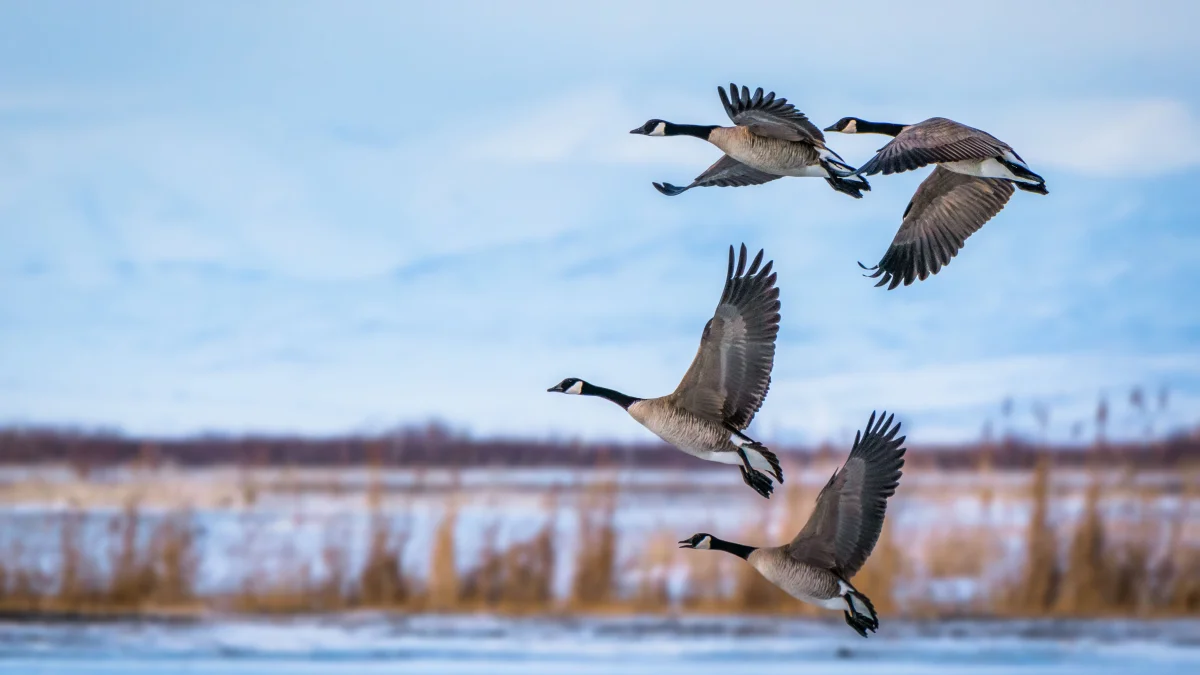
Among the very last to fly off are swans, geese, and ducks. Swans line up in a wedge consisting of more than 100 birds and fly off to the Caspian and Black Seas, the south of Greece and Turkey, the waters of Asia, and the Pacific islands. Wild geese often stop in Azerbaijan, while ducks – in Albania.

It should be noted that migration often takes place in several stages with stops for rest. At the same time, the size of a bird greatly affects its endurance. The smaller the bird, the shorter the distance it is able to cover at one time. For this reason, the record-holder for the distance covered is the white stork. It flies distances of up to 10 thousand kilometers, reaching the south of Africa.