Why have a pond at the dacha: 3 reasons
An artificial body of water carries no practical value, that is true. But how beautiful it is!
- A well-designed decorative pond looks very striking. It adorns the dacha plot and creates a cozy, soothing atmosphere.
- It is a wonderful place to relax, especially in the summer heat, when it is so pleasant to spend time in the natural coolness by the water.
- One's own bodies of water have become a fashionable trend in the design of dacha plots, and their relevance is only growing.
For the pond to look worthy and to please you for many years, you need to prepare a project for it, in which every little detail is carefully thought out. And at all stages of planning, you must always remember that your body of water should:
- Harmonize with the style of the house and the rest of the grounds.
- Match the size of the plot and its surroundings.
- Be safe: not too deep, in case children or animals might fall into it; have a minimum of polished materials on which it is easy to slip; all electrical components (for pumps or lighting) must be carefully insulated.

Deciding how the pond will be used
There are four main types of purpose for garden ponds:
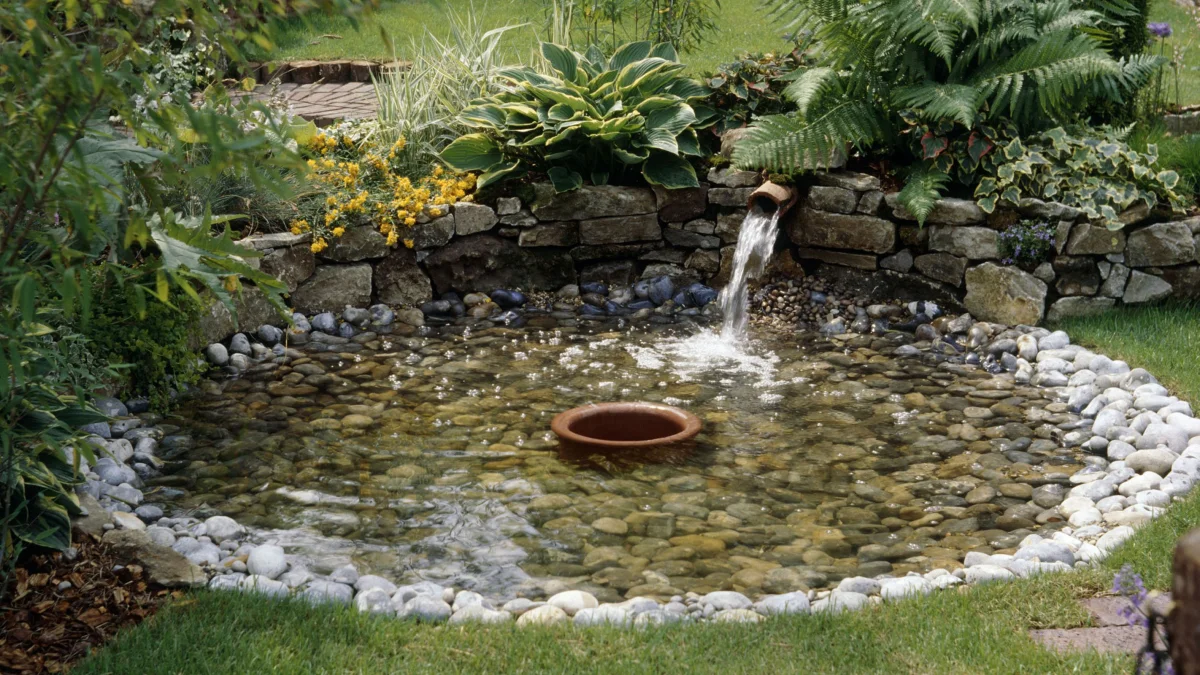
- A mini-pond the size of a small flower bed plays the role of part of a landscape composition. It does not take up much space and is simple to design and maintain.
- A decorative pond serves as an adornment for one of the garden's zones; fountains, bridges, lighting and other design elements are often used with it.
- A body of water for breeding fish and plants. It requires constant care, since the living inhabitants need a certain microclimate.
- A pond-pool for swimming. It should be large enough and must be cleaned regularly.
Determining the style, shape and size
A classic pond means symmetry and precision. It can be rectangular, square or round. Such a body of water is often adorned with a fountain. It is important that all elements decorating the shoreline are also of strict forms (smooth stones, tiles, brick). It is suitable for a garden with a classic layout and modern design (minimalism, high-tech).
The landscape style of pond design is closer to natural bodies of water. It uses an effect of slight neglect: natural forms without clear lines, a minimum of decorations, a chaotic (but only at first glance) arrangement of plants.
When choosing the size of the body of water, we are guided by its purpose and the area of the plot. A huge pond on a small plot will look cumbersome, while one that is too small will get lost on a spacious plot.

Choosing a spot for the future pond
Water always draws the eye, so you should not place a body of water against an unsightly backdrop (an old fence, a pile of trash and so on). This will only draw attention to the flaws. It is advisable to choose a level, slightly lowered spot, but height differences can also be used to create waterfalls and multi-tiered structures. Be sure to take into account the presence of groundwater – both the possible depth of the pond and the difficulty of its installation depend on this.
It is recommended that the body of water be lit for no more than 6 hours a day. With longer exposure to the sun, the water blooms and the level of oxygen in it falls, which has a harmful effect on the fish. It is also better to place the pond away from trees, since fallen leaves, seeds and branches will pollute it, and the plants' roots can damage the walls of the structure. At this same stage you should plan out the water supply and drainage system, as well as the routing of an electrical cable, if you plan to connect filters, pumps and lighting.

Determining the material
The most common solution is ready-made plastic containers. They can be of any shape and size, they are easy to install, and they have a long service life. Such a pond is convenient to wash, it withstands significant loads, and you can both swim in it and breed fish.
The main colors used in the manufacture of plastic ponds are:
- black – for decorative bodies of water (they seem deeper, reflect the sky well);
- blue – suitable for pools (the bottom is visible in them, the water seems cleaner);
- green – ideal for breeding fish and plants.
Besides plastic, waterproofing film of various types and concrete are also used (this is the most expensive and complex option, used for large, even bodies of water). You can give new life to improvised materials: an old bathtub, a basin, a tire, a metal or plastic barrel, but it is rather difficult to arrange them so that the pond looks natural.
Getting started on the installation
We dig a pit according to the project, with a specific depth and geometry. We lay a layer of sand on the bottom and walls, pour water over it and tamp it down. Then, depending on the chosen material, we place the waterproofing, install the plastic container, or carry out the appropriate preparation and concreting of the basin.

Decorating the pond
The final and, perhaps, most important stage is the design of the shoreline. Without this, the pond will not have a finished look and will not look very good. Neatly concealing the material (film, plastic) — that is the first rule when decorating a body of water. You can use tiles, pebbles, a variety of stones (marble fragments, granite boulders and others), wooden boards, concrete (artificial stone is made from it) and even metal.
Small waterfalls, cascades and water mills help make the landscape attractive and lively. They are usually placed at the edge of the body of water and combined with plants and an alpine rock garden. A closed-cycle fountain (a pump circulates water from a reservoir into the basin and back) looks striking, especially if additional lighting is used along the contour of the pond in the evening.
To decorate the pond, you can plant along its edge plants that love moist soil: buttercups, astilbe, spurge, moor grass, sedge, ferns, miscanthus and others. And on the surface of the water, water lilies, reeds, water starwort (necessary where there are fish), duckweed, marsh marigold and pond lilies will look wonderful.