What a halo is
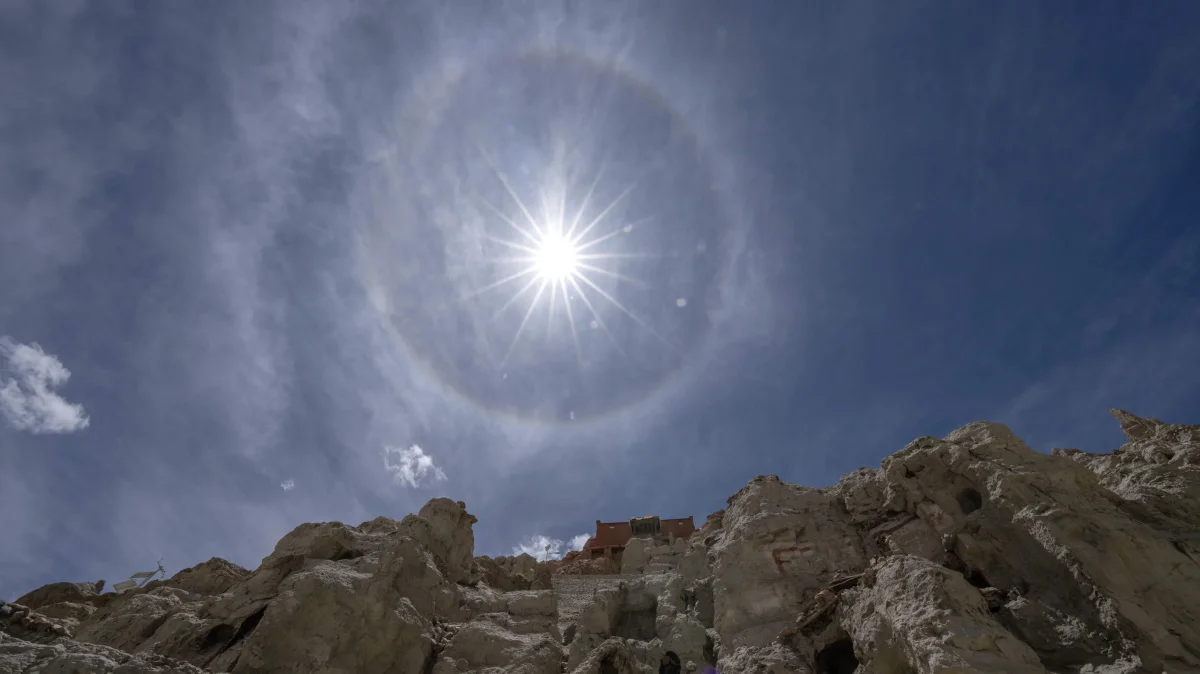
A solar halo, like a lunar one, owes its appearance to the multitude of frozen water crystals found in cirrus clouds at an altitude of approximately 6–10 kilometers. The sun’s rays pass through these ice particles, which have the shape of a hexagonal prism, and are refracted by their faces. As a result, a glowing ring forms around the daytime luminary, and the more crystals there are in the clouds, the brighter it appears.
A halo around the sun can be observed at any time. But it looks most striking in cold weather and at dawn, when the sun’s rays fall on the ice-prisms in the atmosphere at the right angle. Most often a halo appears beyond the Arctic Circle, where diamond dust (tiny ice crystals) is constantly present in the air. But this does not mean it does not occur in other regions: from time to time the residents of the most varied countries and cities admire this most beautiful wonder of nature.

By the nature of its formation, a halo is the same as a rainbow around the sun, but there are significant differences between these phenomena. A rainbow appears after rain, as a result of the refraction of light in water droplets. All the droplets look the same and differ from one another only in size. That is why a rainbow never changes its shape.
Ice crystals are an entirely different matter. Their shape, size, and direction of movement are all different. These little plates, prisms, columns, or pyramids can calmly float in the air, rotate, or fall down. Depending on their behavior, we get the chance to observe the most varied forms of solar halos.

What types of solar halo exist
Scientists count more than 100 varieties of this phenomenon. And all of them are beautiful in their own way. The most common is the circular form. This ring is called a 22-degree halo. It is located close to the sun, with its center on the solar disk. The inner side of the halo in this case has a pale-red tint, transitioning to orange and yellow, while the outer one is bluish. The part of the sky inside the ring looks darker. Far more rarely you can see a large halo, located at an angle of 46 degrees relative to the sun. It is usually colored a slightly reddish tint.

The rarest and most impressive varieties of halo
Parhelia, or false suns – bright spots of light that appear on the sides of the luminary and resemble its twins. This phenomenon occurs at sunset or sunrise, when the sun is still close to the ground.
Light pillars – vertical bands of light, resembling sun paths stretched across the sky. Like parhelia, they arise at dawn or sunset. Sometimes at night and in severe frost you can observe an entire forest of light.

Tangent arcs, surrounding the 22-degree halo.
Crosses – formed when a light pillar is intersected by an arc. In the evening the figure takes on a bright crimson tint and looks rather ominous.
Inverted (or zenith) rainbows, resembling a rainbow smile
How a halo makes history

This unusual optical phenomenon has always attracted heightened attention. And in ancient times, when humans had not yet found an explanation for this phenomenon, it caused genuine fear and was considered a very bad omen.
In medieval chronicles and travelers’ notes, many descriptions remain of cases when strange signs lit up in the sky. It is believed that a halo, as an omen from the Almighty, more than once influenced the outcome of historic battles and momentous events.
For example, the famous literary monument «The Tale of Igor’s Campaign» mentions that in 1185, during the battle with the Polovtsians, 4 suns appeared in the sky. This caused terror and had a negative effect on the warriors’ morale. They were defeated, and Prince Igor was taken captive.
And in the 16th century the Spanish king Charles V was conducting a long siege of the city of Magdeburg, but decided to retreat and abandon the decisive attack when he saw the glow of three suns at once over the city – as if the heavens had risen to defend its inhabitants.
Is it harmful to look?

While admiring this magnificent natural phenomenon, you must not forget about the danger that the bright rings pose to the eyes. Sunlight refracted in ice crystals is too bright and cannot be observed directly. Be sure to use sunglasses with a high level of protection against ultraviolet radiation. In addition, it is recommended to cover the disk of the sun with any round object or with your palm.