Between 2009 and 2024, eight fatal shark attacks were recorded off Egypt's coast. For the millions of tourists who visit each year, this remains an extremely rare risk — but high-profile incidents draw major attention. After Russian tourist Vladimir Popov was killed by a tiger shark attack in Hurghada in June 2023, one question became especially pressing: when is the probability of a shark encounter highest?
Sharks in the Red Sea aren't an anomaly — they're the norm. More than 40 species live here permanently, from harmless reef sharks to potentially lethal tiger and oceanic whitetip sharks. They were here long before the hotels and tourists. But in recent years, human encounters have grown more frequent, and there are specific reasons behind that — ecological, not mystical.
The Most Dangerous Period: Mid-April Through June
Biologists identify a clear window of elevated risk: mid-April to early June. Several factors converge during this stretch.
"In the Sharm el-Sheikh and Hurghada area, the most dangerous time is mid-April to early June. Many shark species migrate from the Indian Ocean into the Red Sea and approach the shallows near shore, since there's more food here, and this is when mating and giving birth occur," explains Vyacheslav Ivanenko, biologist and associate professor of invertebrate zoology at Moscow State University.
During breeding season, sharks are more aggressive than usual: territorial behavior intensifies, and the threshold for attack drops. Females carrying young need more food and hunt more actively near shore.
June through August is somewhat less dangerous, but no reason for complacency. Water warms to +28–29°C, and sharks that arrived in spring stick around. It was in June 2023 that the attack on Vladimir Popov occurred, and in July 2022, on an Austrian tourist in Sahl Hasheesh.
Autumn and Winter: The Lowest Risk
From October through March, sharks retreat from shore into deeper water. The water cools, prey distribution shifts, and large predators appear in the shallows less often. Winter is statistically the safest period.
But "safest" doesn't mean "absolutely safe."
The attack in Marsa Alam on December 29, 2024, when a mako shark killed an Italian tourist and injured his companion, happened precisely in winter. Marsa Alam sits south of Hurghada, where water stays warm year-round, and sharks don't fully leave.
Which Sharks Attack
The Red Sea hosts over 40 species, but only a handful are responsible for attacks:
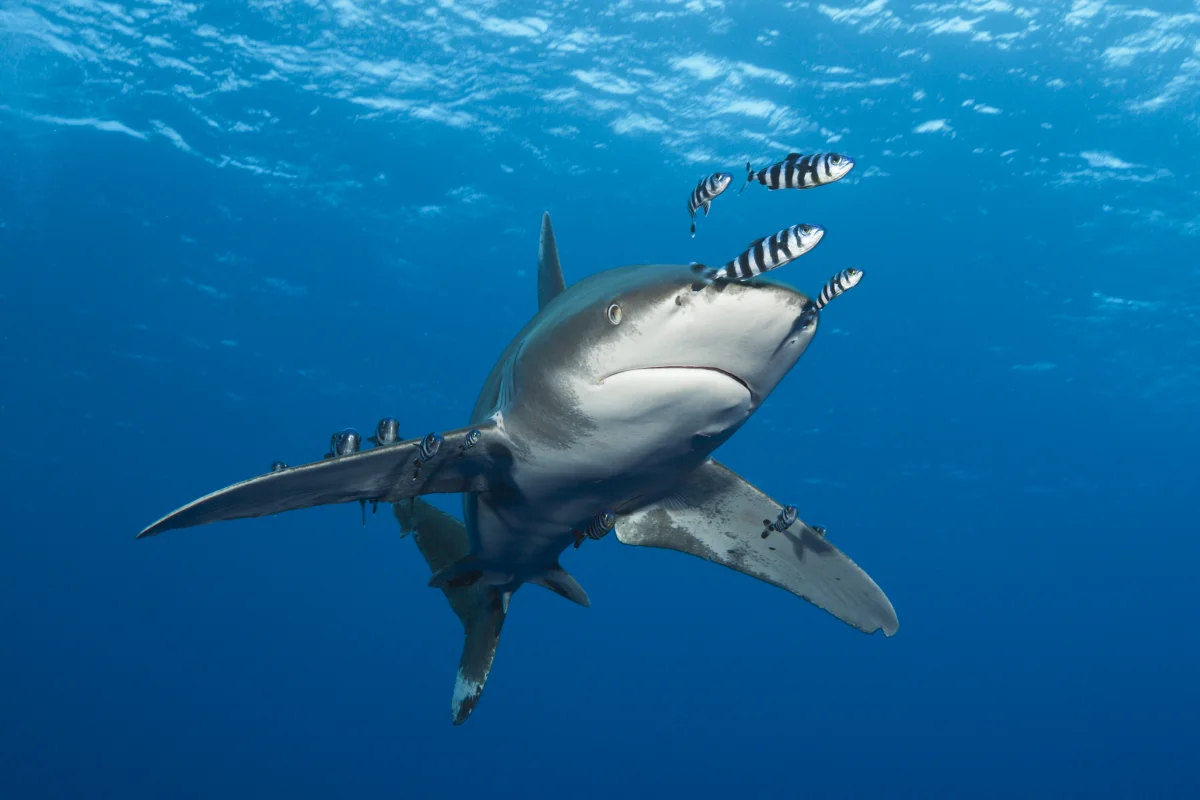
- Oceanic whitetip shark. The primary culprit behind the string of attacks at Sharm el-Sheikh in 2010. Usually lives in the open ocean, but ventures toward reefs. Fast, curious, unpredictable.
- Tiger shark. Killed Vladimir Popov in 2023. One of the most dangerous sharks in the world — large (up to 5 meters), omnivorous, unafraid of shallow water.
- Mako shark. Killed the Italian tourist in Marsa Alam in 2024. The fastest shark species, reaching 70 km/h. Doesn't usually target humans, but becomes lethally dangerous when provoked.
Whitetip reef sharks, blacktip reef sharks, and gray reef sharks are commonly seen, especially while diving, but rarely attack people unless provoked.
Why Attacks Have Increased
Twenty years ago, shark encounters with tourists were rare. Now, they happen every year. The cause isn't a growing shark population — it's a changing environment.
- Chumming from boats
Diving instructor and CEO of the ART-TOUR company Dmitry Arutyunov points to a non-obvious cause:
"Egypt organizes a huge number of boat trips where people are typically fed. Food scraps get tossed overboard."
Fish waste attracts sharks to boats, and boats sit near beaches. Sharks begin associating human activity with food.
- Overfishing
Sharks' natural food base — reef fish — is declining due to industrial and illegal fishing. Hungry sharks move closer to shore in search of alternative prey.
- Warming water
The Red Sea is heating up, and tropical species that used to stay farther south are expanding their range northward, toward the Hurghada and Sharm resorts.
- Rising tourist numbers
More people in the water means a higher chance of an accidental encounter. Reef snorkeling, long-distance swims, and dawn or dusk swimming all increase contact with predators.
Where the Risk Is Highest
Not every stretch of coastline carries equal risk.
Marsa Alam and El Quseir — the southernmost and deepest resort area. Reefs come right up to shore here, depth increases quickly, and large predators end up closer to beaches. Four of the seven fatal incidents from 2009–2024 occurred in this exact area. In May 2026, a shark was spotted off El Quseir again — the beach was closed.
Hurghada (Sahl Hasheesh and beaches south of the city). The site of both the 2022 and 2023 attacks. Open coastline without protective reefs — sharks can approach shore freely.
Sharm el-Sheikh. The 2010 series of attacks shook this resort. Since then, security has been strengthened: nets, patrols, drones. The risk is lower than in Hurghada and Marsa Alam, but not zero.
What Egypt Is Doing for Safety
After the string of incidents, authorities tightened measures:
- In 2023, satellite monitoring devices began being installed to track shark movements in real time.
- Anti-shark nets — metal barriers enclosing swimming zones — have been installed at several beaches.
- Drones patrol the coastline from the air, spotting shark silhouettes before anyone on shore does.
- When a shark is detected, the beach closes immediately and a red flag goes up.
Russian tour operators have compiled lists of hotels equipped with anti-shark nets — available upon request when booking.
How to Reduce the Risk
There's no absolute guarantee — this is wild nature, not a swimming pool. But a few rules significantly reduce the odds of an encounter:
- Don't swim at dawn or dusk. This is hunting time for most predatory sharks. Poor visibility increases the chance a shark mistakes you for prey.
- Don't swim beyond the reef line. The reef is a natural barrier between the shallows and the open sea. Beyond it is shark territory.
- Don't swim with cuts or open wounds. Sharks can detect blood in the water from hundreds of meters away.
- Avoid murky water — after a storm, near wadi mouths (dry riverbeds), or close to fishing boats.
- Don't feed the fish. Feeding attracts small fish, and predators follow them.
- Remove shiny jewelry. Glinting metal underwater resembles the shimmer of fish scales.
- A red flag means an absolute ban. If the beach is closed, don't enter the water — not for a minute, not "just knee-deep."
Should You Cancel Your Trip?
Seven fatal incidents over 15 years, against millions of swimmers annually, puts the risk on the level of being struck by lightning. In 2025, Egypt recorded no confirmed attacks. In 2026, none either — though sharks have been spotted near shore.
Canceling a trip over sharks would be a disproportionate reaction. Ignoring the safety rules, however, would be irresponsible. The Red Sea remains one of the best places in the world for snorkeling and diving. It's teeming with life — and sharks are part of that life. The question isn't whether they're in the water. It's whether you follow the rules that have proven their effectiveness over 15 years.