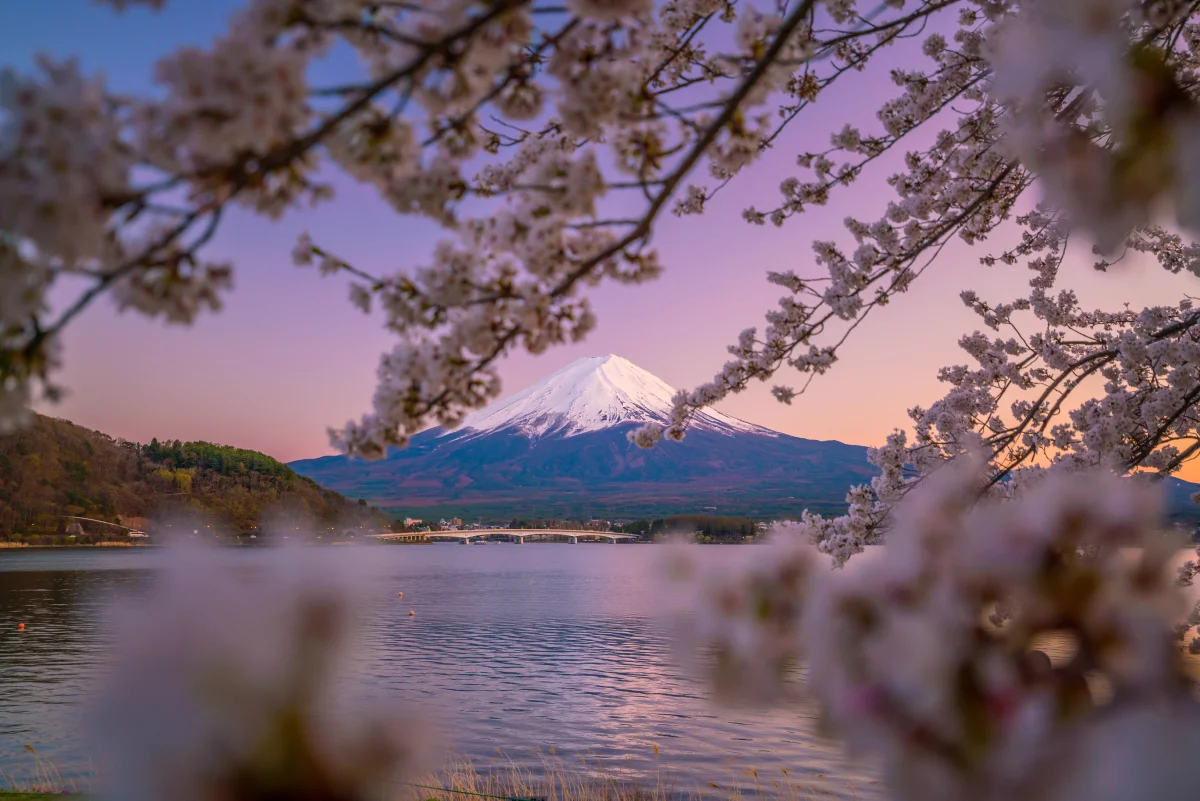
Peak cherry blossom season lasts five to seven days. One gust of wind, one rainstorm, and the petals fall. Miss the date by a week, and instead of pink clouds you'll see bare branches. Hit it exactly, and you'll witness a spectacle the Japanese consider the defining event of the year.
Hanami — "flower viewing" — isn't just a tradition, it's a national ritual. Millions of Japanese spread blankets under blooming trees, drink sake, eat bento, and spend hours looking up. For tourists, hanami is a reason to fly halfway around the world for a few days impossible to schedule with absolute precision.
When It Blooms Depends on the City
Cherry blossoms sweep across Japan from south to north, like a warm front. The first flowers appear in Okinawa as early as late January, while the last bloom in Hokkaido in early May. Between the two extremes lies three and a half months. But the main season that draws tourists fits into a narrower window.
In 2026, the dates broke down as follows:
- Fukuoka (Kyushu) — first bloom March 21, full bloom March 30
- Tokyo — first bloom March 20, full bloom March 27
- Kyoto — first bloom March 25, full bloom April 1
- Osaka — first bloom March 26, full bloom April 2
- Sapporo (Hokkaido) — first bloom April 27, full bloom May 1
Year to year, dates shift by one or two weeks depending on winter temperatures, but the general window stays consistent: late March through early April for central Japan.
Two Japanese Terms Worth Knowing
Kaika (開花) — the moment when a "reference" tree opens 5–6 blossoms. This is the official "start of blooming," announced by meteorologists. In Tokyo, the benchmark tree stands by Yasukuni Shrine; in Kyoto, on observatory grounds. Kaika isn't the peak yet — most trees in the parks still show only scattered flowers.
Mankai (満開) — full bloom, when more than 80% of buds are open. This is the actual peak everyone flies in for. Mankai typically arrives 5–7 days after kaika and holds for another 5–7 days — provided there's no strong rain or wind.
After mankai, petals begin falling — and that's beautiful too. The Japanese call it "hana fubuki," a "flower blizzard": pink petals swirling through the air, covering sidewalks and the surface of canal waters. Many consider this stage even more poetic than full bloom itself.
Why It's So Easy to Miss
Five to seven days is a catastrophically narrow window. And it shifts every year, because cherry blossoms respond to temperature.
A warm winter means earlier blooming. A cold spring means later. The gap between an early and a late year can span a week and a half to two weeks for a single city. In 2021, cherry blossoms in Kyoto bloomed on March 26 — 10 days earlier than average. In 2023, blooming was record-early, occurring in late March.
Forecasts are published starting in January and updated every one or two weeks. JMC, Weathernews, and the Japan Weather Association are the three main sources.
By March, forecasts become fairly accurate (±2–3 days), but in January–February, the margin of error can span a week. Hotels need booking 3–6 months out, when exact dates aren't yet known — which is exactly the challenge.
How to Calculate Your Travel Window
In 2026, the optimal window turned out to be March 28–April 7, when blooming coincided across Tokyo, Kyoto, and Osaka simultaneously. A strategy that worked: arriving in Tokyo by March 28 for mankai or the start of hana fubuki; then, three or four days later, taking the shinkansen to Kyoto, where the peak was just unfolding.
This same technique works almost every year: Tokyo blooms 5–7 days before Kyoto, and a single trip can cover both cities if you allow 8–10 days.
Exact dates for 2027 will appear in January — published by JMC, Weathernews, and the Japan Weather Association, updated every one to two weeks.
Where to Watch — Beyond Tokyo and Kyoto
The classic lineup includes Ueno Park, Shidobashigawa, and Meguro River in Tokyo, and Maruyama Park and the Philosopher's Path in Kyoto. But Japan offers dozens of less famous, less crowded alternatives.
Yoshino (Nara Prefecture) — a mountain covered with 30,000 wild cherry trees, "yamazakura." Blooming climbs the slope in layers, from base to summit, over two weeks. One of the most breathtaking cherry blossom landscapes in the world — and far quieter than Tokyo's parks.
Hirosaki (Aomori Prefecture) — a castle surrounded by 2,600 cherry trees. Petals cover the moat's surface, forming a pink carpet on the water called "hanaikada" (flower raft). Blooming occurs in late April, three weeks after Tokyo.
Kawazu (Shizuoka Prefecture) — the early "kawazu-zakura" variety blooms as early as February, a full month ahead of the main season. Flowers are bright pink and larger than usual. For those who miss the main season, it's an alternative reachable 2.5 hours from Tokyo by train.
Takato (Nagano Prefecture) — 1,500 trees of the "takato-kohigan-zakura," an endemic variety with deep pink flowers. Blooming occurs in early April. Considered one of Japan's three best cherry blossom spots, alongside Yoshino and Hirosaki.
How Not to Get Shut Out of a Hotel
Cherry blossom season is peak occupancy for Japanese hotels. In Tokyo and Kyoto, occupancy in late March through early April exceeds 90%, and prices rise one and a half to two times compared to February.
A few rules that help:
- Book with free cancellation 4–6 months out. Exact blooming dates aren't known yet, but you'll secure your spot. In March, once the forecast sharpens, adjust your dates accordingly.
- Consider the suburbs. A hotel in Yokohama (30 minutes to Tokyo) or Otsu (20 minutes to Kyoto) costs half as much, and transit works flawlessly.
- Ryokan (traditional inns) in smaller towns are an alternative to Kyoto's packed hostels. Pricier, but the experience operates on a different level.
- Check Airbnb — it's legal and works well in Japan, especially for groups.
Weather and What to Wear
Late March through early April in central Japan brings +12–18°C during the day, +5–8°C at night. Sunny, but cool — especially in the evening and early morning, when the parks are at their most photogenic.
Layering is key. Morning hanami under the trees at +10°C calls for a sweater and light jacket. A midday stroll at +17°C needs just a shirt. Evening "yozakura" (nighttime cherry blossom viewing with illumination) calls for a jacket and scarf again.
Rain is the enemy. A single prolonged downpour during mankai can strip petals within a day, leaving bare branches with scattered blooms instead of a pink cloud. An umbrella in your bag is essential.
Hanami, the Japanese Way
Hanami isn't just "looking at flowers." It's a picnic, and it has its own rules.
The Japanese arrive at the park early — sometimes hours ahead — and lay out a blue tarp (buru shiito) on the best spot under a tree. Food comes from convenience stores or is homemade: onigiri, fried karaage chicken, sakura-mochi (rice cakes wrapped in cherry leaves). They drink beer, sake, sometimes pink wine matching the petals.
In larger parks, food courts and street stalls offer yakitori, takoyaki, and sakura-flavored lattes. The atmosphere is festive but not rowdy — Japanese hanami is joyful, but a calm kind of joyful.
For a tourist, hanami is a way to join the culture without a language barrier. Buy food at the nearest convenience store, spread your blanket next to a Japanese group, and you're part of the celebration.
If You Miss the Peak
Missing it by a week isn't a catastrophe. Japan is beautiful year-round, and there's a plan B built around cherry blossoms.
Arrived early (mid-March) — Tokyo has early-blooming ume (plum blossoms) and kawazu-zakura. Less dramatic, but beautiful. Visit Kairakuen Garden in Mito — one of Japan's three great gardens — where ume blooms from February through March.
Arrived late (mid-April) — look for yae-zakura (double-flowered cherry). At Shinjuku Gyoen in Tokyo, it blooms through late April. In Osaka, the Japan Mint opens an avenue of 130 late-blooming varieties, usually in the second week of April.
Instead of cherry blossoms — wisteria and azaleas bloom in late April. Ashikaga Flower Park (2 hours from Tokyo) offers tunnels of purple wisteria — a spectacle no less impressive, and one that lasts longer.
The Golden Rule
Cherry blossoms teach what all of Japanese culture teaches: beauty is fleeting, and that's exactly what makes it valuable. Planning the perfect trip is hard. Arriving three days early or late feels like a disappointment.
But even if you catch a flower blizzard instead of full bloom, or the first buds instead of the peak — it's still Japan in spring. And Japan in spring is always a little more than just trees in bloom.