Australia rings in the New Year at the height of summer — at +30°C, on the beach, in swimsuits. While Russia buries its Olivier salad under snow, Sydney Harbour explodes with fireworks, and Santa Claus arrives to greet children on a surfboard.
For anyone used to a December blizzard and the crunch of snow underfoot, an Australian New Year is pure surrealism. Picture it: +35°C outside, "Jingle Bells" playing, fake snow in shop windows, and you're standing in shorts and flip-flops in front of a decorated tree that will start shedding needles within two days, because conifers don't last long in that climate.
This isn't a glitch or a staged production — it's an ordinary December in the Southern Hemisphere, where the seasons run mirror-opposite to ours.
Why Winter in Australia Is Summer
Earth is tilted 23.5 degrees relative to its orbital plane. When the Northern Hemisphere tilts away from the sun (December–February), the Southern Hemisphere tilts toward it.
While Moscow has its shortest day and longest night, Sydney has its longest day and near-white nights. The sun climbs high and blazes intensely, and a continent surrounded by warm oceans heats up.
Australian summer runs December through February. Autumn is March–May, winter is June–August, spring is September–November. New Year's Day, January 1, falls in the hottest stretch of the year. Average daytime January temperatures: Sydney +26–28°C, Melbourne +25–27°C, Adelaide +28–30°C, and Darwin in the north, +32–34°C with tropical downpours.
Snow does exist in Australia — but only in the Australian Alps in the southeast and on the island of Tasmania, and only in winter (June–August). At Christmas and New Year's, there's snow nowhere at all.
What New Year's Sydney Looks Like
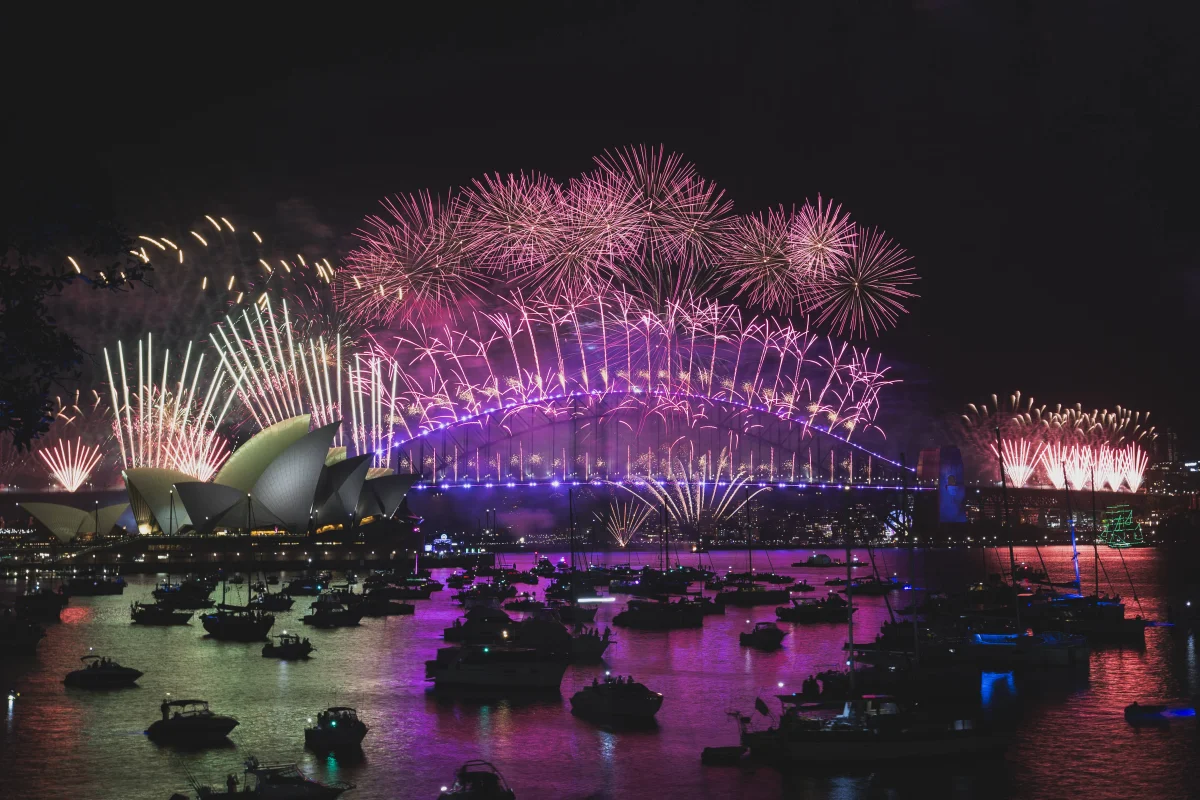
The Sydney Harbour fireworks display is one of the largest pyrotechnic shows in the world. It launches from multiple points — the Harbour Bridge, barges in the bay, and the rooftops of waterfront buildings.
Over a million people gather to watch it every year — and that's just those who arrive on foot. Hundreds of thousands more watch from boats, yachts, and cruise ships right on the water.
Spots along the waterfront start filling from the morning of December 31. By noon, the best positions are already taken — people spread out blankets, set up folding chairs, and bring beer and barbecue gear.
The program starts long before midnight: at 6 p.m., an air show, followed by a ceremony honoring Indigenous traditions, a light display, and concerts. At 9 p.m., the first "family" fireworks show, for those with small children who won't make it to midnight. And finally, at midnight, the main display, lasting about 12 minutes.
The theme changes every year. The budget runs into the millions of dollars. The broadcast reaches the entire world, and while Moscow is still chopping salad ingredients, the news is already showing Sydney's fireworks — since Australia rings in the New Year 8 hours ahead of Moscow time.
Santa on a Surfboard and a Metrosideros Christmas Tree
Australian New Year's traditions are a peculiar blend of British heritage and tropical reality.
Santa Claus exists here — but instead of a reindeer sleigh, he arrives on a surfboard or a lifeguard boat. His familiar attributes — beard and red hat — stay. His fur coat is swapped for shorts or swim trunks, and boots for flip-flops.
At Bondi Beach in Sydney, dozens of people dress up as Santa and catch waves — "Santa surfing" has become its own tradition, replicated up and down the coast.
The Christmas tree is a problem. Conifers dry out and shed needles within days in the Australian climate. Most families put up artificial trees — sometimes imported from Europe, sometimes locally made. But there's a unique alternative: the metrosideros, an evergreen tree that New Zealanders literally call the "New Year tree."
By summer, its small cream-colored flowers turn deep red, and without any decoration at all, the tree starts to resemble a dressed-up Christmas tree. A potted miniature metrosideros is one of the most popular New Year's souvenirs.
On the streets and in malls, huge trees stand decorated with garlands — exactly like Europe's. Nearby: snowman figures in flip-flops, LED reindeer, and fake snow in shop windows. The contrast between these decorations and +35°C outside is the defining visual of an Australian New Year.
What's on the Table: Shrimp Instead of Olivier
The New Year's spread in Australia mirrors the climate. No hot soups or roasted goose — far too hot for that.
The main dish is seafood.
Fresh shrimp, oysters, mussels, lobster, scallops, barramundi (a local fish). The Sydney Fish Market — the largest in the Southern Hemisphere and third-largest in the world — runs 36 hours straight without a break before New Year's. The queue for shrimp on December 31 is as much a part of the tradition as the queue for champagne in Russian stores.
The second pillar is barbecue. Australians grill meat year-round, but on New Year's Eve it becomes a ritual. Families head to the beach or a park, set up portable grills, and cook steaks, sausages, and corn — all under open sky, lit by garlands, with the sound of the ocean.
For dessert: pavlova (a meringue cake with fruit and cream, the national dessert Australia and New Zealand have been arguing over for a century), and chilled fruit: watermelon, mango, passionfruit, cherries — all in season.
How Celebrations Look Outside Sydney
Australia is a vast country, and New Year's sounds different in every city.
Melbourne — free dance parties along the Yarra River and at Federation Square. Fireworks happen too, but more modest than Sydney's. The atmosphere is more intimate and hipster: street musicians, food trucks, craft beer.
December 26 kicks off the Boxing Day Test — an iconic cricket match at the Melbourne Cricket Ground that can run up to five days.
Brisbane — an annual open-air music festival drawing hundreds of thousands. The city sits on a river, and fireworks launch directly over the water.
Adelaide — a calmer, family-oriented format. Park concerts, farmers' markets, wine tastings from the Barossa Valley.
Hobart (Tasmania) — the finish line of the famous Sydney-to-Hobart yacht race, which starts December 26 and is broadcast nationwide. The yachts arrive right around New Year's Eve, and the port transforms into a festive hub.
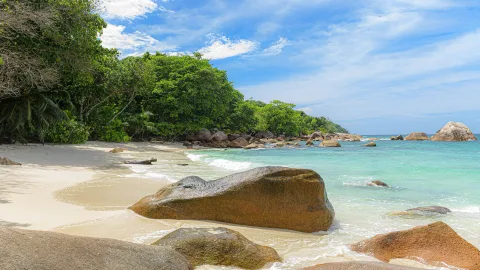
Gold Coast — New Year's on the beach in its purest form. Parties on the sand, dawn surfing on January 1, barbecue on the waterfront until morning.
What About the Russian Community?
Australia is home to a sizeable Russian-speaking diaspora, especially in Sydney and Melbourne. Many keep a tradition of double celebration: December 31 goes by the Australian script (beach, fireworks, shrimp), and December 31 by Moscow time (the morning of January 1 in Sydney) brings Olivier salad, "The Irony of Fate" on a laptop, and a glass of champagne.
Some families add Old New Year on January 14 too — resulting in three celebrations across two weeks.
What the Climate Has to Say About It
New Year's Eve in Australia isn't always a picture-perfect postcard. January is peak season for both warmth and extreme weather.
In the south (Melbourne, Adelaide), abnormal heat is possible: temperatures can spike to +40–45°C. On such days, fireworks may be canceled due to fire risk — dry vegetation around cities can ignite from a single spark. Wildfires in Australia aren't a winter problem but a summer one, and December–January is peak season.
In the north (Darwin, Cairns), it's tropical rainy season. Downpours, thunderstorms, sometimes cyclones. New Year's Eve there is spent under tents and awnings, with humidity reaching 90%.
The east coast (Sydney, Brisbane, Gold Coast) is the most predictable zone: +26–30°C, sunny, with light rain possible — but it usually refreshes rather than ruins the party.
What It's Like to Adjust
Russian emigrants living in Australia generally say the same thing: the first New Year's is a shock, the second is curiosity, the third becomes the new normal. The strangest part isn't the heat or the absence of snow — it's Christmas songs about a winter wonderland playing through speakers at +35°C.
And conversely, in June–August, when it's winter in Australia (though mild — +10–15°C in Sydney), there's a lingering feeling that festive season should be starting soon — but it's still six months away.
Still, Australians resolved this cognitive dissonance long ago. They simply live by their own calendar — and genuinely don't understand why anyone would freeze on New Year's Eve when you could dive into the ocean instead.